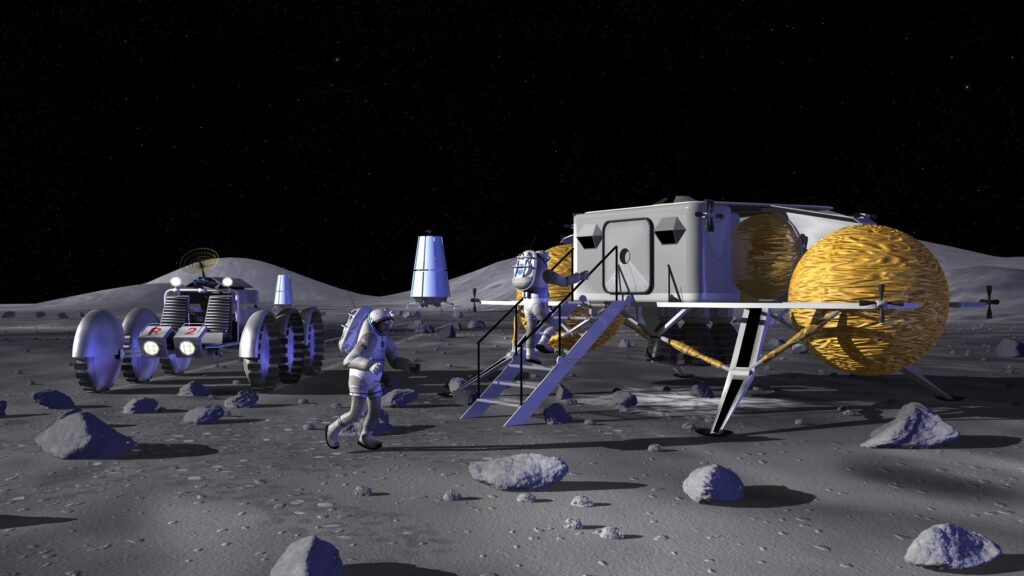
As NASA’s Artemis program and international space agencies transition from short-duration sorties to a sustained human presence on the Moon, mission planners and structural engineers must confront a mechanical hazard that received little attention during the Apollo era: lunar seismicity. The Moon is not a geologically inert rock. The character of its seismic activity poses structural engineering challenges that are fundamentally different from anything encountered in terrestrial construction.
To build structures that survive for decades on the lunar surface, we cannot simply copy-paste terrestrial building codes like ASCE 7 or Eurocode 8. Instead, we must pivot from traditional civil engineering paradigms toward the rigorous, high-cycle vibration environments typical of aerospace and turbomachinery design.
On the Moon, the primary threat is often not the peak ground acceleration ($PGA$) of a sudden shock, but the extraordinary duration of the vibration environment and the resulting fatigue accumulation in pressure vessels, life-support piping, solar arrays, and primary structural welds.
1. The Apollo Seismic Baseline & The Scattering Crust
Between 1969 and 1972, Apollo missions 12, 14, 15, and 16 deployed Passive Seismic Experiment (PSE) packages as part of the Apollo Lunar Surface Experiments Package (ALSEP). These arrays remained operational until funding was cut in September 1977, providing an uninterrupted eight-year window into the lunar interior.
The instruments featured a pendulum-based, long-period (LP) triaxial seismometer and a short-period vertical (SPZ) sensor. These instruments revealed four distinct classes of lunar seismic events:
Deep Moonquakes
Occurring at depths between 700 km and 1,200 km, these events are explicitly driven by tidally induced cyclic stresses as the Moon moves through its eccentric orbit around Earth. They are highly localized, erupting from specific subterranean focal regions known as “nests.”
Thermal Cracking Events
Micro-seismic pops occurring primarily near the lunar terminator. As the surface transitions through a 260°C temperature swing—from $+107^\circ\text{C}$ in full sunlight to $-153^\circ\text{C}$ during the lunar night—the extreme thermal gradients cause localized mechanical fracturing of surface rocks and regolith.
Meteorite Impacts
Hypervelocity impacts generate high-frequency stress waves. Because the Moon lacks an atmosphere to burn up debris, it is subjected to continuous bombardment, producing a steady background of seismic noise and distinct, long-rise-time waveforms.
Shallow Moonquakes
The most hazardous events, originating in the upper crust (typically 20 to 30 km deep). Modern re-examinations of Apollo data indicate these intraplate-like events can reach a body-wave magnitude ($m_b$) of up to 5.5. On Earth, a magnitude 5.5 earthquake is a routine occurrence that modern buildings ride out with ease. On the Moon, it represents a profound engineering threat.
2. The Mechanics of the Lunar Megaregolith Separator
To understand why a magnitude 5.5 moonquake is so dangerous, we have to look at the geology of the outer lunar crust. The terrestrial crust contains liquid water, hydrated minerals, and extensive sedimentary layers. These act as high-attenuation buffers, absorbing and dissipating seismic energy via material damping (internal friction) within cycles. An earthquake on Earth is typically a violent but brief transient pulse, lasting seconds to a few minutes.
The Moon is entirely dry, intensely fractured, and highly heterogeneous down to dozens of kilometers due to billions of years of impact cratering. This smashed layer is known as the megaregolith.
Because there is no interstitial water or volatile fluid to provide visco-elastic damping, the megaregolith acts as a nearly perfect, lightly damped scattering medium.
When a shallow moonquake releases energy, the seismic waves (both compressional $P$-waves and shear $S$-waves) do not propagate cleanly. Instead, they hit an infinite maze of internal voids, fractures, and crater boundaries, scattering repeatedly in every direction.
Instead of dissipating, the seismic energy is trapped, echoing and reverberating through the crust. While a terrestrial earthquake decays exponentially in minutes, a lunar seismic signature exhibits an incredibly long rise time—often taking 5 to 15 minutes just to reach peak amplitude—followed by a “ring-down” tail that can persist for one to over two hours. The Moon does not simply shake; it rings like a massive, highly resonant cathedral bell.
3. Meteorite Impacts: The Extraterrestrial Seismic Impulses
Because the Moon lacks an atmosphere to burn up incoming space debris, meteoroids hit the lunar surface at hypervelocity speeds, typically ranging from $11\text{ km/s}$ to $72\text{ km/s}$. These impacts act as massive mechanical impulses, injecting extreme amounts of kinetic energy directly into the crust.
The conversion of this energy into seismic waves occurs across two distinct regimes:
- The Hydrodynamic Phase: At hypervelocity impact speeds, pressure levels instantly exceed the material yield strength of both the projectile and the target regolith. A localized shock wave propagates outward, vaporizing, melting, and crushing the immediate rock layers.
- The Elastic Phase: As the shock wave expands away from the freshly formed crater, it attenuates into a low-amplitude elastic stress wave. These propagate across the surface and through the deep interior as $P$-waves and $S$-waves.
Impact Signatures vs. Tectonic Events
Because impacts are zero-depth surface events, they produce a seismic profile distinct from tectonic moonquakes. They feature extended rise times and highly suppressed shear ($S$-wave) arrivals due to the predominantly compressive downward force of the strike.
The structural threat was verified during the Apollo missions when NASA intentionally crashed spent Saturn V third stages ($S\text{-}IVB$) and Lunar Module ascent stages into the surface for calibration. The impact of the Apollo 12 $S\text{-}IVB$ released energy equivalent to roughly 11 tons of TNT, inducing a continuous, low-damping resonant ringing within the megaregolith that lasted for over three hours on the telemetry arrays.
4. Advanced Structural Dynamics: Resonant Amplification under Ultra-Low Damping
For a structural engineer, a prolonged seismic input combined with ultra-low structural damping means one thing: extreme resonant amplification.
When a structure is subjected to a transient load on Earth, the system’s material damping (typically modeled between 2% and 7% of critical damping for steel and concrete structures) quickly suppresses resonant build-up. On the Moon, because the input ground motion itself behaves like a continuous, steady-state sinusoidal sweep rather than a sharp decay, any alignment between the ground motion’s dominant frequencies and the habitat’s natural frequencies ($f_n$) will trigger severe dynamic amplification.
The steady-state dynamic amplification factor ($DAF$) for a single-degree-of-freedom (SDOF) system under harmonic excitation is defined by the classical equation:
$$DAF = \frac{1}{\sqrt{(1 – \beta^2)^2 + (2\zeta\beta)^2}}$$
Where:
- $\beta = \frac{f}{f_n}$ is the frequency ratio (excitation frequency divided by natural frequency).
- $\zeta$ is the critical damping ratio of the system.
On Earth, if a structure experiences resonance ($\beta = 1$), a damping ratio of $\zeta = 0.05$ caps the maximum amplification at a factor of:
$$DAF = \frac{1}{2(0.05)} = 10$$
Furthermore, the brief duration of terrestrial shaking usually prevents the structure from ever reaching this theoretical steady-state maximum.
On the Moon, if an engineer relies solely on the raw material damping of aerospace-grade metallic alloys (such as Aluminum-Lithium 2195, where $\zeta \approx 0.002$ to $0.005$), the theoretical amplification factor at resonance explodes:
$$DAF = \frac{1}{2(0.002)} = 250$$
Because the moonquake provides an hour-long window of continuous excitation, the structure will have more than enough time to achieve full, steady-state resonant amplification. Even a minor baseline ground acceleration can scale up into devastating internal inertial forces, threatening to tear apart secondary attachments, life-support plumbing, and instrument racks.
5. Fatigue Engineering and Cumulative Damage Mechanics
Because lunar seismic hazards are defined by duration rather than raw peak force, the ultimate limit state ($ULS$) design paradigm—checking if the maximum stress exceeds the yield or ultimate strength of the material ($\sigma_{max} < \sigma_y$)—is insufficient. We must design for the serviceability limit state ($SLS$) governed by high-cycle vibration fatigue.
A single, 90-minute shallow moonquake can subject a structural component to tens of thousands of stress cycles. Over a 20-year operational lifespan, periodic deep moonquakes and recurring shallow tectonic events will accumulate millions of micro-strains.
To quantify this, engineers must utilize Miner’s Rule for Cumulative Damage, which posits that total fatigue damage ($D$) is the linear summation of the damage caused by individual stress cycles at varying amplitudes:
$$D = \sum_{i=1}^{k} \frac{n_i}{N_i}$$
Where:
- $n_i$ is the number of accumulated cycles at a specific stress range ($\Delta \sigma_i$), extracted from moonquake time-history data using Rainflow Cycle Counting algorithms.
- $N_i$ is the number of cycles to failure at that same stress range, derived from the material’s empirical $S\text{-}N$ curve (Stress vs. Cycles to Failure), modified for the extreme lunar thermal environment.
Failure is predicted when $D \ge 1.0$. However, for life-critical manned infrastructure, mission-assurance guidelines will likely dictate a conservative safety factor, requiring $D \le 0.25$.
6. Soil-Structure Interaction (SSI) in Manned Habitats
To protect crew members from space radiation (GCRs and SPEs) and extreme micro-meteorite strikes, most architectural concepts involve burying habitats under a protective blanket of lunar regolith, typically between 2 to 5 meters thick. While excellent for radiation shielding, this massive overburden fundamentally transforms the habitat’s seismic profile through complex Soil-Structure Interaction (SSI).
SSI on the Moon operates via two concurrent mechanics:
$$f_n = \frac{1}{2\pi}\sqrt{\frac{K}{M_{eff}}}$$
An increase in mass ($M_{eff}$) without a corresponding increase in structural stiffness ($K$) drives the system’s natural frequencies downward. This shift can inadvertently drop the habitat’s fundamental mode directly into the peak energy bandwidth of shallow moonquakes.
Furthermore, the regolith provides a confined boundary condition, acting as a non-linear continuum spring-damper system. While the internal material damping of the regolith helps suppress vibrations (a positive effect), the intense confining pressures drastically alter the structural load paths. During an extended seismic ring-down, the lateral soil pressures oscillate dynamically. If the regolith is not properly retained, it can undergo localized settlement or continuous down-slope shifting, causing asymmetric loading on the underlying pressure hull.
7. Engineering Countermeasures & Mitigation Paradigms
To counteract ultra-low damping, resonance, and high-cycle fatigue, lunar civil engineers must look beyond traditional Earth-based structural designs. We must implement advanced, passive and active structural control systems.
- Friction Pendulum Bearings: Utilizing self-lubricating diamond-like carbon (DLC) coatings operating on high-strength titanium sliders. These systems shift the structure’s fundamental period far above the hazardous frequencies of ground motion, dissipating energy purely through dry coulomb friction.
- Shape Memory Alloy (SMA) Isolators: Superelastic Nitinol ($NiTi$) wire dampers can be woven into foundation interfaces. SMAs absorb vast amounts of strain energy through hysteretic phase transformations (a reversible transition between austenite and martensite crystal structures) without suffering permanent deformation or degradation in a vacuum.
When a moonquake strikes and the building begins to sway, the TMD oscillates out of phase with the primary structure, counteracting the inertial forces and extracting kinetic energy from the system. Given the absence of fluids, these dampers will rely on eddy-current magnetic braking systems to provide predictable, maintenance-free damping forces in a vacuum.
8. Numerical Modeling Framework: Craig-Bampton Substructuring
Simulating the complete dynamic response of a massive, multi-module lunar base—comprising rigid modules, expandable inflatables, internal equipment racks, fluid networks, and the surrounding non-linear regolith foundation—presents a computationally staggering problem if analyzed as a single finite element model (FEM).
To execute rapid design iterations, optimization loops, and safety certification, engineers must use Craig-Bampton Component Mode Synthesis (CMS). This is a mathematical substructuring technique widely used in aerospace coupled-loads analysis (CLA) to join spacecraft payloads to launch vehicles.
Under this framework, the lunar base is mathematically partitioned into distinct, manageable substructures (e.g., the Habitat Module and the Geotechnical Foundation Matrix).
- Kinematic Reductions: The internal physical degrees of freedom ($DOFs$) of each substructure are reduced to a highly condensed set of generalized coordinates. This is achieved by combining fixed-interface normal modes (capturing internal resonance) with constraint modes (representing the static deformation shapes resulting from unit displacements at the boundaries where the substructures meet).
- Coupling: The reduced mass ($M_{CB}$) and stiffness ($K_{CB}$) matrices of the individual components are assembled into a unified system-level equation of motion using structural compatibility conditions at the boundary interfaces.
- Simulation: Because the resulting system matrices are drastically smaller than the original full-scale FEM, designers can efficiently run long, multi-hour time-history simulations of extended lunar ring-down profiles. This allows teams to safely evaluate structural margins across hundreds of different moonquake scenarios and soil condition variables.
9. Summary Comparison: Seismic Environments
| Engineering Parameter | Earth (Tectonic Regions) | The Moon |
| Maximum Recorded Magnitude | $9.5$ $M_w$ (Valdivia, 1960) | $\approx 5.5$ $m_b$ (Apollo-era Reanalysis) |
| Primary Genesis Mechanisms | Lithospheric plate boundary shearing & subduction | Tidal loading, crustal thermal gradients, global contraction, meteorites |
| Dominant Wave Profile | High peak-acceleration transient pulse | Highly scattered, prolonged sinusoidal reverberation |
| Typical Shaking Duration | 30 seconds to 3 minutes | 30 minutes to 2+ hours |
| Crustal Damping Characteristics | Moderate to High ($\zeta \approx 0.05 – 0.10$) due to fluids/sediment | Ultra-Low ($\zeta < 0.005$) via completely dry, fractured rock |
| Primary Failure Hazard Mode | Ultimate material limit state exceedance (ductile/brittle collapse) | High-cycle vibration fatigue and structural resonance |
Conclusion: Designing for the Ringing, Not the Shock
The data left behind by the Apollo program, verified by modern orbital imagery, leaves no room for debate: the Moon is a uniquely active seismic environment.
For the structural engineers tasked with designing humanity’s first permanent off-world outposts, adapting to this environment requires a fundamental shift in mindset. We cannot design lunar habitats to simply absorb a short, sharp shock like an office building in San Francisco or Tokyo. We must design them to endure a continuous, hours-long mechanical ringing.
The challenge of lunar hab design is not just withstanding the shaking—it is withstanding the ringing. By integrating advanced soil-structure interaction models, executing meticulous high-cycle fatigue analyses, and introducing specialized passive damping systems, we can ensure that our bases will remain sound, pressurized, and safe for decades to come.
See also: Scientists are certain a wayward SpaceX rocket slammed into the moon as predicted
– Tom Irvine