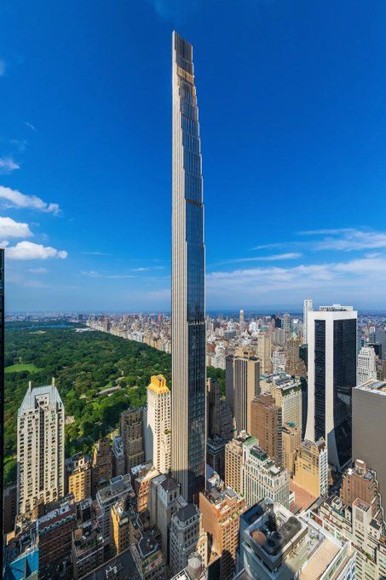
Skyscraper design was once governed almost entirely by strength — could the frame carry gravity, wind and seismic loads with adequate margin? For the new generation of ultra-slender “pencil towers,” the governing requirement has shifted to something more subtle: occupant comfort. A building can be structurally sound with enormous reserve strength and still be unlivable if its residents feel it move. Steinway Tower at 111 West 57th Street in Manhattan is a striking case study.
Steinway Tower
Steinway Tower rises approximately 1,428 ft (435 m) above a base only about 60 ft (18.3 m) wide, giving a slenderness ratio near 24:1 — among the most slender skyscrapers ever built. The structural system is a reinforced concrete core with perimeter shear walls, including two 1-m-thick walls along the east and west faces, with concrete strengths ranging from 6,000 to 14,000 psi. Foundation piles extend roughly 100 ft to bedrock and are engineered for uplift, holding the building down as much as holding it up.
The estimated natural frequencies illustrate why wind, not earthquake, dominates the dynamic design:
| Mode | Description | Estimated Frequency (Hz) | Period (sec) |
|---|---|---|---|
| 1 | 1st bending, N–S (weak axis) | ~0.10–0.12 | ~8–10 |
| 2 | 1st bending, E–W (strong axis) | ~0.13–0.16 | ~6–8 |
| 3 | 1st torsion | ~0.18–0.25 | ~4–6 |
| 4 | 2nd bending, N–S | ~0.55–0.70 | ~1.5–1.8 |
Wind loading spans roughly 0.01 to 1 Hz and thus overlaps the fundamental mode, creating a resonance risk. Earthquake energy is concentrated mostly above 0.5 Hz, well above the fundamental mode, so seismic loading produces less dynamic amplification here. Seismic design (SDC D) governs strength, ductility and detailing; wind design governs serviceability, comfort and dynamics.
Vortex Shedding and Lock-In
Wind flowing past a bluff body sheds alternating vortices at the Strouhal frequency
$$ f_s = \frac{S \, U}{D} $$where $S$ is the Strouhal number (roughly 0.2 for a bluff rectangular tower), $U$ is the wind speed, and $D$ is the across-wind dimension. The critical wind speed for lock-in with the fundamental mode is
$$ U_{crit} = \frac{f_n \, D}{S} \approx \frac{(0.11 \ \text{Hz})(18.3 \ \text{m})}{0.2} \approx 10 \ \text{m/s} \approx 22 \ \text{mph} $$This is an ordinary windy afternoon in Manhattan, not a hurricane. This is why Steinway Tower relies on aerodynamic countermeasures: tapering and setbacks that de-correlate vortex formation along the height, terracotta façade piers that organize the airflow, and open “blow-through” mechanical floors that act as pressure relief valves to disrupt coherent vortex shedding.
Acceleration, Not Displacement
Human occupants are sensitive to acceleration, not displacement. A tower top may sway through a large displacement with no complaint from residents, while a much smaller motion at unfavorable acceleration levels causes discomfort, anxiety, and in prolonged exposure, motion sickness.
For nearly sinusoidal sway at frequency $f$ with displacement amplitude $X$, the peak acceleration is
$$ \ddot{x}_{peak} = (2 \pi f)^2 \, X $$Consider Steinway Tower swaying in its fundamental mode at 0.11 Hz. A displacement amplitude of 0.25 m (about 10 inches) at the top gives
$$ \ddot{x}_{peak} = \left[ 2 \pi (0.11) \right]^2 (0.25) \approx 0.12 \ \text{m/s}^2 \approx 12 \ \text{milli-g} $$Doubling the sway to 0.5 m doubles the acceleration to about 24 milli-g. The displacement itself is harmless — the tower has enormous strength reserve — but the acceleration crosses into territory that residents paying for penthouse views will not tolerate.
Human Perception Thresholds
| Peak Horizontal Acceleration | Typical Human Response |
|---|---|
| < 5 milli-g | Imperceptible to most occupants |
| ~5–10 milli-g | Motion noticeable; sensitive individuals may object |
| ~15–20 milli-g | Uncomfortable; complaints likely; difficulty with fine tasks |
| > 40 milli-g | Strongly objectionable; alarm; possible motion sickness |
Perception is frequency dependent. In the 0.06 to 1 Hz range covered by ISO 6897 and ISO 10137, human tolerance generally decreases as frequency decreases toward the 0.1–0.2 Hz band — exactly where pencil towers live. Motion sickness sensitivity peaks near 0.1–0.3 Hz, the same band as ocean swell, which is why severe building sway produces symptoms familiar to seasick passengers. ISO 10137 residential criteria for a one-year return period wind event fall in the mid-single-digit milli-g range near 0.1 Hz, considerably more stringent than office criteria, and prolonged exposure increases sensitivity further.
What About Jerk?
Jerk — the time derivative of acceleration — is sometimes raised as a comfort metric, and for good reason in other applications: elevator ride quality is explicitly jerk-limited, with comfort limits on the order of 1–2 m/s³. For steady-state building sway, however, each derivative of sinusoidal motion adds a factor of $2 \pi f$:
$$ j_{peak} = (2 \pi f)^3 \, X = (2 \pi f) \, \ddot{x}_{peak} $$At Steinway Tower’s fundamental frequency of 0.11 Hz, $2 \pi f \approx 0.69$ rad/s. The 12 milli-g sway example above therefore carries a peak jerk of only about 0.08 m/s³ — nearly two orders of magnitude below elevator comfort limits. At very low frequencies the small $2 \pi f$ multiplier suppresses jerk relative to acceleration, which is why ISO 6897 and ISO 10137 frame their serviceability criteria in acceleration rather than jerk.
Jerk nonetheless enters the comfort picture in three ways. First, transient onset: perception studies show that occupants detect suddenly commencing motion more readily than steady-state motion at the same acceleration level, so a gust front with high jerk content “announces” the sway and effectively lowers the perception threshold. Second, higher modes: the second N–S bending mode near 0.6 Hz carries a $2 \pi f$ multiplier about six times larger than the fundamental, so equal acceleration in a higher mode produces proportionally more jerk and a sharper, more noticeable feel. Third, impulsive events — tuned-mass-damper engagement, slack take-up in mechanical systems, and the elevator cable dynamics discussed below — are effectively jerk events, perceived as bumps or thuds rather than sway.
The Tuned Mass Damper
Intrinsic structural damping in a tall concrete tower is only about 1–2% of critical — far too little to hold accelerations below perception thresholds during design wind events. Steinway Tower therefore carries an approximately 860-metric-tonne tuned mass damper in its crown, among the heaviest solid TMDs ever installed in a building. The suspended steel mass is tuned to the fundamental lateral frequency near 0.1 Hz and moves out of phase with the building, acting as a classical dynamic vibration absorber that extracts energy from the sway mode and reduces peak acceleration at the upper floors.
The TMD is not an optional refinement. It is the enabling technology that makes a 24:1 slender residential tower habitable, working in combination with the shear-wall stiffness, the blow-through floors, and the façade aerodynamics.
Case Histories
432 Park Avenue, New York (2015). Steinway Tower’s neighboring pencil tower — 1,396 ft tall with a slenderness ratio near 15:1 — is the cautionary counterpart. Despite carrying a tuned mass damper system of its own, residents documented creaking, banging and groaning noises during wind events, elevator shutdowns when sway exceeded the tolerance of the cables in the shafts, and perceptible motion in the upper floors, culminating in litigation and extensive press coverage around 2021. Notably, many of the complaints were acoustic rather than inertial — residents objected to what they heard as much as what they felt — reinforcing that comfort criteria extend beyond an accelerometer reading.
John Hancock Tower, Boston (1976). The classic occupant-comfort failure. Beyond the famous falling glass panels, upper-floor occupants of the 790-ft tower experienced motion sickness from a combination of lateral sway and torsional motion. The remedy was one of the earliest tuned-mass-damper retrofits driven purely by serviceability: two 300-ton lead-and-steel dampers installed at opposite ends of the 58th floor, positioned to counteract both the sway and the twist.
Citicorp Center, New York (1977). One of the first skyscrapers designed with a TMD from the outset — a 400-ton concrete block riding on oil bearings atop the 915-ft tower, sized to cut peak sway acceleration roughly in half. The damper was installed for comfort, not strength. (The building’s later bolted-joint strength crisis is a separate story and a separate failure mode; the TMD was never intended as a structural safety device.)
Taipei 101, Taiwan (2004). The most famous TMD in the world: a 660-tonne welded steel sphere suspended as a pendulum between the 87th and 92nd floors, tuned to the tower’s fundamental period of roughly 7 seconds (~0.15 Hz) and left visible to the public as an architectural feature — a striking contrast with Steinway’s hidden solid damper. During Typhoon Soudelor in 2015 the sphere recorded its largest excursion, on the order of 1 m, while holding occupant accelerations within serviceability limits.
Burj Khalifa, Dubai (2010). The opposite approach: no TMD at all. At 2,717 ft with a fundamental period around 11 seconds (~0.09 Hz), the tower relies entirely on aerodynamic shaping — the Y-shaped plan and spiraling setbacks “confuse the wind” by de-correlating vortex shedding along the height, so that shaping alone controls the across-wind response. Burj Khalifa and Steinway Tower thus bracket the design space: pure aerodynamics versus aerodynamics plus heavy supplemental damping, both aimed at the same milli-g target.
TechnoMart, Seoul (2011). A reminder that comfort problems are not exclusively wind-driven or limited to sub-1-Hz sway. A rooftop-level gym class exercising in synchrony at approximately 2.7 Hz excited a vertical mode of the 39-story building, producing floor vibrations roughly ten times normal levels and prompting a full evacuation. The structure was undamaged; the event was purely a resonant serviceability problem, with the excitation frequency and its harmonics aligning with a vertical natural frequency.
Tuned liquid alternatives. One Wall Centre in Vancouver and One Rincon Hill in San Francisco use tuned liquid column dampers — large water tanks whose sloshing water column is tuned to the building’s fundamental frequency — as a lower-cost alternative to a solid steel mass. The water serves double duty as a fire-suppression reserve, and the damping mechanism is the same in principle: an auxiliary mass moving out of phase with the structure.
Beyond Milli-g: Acoustic Comfort
Comfort criteria extend beyond perceived acceleration. Even when sway remains below the physical discomfort threshold, audible noise from building movement can cause significant occupant anxiety. Sources include architectural friction — creaking and popping of partitions, drywall and connections under lateral and torsional strain; elevator “cable slap” against shafts and guide-rail friction as the slender tower bends and twists; and aeroacoustic howling of high-velocity wind through the crown, the open mechanical slots, and the terracotta façade details. A resident who hears the building groan will report discomfort regardless of what an accelerometer says.
References
1. ISO 10137, Bases for Design of Structures — Serviceability of Buildings and Walkways Against Vibrations
2. ISO 6897, Guidelines for the Evaluation of the Response of Occupants of Fixed Structures to Low-Frequency Horizontal Motion
3. The Skyscraper Center, 111 West 57th Street: https://www.skyscrapercenter.com/building/111-west-57th-street/14320
4. Structural Engineer HQ, Skinniest Tower Ever: https://structuralengineerhq.com/skinniest-tower-ever/
5. MegaBuilds Signal video: https://www.youtube.com/watch?v=-WEtpnKOBjs
6. The Skyscraper Center, 432 Park Avenue: https://www.skyscrapercenter.com/building/432-park-avenue/13227
7. The Skyscraper Center, Taipei 101: https://www.skyscrapercenter.com/building/taipei-101/117
8. The Skyscraper Center, Burj Khalifa: https://www.skyscrapercenter.com/building/burj-khalifa/3
See also: Steinway Tower Slides
📌 Related Earthquake Engineering Knowledge Hub
This article is featured in our main Earthquake Engineering & Structural Dynamics Hub . Visit the hub to explore related articles on shock response spectra, time history analysis, seismic equipment qualification, and structural case studies.