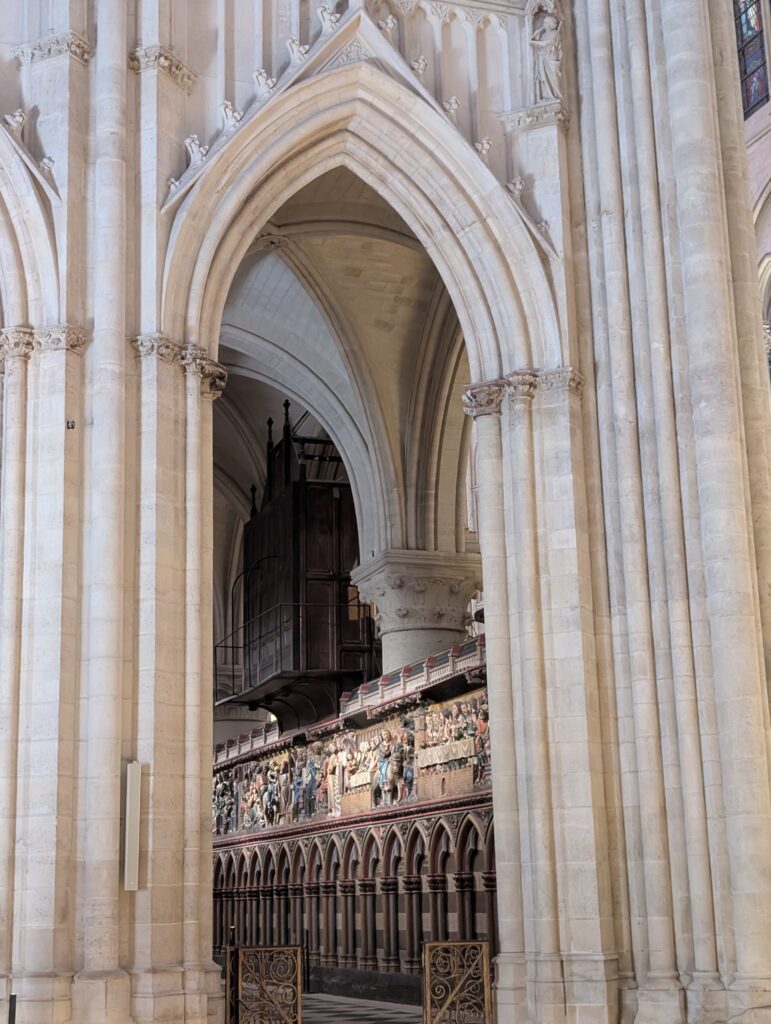
Pointed Gothic arches framing the choir, Notre-Dame de Paris.
Smooth and Pointed Arches: Loads, Stress, Fracture, and Fatigue
Introduction
The accompanying photograph shows the interior of Notre-Dame de Paris, where every opening is spanned by a pointed arch. Stand in a Roman basilica instead and the openings would be round. Stand in a Greek temple and there would be no arch at all — only a horizontal stone beam resting on columns. Those three choices are not merely stylistic. Each represents a different answer to the same structural question: how do you carry a vertical load across an open span using stone, a material that is strong in compression but weak in tension?
This post traces the arch from Greek post-and-lintel construction through the Roman semicircle, the Moorish horseshoe, and the Gothic point, and then examines the mechanics that unite them: the flow of load, the resulting stresses, the stress concentrations at geometric discontinuities, and the long, slow processes of fracture and fatigue that act on a masonry structure over centuries.
A Short Structural Lineage
Greek: the trabeated ideal
Classical Greek architecture is trabeated — built from posts and lintels. A stone lintel spanning between two columns behaves as a simply supported beam. Under its own weight and any imposed load, the bottom fiber goes into tension. Model the lintel as a uniformly loaded beam of span \(L\), width \(b\), and depth \(d\). The maximum bending moment and the extreme-fiber stress are:
\[ M_{max} = \frac{w L^2}{8}, \qquad \sigma = \frac{6 M_{max}}{b\,d^{2}} = \frac{3\,w L^{2}}{4\,b\,d^{2}} \]Stone typically carries only one-tenth to one-twentieth of its compressive strength in tension, so the tensile bottom fiber governs, and the practical clear span of a stone lintel is short. The Greeks knew the true arch but preferred the visual order of the colonnade; where they needed to span heavily, as at the Mycenaean Lion Gate, they used the corbel arch — a stepped, cantilevered stack of stones that is not a true arch and still relies on the mass above to stay in compression.
Roman: the true voussoir arch
The Roman contribution was the mature voussoir arch: wedge-shaped stones locked by a central keystone, forming a semicircle. The arch converts a vertical load into a compression thrust that flows around the ring and down into the supports, keeping the masonry almost entirely in compression — exactly where stone is strong. From this single idea came the barrel vault, the groin vault, the dome of the Pantheon, and the great aqueducts.
The semicircular form has one persistent drawback. The thrust arrives at the springing with a large horizontal component, and near the haunches the natural line of thrust wants to bulge outside a thin ring. Roman builders answered with mass: deep piers, thick spandrel fill over the haunches, and continuous buttressing.
Moorish: the horseshoe and the tiered arch
Islamic builders in Spain and North Africa developed the horseshoe arch, whose curve continues below the springing line so that it encloses more than a semicircle. This emphasizes verticality but re-introduces a subtlety: the re-entrant lower curve tends to spread outward, so horseshoe arches are commonly contained within a rectangular frame (the alfiz) and supported by adjacent masonry. At the Great Mosque of Córdoba the builders stacked two tiers of arches on relatively short reused columns — a way to reach a tall, stable ceiling without tall monolithic supports. Later Moorish work moved toward pointed-horseshoe and lobed (multifoil) profiles that are increasingly decorative rather than structural.
Gothic: the pointed arch
The Gothic pointed arch is the geometric hinge of the whole story. By breaking the curve to a point, the designer steepens the line of thrust so that it descends more nearly vertically, reducing the horizontal thrust delivered to the supports relative to a round arch of the same span. Three innovations work together: the pointed arch, the ribbed vault that channels load to discrete points, and the flying buttress that catches the residual horizontal thrust and carries it to external piers weighted by pinnacles. The pointed arch also brings a purely geometric benefit — two arches of different span can be raised to the same crown height simply by adjusting the sharpness of the point, which a semicircle (whose rise is fixed at half the span) cannot do. That freedom is what let Gothic masons vault rectangular bays and open the walls into the great clerestory windows.
The pointed profile most likely reached Western Europe through contact with Islamic building in Spain and Sicily and by way of the Crusades; the precise route is still debated, but the mechanical advantage was quickly and thoroughly exploited.
| Tradition | Approx. era | Characteristic form | Structural principle | Thrust behavior |
|---|---|---|---|---|
| Greek | 700–100 BC | Post-and-lintel; corbel “arch” | Beam in bending | Bottom-fiber tension limits span |
| Roman | 200 BC–400 AD | Semicircular voussoir arch, vault, dome | Compression thrust ring | Large horizontal thrust at haunches |
| Moorish | 700–1400 AD | Horseshoe, pointed-horseshoe, multifoil | Extended/steepened curve, tiered | Spreading lower curve; framed by alfiz |
| Gothic | 1140–1500 AD | Pointed arch, ribbed vault, flying buttress | Steepened thrust line | Reduced horizontal thrust; height and geometric flexibility |
Why the Arch Works: Thrust and the Middle Third
Idealize an arch as carrying a uniform load \(w\) per unit horizontal length across a span \(L\) with a rise \(f\). If the arch is shaped to follow the funicular line of that load — a parabola for a uniform load — it carries pure compression with no bending, and the horizontal thrust at the supports is:
\[ H = \frac{w L^{2}}{8 f} \]The message is in the denominator. For a given span and load, a higher rise \(f\) produces a lower horizontal thrust. A pointed arch has a larger rise-to-span ratio than a semicircle, which is precisely why it pushes its abutments outward less — and why Gothic walls could be made thinner and taller than Roman ones.
Real masonry arches are not weightless funicular lines; they are thick rings that carry some bending. The classic tool for judging them is the line of thrust and the middle-third rule. Consider a cross-section of thickness \(t\) carrying a normal force \(N\) at eccentricity \(e\) from the centroid. The extreme-fiber stresses are:
\[ \sigma = \frac{N}{A}\left(1 \pm \frac{6e}{t}\right) \]As long as the thrust line stays within the middle third of the section, \(e \le t/6\), both fibers remain in compression and no tension appears — the safe condition for a material that cannot pull. When the thrust line reaches the edge, \(e = t/2\), the section opens on the far face and a hinge forms. This is the foundation of Heyman’s limit analysis of masonry: an arch is safe not because stresses are low (they usually are), but because a valid line of thrust can be drawn somewhere within the masonry. Collapse comes when enough hinges form to turn the arch into a mechanism, typically four hinges for a single arch.
Loads on a Cathedral Arch
The stresses in a cathedral arch are driven by a spectrum of loads, some static and some decidedly dynamic. The dynamic ones are where structural-dynamics thinking earns its keep.
| Load | Nature | Structural effect | Fatigue relevance |
|---|---|---|---|
| Self-weight (dead) | Static, dominant | Sets the baseline thrust line | Provides the mean stress |
| Wind | Dynamic, gusting | Lateral sway of towers and spires | High-cycle |
| Thermal | Cyclic (diurnal, seasonal) | Differential expansion, joint movement | Low-cycle thermal fatigue |
| Swinging bells | Periodic, resonance risk | Tower excitation near a structural mode | High-cycle, resonance-amplified |
| Seismic | Transient, rare | Rocking and hinge mechanisms | Low-cycle, extreme amplitude |
| Foundation settlement | Imposed displacement | Redistributes the thrust line | Sustained crack driver |
| Freeze–thaw / moisture | Cyclic environmental | Crack wedging and spalling | Environmentally-assisted |
The bell load deserves special note. A swinging bell delivers a periodic horizontal reaction at its pendulum frequency. If that frequency approaches a natural mode of the tower, the response is amplified by the dynamic magnification factor, and modest input forces produce large, repeated stresses. Bell-tower cracking driven by resonance is a recurring problem in historic structures, and the cure is the familiar one: shift the frequency ratio away from unity or add damping.
Stress and Stress Concentration
Away from discontinuities, the compressive stresses in a cathedral arch are surprisingly modest — often well under 1 MPa, a small fraction of the crushing strength of good limestone. Masonry is rarely in danger of crushing. The danger lives at the discontinuities, where the smooth stress field is disturbed and locally magnified:
\[ \sigma_{max} = K_t \, \sigma_{nom} \]The stress-concentration factor \(K_t\) climbs wherever geometry changes abruptly — the sharp apex of a pointed arch, the cusps of window tracery, the corners of voussoir joints, the point loads where ribs land on a pier or corbel, and any crack-like flaw or open mortar joint. For an elliptical flaw of length \(2a\) and tip radius \(\rho\), the concentration scales roughly as:
\[ K_t \approx 1 + 2\sqrt{\frac{a}{\rho}} \]which grows without bound as the tip sharpens. A hairline crack or an open bed joint is, in this sense, a very efficient stress raiser. This is why cracks in masonry propagate along mortar joints in the characteristic stepped pattern: the joints are both the weakest planes and the sharpest existing flaws.
Fracture
Building stone is brittle, so its failure is governed by fracture mechanics rather than yielding. The stress-intensity factor at a crack of length \(a\) under remote stress \(\sigma\) is:
\[ K_I = Y\,\sigma\sqrt{\pi a} \]and unstable fracture occurs when \(K_I\) reaches the fracture toughness \(K_{IC}\), which for limestone is low — on the order of 0.5 to 1.5 MPa·m1/2. Because masonry cannot carry tension across a joint, the practical failure mode is not a single running crack but the hinge mechanism described earlier: where the thrust line touches a face, the joint opens, a hinge forms, and once enough hinges accumulate the arch becomes a mechanism and moves. Settlement, spreading abutments, and lost buttressing all act by pushing the thrust line to a face and opening that first hinge.
Fatigue
An 800-year-old cathedral is a fatigue specimen of extraordinary duration. Even at low stress amplitudes, the sheer number of cycles is enormous. A single daily thermal cycle over eight centuries is on the order of \(3 \times 10^{5}\) cycles; wind gusting and bell ringing push the relevant count into the \(10^{7}\)–\(10^{9}\) range. Several distinct fatigue mechanisms operate:
Thermal cycling (low-cycle). Differential expansion between sun-warmed and shaded stone, and between stone and mortar, imposes cyclic strain at the interfaces. For a fully restrained element the thermal stress is:
\[ \sigma_{th} = E\,\alpha\,\Delta T \]With \(E \approx 50\) GPa, \(\alpha \approx 6 \times 10^{-6}\)/°C, and \(\Delta T \approx 40\)°C, a fully restrained fiber would see roughly 12 MPa — comfortably above the tensile strength of limestone. Real elements are only partially restrained, but partial restraint at joints and interfaces is enough to open and work cracks over repeated cycles.
Vibration (high-cycle). Wind-induced sway and bell-induced resonance supply the high-cycle end of the spectrum. Where a stress raiser already exists, cyclic loading advances the crack according to the Paris law:
\[ \frac{da}{dN} = C\,(\Delta K)^{m} \]so a crack that would be stable under a single application of the peak load can still grow, cycle by cycle, until it reaches critical size. Modern additions to the load spectrum — nearby road traffic and underground rail — add steady high-cycle excitation that the original builders never anticipated.
Environmentally-assisted cracking. Water that enters a crack and freezes exerts wedging pressure, extending the crack on each freeze–thaw cycle — a masonry analog of environmentally-assisted fatigue. A related and often decisive mechanism is oxide jacking: medieval builders embedded iron cramps and tie bars, set in lead, to stitch the masonry together. As that iron corrodes, its oxidation products occupy several times the original volume, generating large tensile stresses in the surrounding stone and splitting it from within. Notre-Dame de Paris is a pointed case: examinations following the 2019 fire confirmed that iron staples were used extensively to reinforce its masonry, among the earliest such use in a Gothic cathedral. Its slow corrosion is one of the most persistent drivers of stone cracking and spalling.
Closing Thoughts
The progression from the Greek lintel to the Gothic point is a progression in load management. The lintel fights stone’s weakness in tension and loses at short spans. The Roman semicircle turns the load into compression but pays for it in horizontal thrust and mass. The pointed Gothic arch steepens the thrust line, sheds horizontal force, and — with the ribbed vault and flying buttress — frees the wall for light. In every case the governing physics is the same: keep the line of thrust inside the masonry, respect the material’s aversion to tension, watch the discontinuities where stress concentrates, and remember that over centuries even gentle cyclic loads accumulate into fatigue damage. The cathedrals that still stand are the ones whose builders, by intuition and iteration, kept all of these in balance.
For related material, see Tom’s ebooks, available free of charge. And consider enrolling in the VibrationData professional development course series, which begins each September.
by Tom Irvine
📌 Related Earthquake Engineering Knowledge Hub
This article is featured in our main Earthquake Engineering & Structural Dynamics Hub . Visit the hub to explore related articles on shock response spectra, time history analysis, seismic equipment qualification, and structural case studies.