Updated August 10, 2026. The original post was written two days after the incident. This revision adds the investigation developments through early August, including the project engineer’s assertion that specified column reinforcement was never installed, and a new section on what that reinforcement would have done to the section properties.
Incident Summary
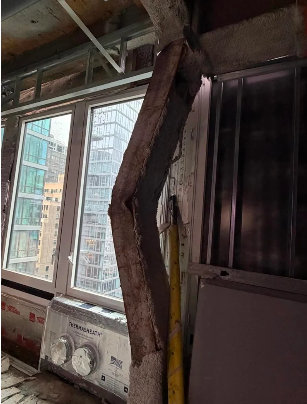
On the morning of July 7, 2026, construction workers on the 21st floor of 235 East 42nd Street in Midtown Manhattan discovered structural steel columns buckling before their eyes, along with bending box beams, cracks, and sagging floors. The 37-story tower — the former global headquarters of Pfizer, a 1970s-era steel-framed office building one block from the Chrysler Building — is midway through conversion into roughly 1,600 residential apartments. The fire department’s first call, just before 8 a.m., reported bricks falling from the building.
The site and several neighboring buildings were evacuated, streets were closed, and officials warned of a possible partial collapse; the fire department noted that the building continued to move after crews arrived, and that a steel-framed structure of this type was more likely to suffer a localized internal collapse than a total one. Emergency crews installed temporary jacks at the weakest points, followed by new steel shoring extending across floors 18 through 23. By the following day the city’s Department of Buildings reported no further movement, and most evacuation orders were lifted.
No injuries were reported — a credit to the steamfitters who spotted the distress and helped clear the floor. The developer has maintained that the situation was localized and that no portion of the building was ever at risk of collapse, and has said it will rebuild the affected areas.
Whatever the investigation ultimately concludes, the incident is a live illustration of the most unforgiving failure mode in structural engineering: column buckling. This post reviews the mechanics.
Where the Investigation Stands
Nothing below is an official finding. The Department of Buildings has not issued a cause determination, and the statements of the parties should be read with the understanding that contractual and insurance liability is now in play. With that caveat, the picture has sharpened considerably since early July.
The engineer of record says the column reinforcement was never installed. The project’s structural engineer, GACE Consulting Engineers, has stated that the reinforcement specified from the 19th floor through the top of the 21st floor — the reinforcement that would have substantially raised the columns’ strength — was “never installed,” and that the structure as built did not match the reinforcement the design required. Journalists who obtained the city-approved structural drawings report that those drawings called for plates along the length of the two columns that later buckled, converting I-shaped members into closed steel boxes. Two independent structural engineers who reviewed the drawings against the published photographs said the distressed columns appeared to be open I-shapes rather than the closed boxes the drawings depict.
The buckled columns sit directly beneath the vertical expansion. The conversion adds fourteen stories above the existing structure, and the failed columns are located at the interface between the original frame and the new construction. The developer’s early hypothesis — that the column supports were carrying more load than they could take — and the engineer’s assertion that the reinforcement was omitted are not competing explanations. They are the two halves of the same equation: demand was raised by design, capacity was to be raised to match, and the capacity increase is alleged not to have been executed.
Independent oversight has been imposed. The Department of Buildings directed the owner to retain Thornton Tomasetti as a third-party engineering firm for stabilization oversight and forensic review, and Special Testing & Consulting as a third-party special inspection agency, layered on top of the existing engineering and inspection teams. The Manhattan District Attorney’s office and the city’s Department of Investigation have each opened inquiries, and the Buildings Department has said civil enforcement actions await its findings.
A citywide inspection sweep found no systemic conversion problem. In early August the Buildings Department reported the first phase of an enforcement sweep covering 180 job sites connected to the project team, including roughly two dozen other office-to-residential conversions. Nineteen sites showed lapses, resulting in eighteen partial stop-work orders and one full stop-work order, along with roughly sixty-five violations, most for unsafe conditions or failure to follow approved structural plans. Inspectors reported no immediately hazardous structural conditions and no evidence that the East 42nd Street failure reflects something inherent to conversion work. A second phase covering additional firms was announced.
Peer review has become the live policy question. The city ordered the developer to obtain an outside peer review of the structural drawings for the adjacent project at 219 East 42nd Street, where twenty-one stories are being added atop a nine-story building, with a report due in mid-August. Neither of the two East 42nd Street sites met the size thresholds that would have triggered a mandatory peer review under the existing rules. That is the detail most likely to change practice, and it is discussed further below.
Buckling Is a Stability Failure, Not a Strength Failure
A column can fail in two fundamentally different ways. It can crush, when the compressive stress reaches the material strength — a failure of strength. Or it can buckle, bowing sideways under a load well below the crushing load — a failure of stability. Buckling is a bifurcation: below the critical load the straight configuration is stable, and at the critical load the straight configuration abruptly ceases to be, with essentially no warning in the load path leading up to it. This is why buckling events are so often described by witnesses as sudden. The steel did not weaken; the equilibrium did.
The classical result is Euler’s critical load for an ideal elastic column:
\[ P_{cr} = \frac{\pi^{2} E I}{(K L)^{2}} \]where \(E\) is the elastic modulus, \(I\) is the area moment of inertia of the cross-section about the weak axis, \(L\) is the column length, and \(K\) is the effective-length factor set by the end restraint conditions. Dividing by area and introducing the radius of gyration \(r = \sqrt{I/A}\) gives the critical stress in terms of the slenderness ratio \(KL/r\):
\[ \sigma_{cr} = \frac{\pi^{2} E}{(KL/r)^{2}} \]Two features of these equations deserve emphasis. First, the critical load depends on stiffness \(E\), not strength — a higher-strength steel of the same modulus buckles at the same load. Second, the effective length enters as a square. Double the unbraced length of a column and its elastic buckling capacity falls by a factor of four.
| End conditions | Theoretical \(K\) | Design (recommended) \(K\) |
|---|---|---|
| Fixed–fixed | 0.5 | 0.65 |
| Fixed–pinned | 0.7 | 0.80 |
| Pinned–pinned | 1.0 | 1.0 |
| Fixed–free (flagpole) | 2.0 | 2.1 |
For stocky columns, the Euler stress exceeds the yield strength and the failure becomes inelastic; design practice transitions to an inelastic column curve, such as the classical Johnson parabola,
\[ \sigma_{cr} = \sigma_{y}\left[ 1 – \frac{\sigma_{y}\,(KL/r)^{2}}{4\pi^{2}E} \right] \]or the equivalent AISC column-strength curves, which blend the elastic and inelastic regimes and account for residual stresses and initial crookedness. Note that heavy wide-flange columns at ordinary story heights are firmly in the inelastic regime, where capacity is governed largely by cross-sectional area and yield strength. That observation matters for what follows.
Real Columns: Eccentricity and Imperfection
Real columns are never perfectly straight, and real loads are never perfectly centered. An eccentricity \(e\) turns the bifurcation into a smoothly amplifying bow, described by the secant formula for the peak compressive stress:
\[ \sigma_{max} = \frac{P}{A}\left[ 1 + \frac{ec}{r^{2}} \sec\!\left( \frac{KL}{2r}\sqrt{\frac{P}{EA}} \right) \right] \]As \(P\) approaches the Euler load, the secant term grows rapidly — small imperfections are amplified into large lateral deflections. A column that appears visibly bent, as in the published photographs from the 21st floor, is a column operating in this amplification regime: it has not yet fully collapsed, but its remaining margin is small and falling, which is why the emergency priority was to get jacks under the load immediately.
Observe also that the eccentricity term scales as \(ec/r^{2}\). Enlarging the section reduces the sensitivity to eccentricity twice over: it raises \(r^{2}\) directly, and it reduces the argument of the secant. A column reinforced to a larger effective section is not merely stronger; it is less sensitive to the load-introduction imperfections that are unavoidable where a new frame lands on an old one.
Steel box columns and built-up sections add a second mode: local buckling of the thin plate walls. The elastic critical stress of a plate element of width \(b\) and thickness \(t\) is:
\[ \sigma_{cr} = \frac{k\,\pi^{2} E}{12\,(1-\nu^{2})} \left( \frac{t}{b} \right)^{2} \]where \(k\) depends on edge support and loading. Local plate buckling reduces the effective section, which in turn lowers the global buckling resistance — the two modes interact, and the interaction is always in the unfavorable direction.
What Cover Plates Do: The Mechanics of the Missing Reinforcement
The reinforcement described in the reporting — plates that close an I-shape into a box — is the standard way to upgrade an existing column in place without demolishing the frame around it. It is worth working out what such a detail actually buys, because the answer is not uniform across the section properties. Some go up modestly; one goes up by two orders of magnitude.
Consider an illustrative heavy wide-flange column, a W14×176, and suppose 1-inch side plates are added between the flange tips to close the section. This is a generic example chosen to show the scaling; it is not the actual member at 235 East 42nd Street, whose size and detail are not public.
| Property | As-rolled I-shape | Closed box | Ratio |
|---|---|---|---|
| Area \(A\), in.2 | 51.8 | 77.0 | 1.49 |
| Weak-axis \(I_y\), in.4 | 838 | 2380 | 2.84 |
| Weak-axis \(r_y\), in. | 4.02 | 5.56 | 1.38 |
| Strong-axis \(I_x\), in.4 | 2140 | 2470 | 1.16 |
| Torsion constant \(J\), in.4 | 26.5 | ≈ 3300 | ≈ 125 |
The torsional result follows from the fact that an open section and a closed section resist twist by entirely different mechanisms. For a thin-walled open section the torsion constant is the sum of the individual plate contributions,
\[ J_{open} = \frac{1}{3}\sum_{i} b_i t_i^{3} \]while for a single-cell closed section the Bredt–Batho result applies,
\[ J_{closed} = \frac{4 A_m^{2}}{\displaystyle\oint \frac{ds}{t}} \]where \(A_m\) is the area enclosed by the wall midline. Closing the section replaces a cubic-in-thickness sum with a term proportional to the square of the enclosed area, and the enclosed area of a 15-inch column is large. Hence the factor of roughly 125.
Now the honest qualification, because it is easy to overclaim here. For a stocky column at a single 13-foot story, \(KL/r_y\) is only about 39 for the bare shape and 28 for the box; the elastic Euler stress in both cases is far above yield, so pure flexural buckling does not govern and the column is essentially squash-controlled. Torsional buckling likewise does not govern such a member: evaluating the doubly symmetric torsional buckling stress,
\[ F_{e} = \left[ \frac{\pi^{2} E C_{w}}{(K_{z} L)^{2}} + G J \right] \frac{1}{I_{x} + I_{y}} \]for the bare W14×176 at one story height gives a value well in excess of 200 ksi. The large \(J\) increase is therefore not primarily a buckling-mode benefit. Its value is in the load-introduction condition: where a new frame lands on an existing column with framing offsets, transfer girders, and connections that are not concentric, the column sees torsion and biaxial moment as well as axial force, and a closed section carries that torsion in shear flow around the cell rather than in warping of open plates.
The picture changes sharply if the unbraced length is more than one story. The reported extent of the missing reinforcement spans three floor levels. If bracing at intermediate levels were also incomplete during the construction sequence — a hypothesis, not a reported fact — then at an unbraced length of three stories, roughly 39 feet, \(KL/r_y\) reaches about 116 for the bare shape against 84 for the box. The corresponding elastic Euler stresses are approximately 21 ksi and 40 ksi. The bare column has fallen to well under half of a 50 ksi yield, while the boxed column is still up in the inelastic transition range. That is the regime in which the difference between an I and a box stops being a design refinement and becomes the difference between standing and bending.
The general lesson is the one that recurs throughout this subject: a reinforcement detail is not a safety factor added on top of an adequate column. When the design raises demand and simultaneously specifies the reinforcement that answers it, the reinforced section is the design. The unreinforced member is not a slightly weaker version of the intended column; it is a different structure carrying loads that were never calculated for it.
Load Redistribution: Why One Column’s Problem Is Its Neighbors’ Problem
A steel frame is statically indeterminate, and that redundancy is both its salvation and its trap. When one column softens and sheds load, the girders and slabs redistribute that load to the adjacent columns — which are now carrying more than their design share and are themselves closer to their critical loads. If the neighbors have margin, the structure finds a new equilibrium and stands, visibly distressed, exactly as this building did. If they do not, the failure propagates column to column and the result is a progressive, disproportionate collapse. The reported observation that the building “continued to move” during the first hours is consistent with this redistribution process still seeking equilibrium — and it is why shoring was installed not just at the damaged columns but across at least six floors, to intercept the redistributed load paths above and below.
Redistribution also explains why a localized omission does not stay localized. If a reinforcement detail is missed at two columns, the load those columns shed is not lost; it goes to members that were sized for their own share and no more.
Conversion-Specific Risk Factors
Office-to-residential conversions are structurally invasive in ways that bear directly on column stability. The investigation will determine which, if any, of these applied here; the list below is general.
| Conversion activity | Effect on the governing equation |
|---|---|
| Added stories or rooftop overbuild | Increases \(P\) on the columns below, consuming margin against \(P_{cr}\) |
| Specified column reinforcement omitted, incomplete, or installed out of sequence | The design raised \(P\) on the assumption of an upgraded section; the field member retains its original \(A\), \(I\), \(r\), and \(J\). The calculated capacity belongs to a column that does not exist. |
| Cutting floor slabs (light wells, new stairs, MEP risers) | Removes lateral bracing points; increases unbraced length \(L\), and \(P_{cr}\) falls with \(1/L^{2}\) |
| Removing walls or diaphragm sections | Softens end restraint; effective-length factor \(K\) increases toward the pinned or free condition |
| Temporary column-transfer or reinforcement work | During the transfer, the load path may pass through temporary elements with less capacity than the permanent design |
| Material staging (stacked drywall, block, equipment) | Concentrated live loads on individual bays, potentially eccentric to the column axes |
| New heavy systems (amenity pools, green roofs, façade replacement) | Permanent dead-load increase on a 1970s frame designed to office criteria |
Note that several of these mechanisms act on the denominator of the Euler equation rather than the numerator of the demand. A column that gains 20 percent more load has lost 17 percent of its margin; a column whose unbraced length grows by 40 percent has lost half of its elastic buckling capacity. Slab cuts and bracing removal are, pound for pound, more dangerous to a column than added weight — and far less visible on a loading tally sheet.
The second row is the one this incident has pushed to the front. It differs from the others in kind rather than degree: the first, third, and fourth rows describe margin consumed by the design of the conversion, which an engineer can calculate. The second describes margin the engineer calculated correctly and the field never delivered. No amount of analysis catches that. Only verification does.
Verification Is Part of the Load Path
The classical stability equations assume the section they are given. Everything above is exact for the column on the drawing, and irrelevant to a column that was built differently. In a new-construction project the gap between the two is closed by special inspection and by the engineer of record’s continued involvement during erection. In a conversion, that gap is wider and more consequential, for three reasons.
First, the reinforcement of an existing member is often concealed almost immediately — wrapped in fireproofing, boxed in furring — so the window in which a plate detail is visible for inspection is short. Second, the reinforcement work is frequently sequenced against occupancy, demolition, and shoring constraints, so it is executed piecemeal rather than in one clean campaign, and a partial installation looks a great deal like a complete one from a distance. Third, the demand increase it answers arrives on a schedule of its own: steel goes up above whether or not the reinforcement below is finished. The margin between the two is a construction-sequence quantity, not a design quantity.
Commentary from the American Institute of Steel Construction in the wake of this incident made the corresponding point about roles: while contractors own means and methods and may retain specialty engineers for temporary works, the engineer of record designs the completed structure and should remain informed as construction proceeds. That is not a novel principle, but conversions test it harder than new construction does, because in a conversion the structure passes through many intermediate configurations that appear on no drawing set.
The peer review question follows directly. Both East 42nd Street projects fell below the thresholds that would have required independent review of the structural design, despite adding fourteen and twenty-one stories respectively to existing frames. Whatever the forensic report concludes about this particular building, a threshold scheme keyed to building size does not capture the risk of a vertical expansion, where the governing engineering problem is not the new frame at all but the adequacy and verified condition of the old columns underneath it. A modest tower added to a modest building can pose a stability problem that a much larger conventional project does not.
Emergency Shoring Mechanics
The stabilization sequence reported at this site follows standard urban search-and-rescue and forensic-engineering practice. Hydraulic or screw jacks are placed first to arrest movement and pick up a share of the load from the damaged columns; these are fast to deploy but are temporary by nature. New steel posts and struts are then installed to create a redundant, permanent-enough load path around the damaged members, extended several floors above and below so that the redistributed forces are intercepted rather than merely relocated. Throughout, the structure is monitored for movement from inside and outside — survey targets, crack gauges, and increasingly real-time sensing — because the shoring operation itself perturbs the load paths, and the confirmation that matters is measured stillness, not calculated capacity. The reports that the building had not moved since the shoring went in were the real all-clear signal.
Closing Thoughts
Buckling gives little warning and forgives nothing, because it is a failure of geometry and stiffness rather than of material strength. The margin against it is spent invisibly — by an extra story here, a slab opening there, a stack of drywall in the wrong bay — until the secant amplification takes over and a straight column becomes a bent one in seconds.
What the past month has added to that picture is a harder point. The margin can also be spent by a detail that was correctly designed, correctly drawn, correctly approved, and not correctly built. Euler does not know what the drawings said. A column resists with the section it has, at the unbraced length it has, on the day the load arrives. Every reinforcement detail on a conversion project is therefore a load-bearing element of the analysis itself, and its verification belongs in the same category of rigor as the calculation that called for it.
The forensic evaluation of 235 East 42nd Street will take months, and the criminal and civil inquiries longer still. The eventual report will be worth reading closely, particularly for what it says about how the reinforcement sequence was tracked against the erection of the floors above. In the meantime, the incident is a reminder that in renovation work the structure that matters is not the one on the original drawings, nor the one on the final drawings, but every intermediate configuration in between — and each of those configurations must satisfy Euler on its own.
I will post a further update when the forensic findings are released.
Sources
Initial reporting, July 7–9:
- NBC News — Buckling Manhattan high-rise deemed stable after evacuations
- CNN — Stabilization work continues on buckled columns at NYC high-rise
- NBC New York — Photos from inside the 21st floor
- ABC7 NY — Building deemed stable as investigation continues
Investigation developments, July–August:
- Gothamist — Engineer behind buckled high-rise says crucial reinforcing steel was never installed
- Engineering News-Record — Structural engineer claims reinforcement was never installed; third-party oversight ordered
- Gothamist — City orders peer review of structural plans at the adjacent 219 East 42nd Street project
- Gothamist — Safety blitz finds lapses at 19 job sites tied to the project team
- Construction Dive — DOB wraps first wave of construction safety sweeps
For related material, see Tom’s ebooks, available free of charge. And consider enrolling in the VibrationData professional development course series, which begins each September.
by Tom Irvine
An Excellent piece of writing on a real world buckling issue and supplemental classical theory.