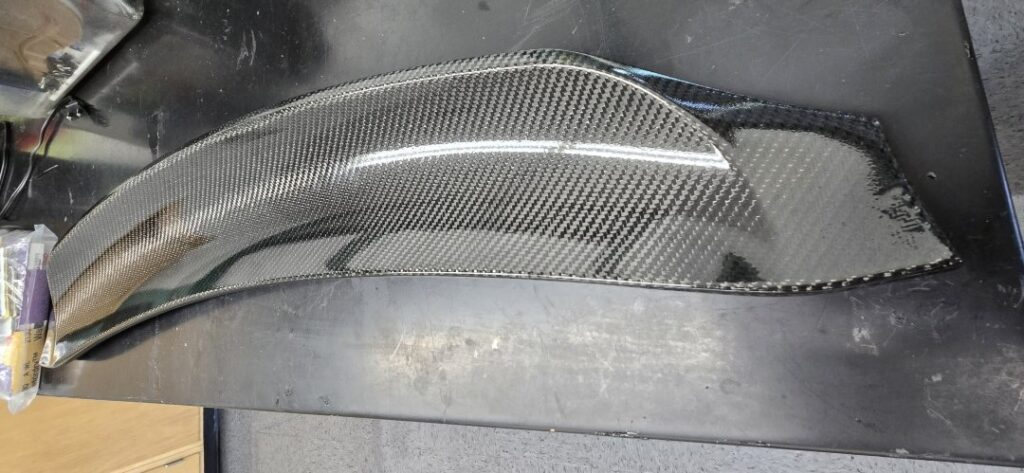
The carbon fiber automotive part in the photo above shows two composite engineering choices worth examining before it ever sees the road: the woven fabric architecture visible through the surface, and the glossy clear coat protecting it. Composite structures rarely fail in the fiber direction first — they fail at the surface, through erosion, impact, delamination, and UV degradation. The right protective coating buys back damage tolerance that the laminate alone cannot provide. But “the right coating” depends entirely on the dominant damage mode, and the coating that resists abrasion is often the worst choice for fracture.
1. Reading the Photo: Twill Weave and Clear Coat
The 2×2 Twill Weave
The diagonal herringbone pattern visible in the part is a 2×2 twill weave — each tow passes over two perpendicular tows, then under two, with the crossover points offset row by row to produce the characteristic diagonal ribs. This is the signature “carbon fiber look” of automotive components, but the choice is structural as much as cosmetic:
- Drapeability. Twill conforms to compound curvature far better than plain weave. The gentle S-curve and edge returns on this part would bridge and wrinkle with a stiffer fabric. Fewer interlacing points per unit area means the fabric shears more freely during layup.
- Reduced crimp. Tows in a twill undulate less than in a plain weave, so the in-plane stiffness and strength are somewhat higher for the same fiber and areal weight. Crimp matters for fatigue, too: the resin-rich pockets at crossover points and the local fiber curvature are where matrix cracking initiates under cyclic load.
- Quasi-isotropic surface plies. A woven ply carries fiber in both the 0° and 90° directions at once, which suits a body panel loaded by distributed aerodynamic pressure and handling loads rather than a single dominant load path. Unidirectional plies beat woven fabric on specific stiffness along one axis, but a spoiler or trim panel sees loads from every direction.
The tradeoff: woven fabrics give up some stiffness and fatigue performance relative to unidirectional laminates because of the crimp, and the weave crossovers create a periodic array of micro stress concentrations. For a cosmetic-structural automotive part, that tradeoff is easily worth it. For a rocket structure or a rotor spar, unidirectional plies with a woven surface ply is the more common compromise.
The Clear Coat as a Protective Coating
The glossy surface is not just polish — it is a working example of the environmental-protection coatings discussed below. Automotive carbon parts typically carry a UV-stabilized polyurethane or epoxy clear coat, often over an in-mold surfacing resin. Its jobs:
- UV screening. Epoxy matrices yellow, chalk, and lose surface toughness under UV. The clear coat carries UV absorbers and hindered-amine light stabilizers so that the sacrificial degradation happens in the coating, not the matrix.
- Moisture barrier. Slows moisture uptake into the laminate, which otherwise plasticizes the matrix and degrades the fiber/matrix interface.
- Minor impact and abrasion buffer. Stone chips and wash-brush scratches stop in the clear coat rather than exposing fibers.
When the clear coat on an automotive carbon part fails — the familiar cloudy, flaking “clear coat delamination” — the laminate underneath begins degrading quickly. The coating is the consumable; the laminate is the investment.
2. Coating Families by Damage Mode
Erosion and Wear Protection
- Polyurethane coatings and tapes (e.g., 3M 8663 and similar erosion films) — the industry standard for rain and sand erosion on the leading edges of helicopter rotor blades, wind turbine blades, and radomes. The elastomer absorbs the droplet impact energy that would otherwise pit and erode the laminate surface. The automotive equivalent is paint protection film (PPF) applied over the clear coat on high-impingement areas.
- Thermally sprayed carbides (WC-Co applied via HVOF) — for severe abrasive wear. Spray temperatures and residual stresses require care on polymer-matrix substrates; a bond coat is often required, or the application is limited to metal-capped edges.
- Electroformed nickel or cobalt erosion shields — bonded metallic caps on helicopter blade leading edges. Hard enough to resist erosion, ductile enough not to shatter.
Impact Protection
- Elastomeric polyurea coatings — thick sprayed layers that spread contact loads and reduce delamination from low-velocity impact. The same chemistry is used for blast mitigation on structures.
- Thermoplastic surface films — co-cured onto the laminate to improve damage tolerance and provide a sacrificial outer layer.
Environmental, UV, and Moisture Protection
- Epoxy or polyurethane paint systems with UV-stable topcoats — baseline protection, since polymer matrices (especially epoxies) degrade under UV exposure. The clear coat on the part in the photo belongs to this family.
- Fluoropolymer topcoats (PVDF, FEVE) — for long-term weathering resistance.
Thermal and Specialty Coatings
- Ablative and intumescent coatings — fire and thermal protection.
- Conductive coatings (embedded metal mesh, flame-sprayed aluminum, conductive paints) — lightning strike protection on aircraft composites. Lightning attachment is arguably a form of impact damage, delivered electrically.
3. Boron Nitride Coatings
Boron nitride (BN) appears in coating technology in two very different crystallographic forms, with nearly opposite mechanical roles.
Hexagonal BN (h-BN) — the “White Graphite”
Soft, lubricious, chemically inert, and thermally stable to roughly 900°C in air. It serves as a dry lubricant and mold-release coating. Its most important structural application, however, is inside ceramic matrix composites (CMCs): a thin h-BN interphase coating (on the order of 0.1–1 μm) is applied to SiC fibers in SiC/SiC composites. This coating is not for external wear at all — it deliberately creates a weak fiber/matrix interface so that matrix cracks deflect along the fiber surface and fibers pull out rather than fracture. That crack-deflection mechanism is what gives the composite its toughness. The h-BN interphase is standard practice in aerospace CMCs, including turbine engine hot-section components.
Cubic BN (c-BN) — the Diamond Analog
The second-hardest known material, deposited by PVD or CVD as a thin hard coating for extreme wear and abrasion resistance, primarily on cutting tools. Deposition on polymer-matrix composites is impractical — the process temperatures, residual stresses, and adhesion problems rule it out — so its use is essentially limited to ceramic and metallic substrates.
Related Boron-Based Options
Boron carbide (B4C) coatings are used for hard-facing and neutron shielding. Boriding produces hard boride surface layers on metals, but is not applicable to polymer-matrix composites.
For a polymer-matrix composite, BN shows up mainly as a filler in lubricious or thermally conductive coatings rather than as a standalone hard coating. For CMCs, the BN fiber interphase is the flagship application.
4. Which Coating Is Best for Fracture Resistance?
The answer depends on which fracture mode dominates, because hard and soft coatings work in opposite directions.
Polymer-Matrix Composites: Impact-Induced Fracture and Delamination
The elastomeric coatings win. Thick polyurea or polyurethane layers spread the contact load, lengthen the impact pulse, and absorb energy — measurably reducing delamination area and back-face fiber breakage from low-velocity impact. Hard coatings (c-BN, sprayed carbides) are counterproductive here: they are brittle, they crack first, and those cracks can act as initiation sites in the underlying laminate.
Ceramic-Matrix Composites: The h-BN Interphase
The h-BN fiber interphase is unambiguously the best “coating” for fracture resistance in CMCs — it is the mechanism that transforms a brittle ceramic into a damage-tolerant composite by deflecting matrix cracks along the fiber interface. Without it, a SiC/SiC composite fails like monolithic ceramic.
When Wear and Fracture Resistance Are Both Required
This is the classic conflict. The practical compromises are:
- Metallic erosion shields (electroformed nickel caps) — hard enough to resist erosion, ductile enough not to shatter under impact.
- Duplex coating systems — a compliant bond layer beneath a harder top layer, so that cracks initiating in the hard layer arrest at the compliant interface rather than propagating into the substrate.
Summary Comparison
| Coating | Best For | Fracture Resistance Role | Limitation |
|---|---|---|---|
| UV-stable clear coat (automotive) | UV and moisture protection of cosmetic carbon parts | Minor — buffers stone chips and scratches | Sacrificial; laminate degrades quickly once coating fails |
| Polyurethane / polyurea (thick elastomeric) | Rain/sand erosion, low-velocity impact on PMCs | Excellent — absorbs impact energy, reduces delamination | Limited abrasion resistance; adds mass and damping |
| h-BN fiber interphase | SiC/SiC and other CMCs | Essential — crack deflection and fiber pullout | Internal interphase only; not an external coating |
| Electroformed Ni/Co erosion shield | Rotor blade leading edges | Good — ductile metal tolerates impact | Mass penalty; bondline is the weak link |
| HVOF carbide (WC-Co) | Severe abrasive wear | Poor — brittle; cracks can seed substrate damage | Deposition stresses on PMC substrates |
| c-BN (PVD/CVD) | Extreme abrasion (cutting tools) | Poor — very brittle | Impractical on polymer-matrix substrates |
| Duplex (compliant bond + hard top) | Combined wear + impact environments | Good — crack arrest at the compliant interface | Process complexity; interface QC critical |
5. Conclusions
The part in the photo embodies both halves of this post: a 2×2 twill weave selected for drapeability and bidirectional stiffness, and a UV-stable clear coat serving as its first line of environmental defense. For fracture and impact resistance on polymer-matrix composites, choose compliance and energy absorption at the surface — elastomeric polyurethane and polyurea systems. For ceramic-matrix composites, the h-BN fiber interphase is the enabling fracture-toughness technology. Reserve hard coatings — carbides, c-BN — for abrasion-dominated environments, and where wear and fracture threats coexist, use ductile metallic shields or duplex architectures that arrest cracks before they reach the laminate.
Coating selection is failure-mode selection. Identify the dominant damage mechanism first; the coating chemistry follows.
See also the free ebooks at vibrationdata.com/ebooks, including references on composite stress and fatigue analysis.
Looking for a deep dive on this topic? Explore our comprehensive guide and resource collection on the Residual Stress & Structural Integrity Hub.