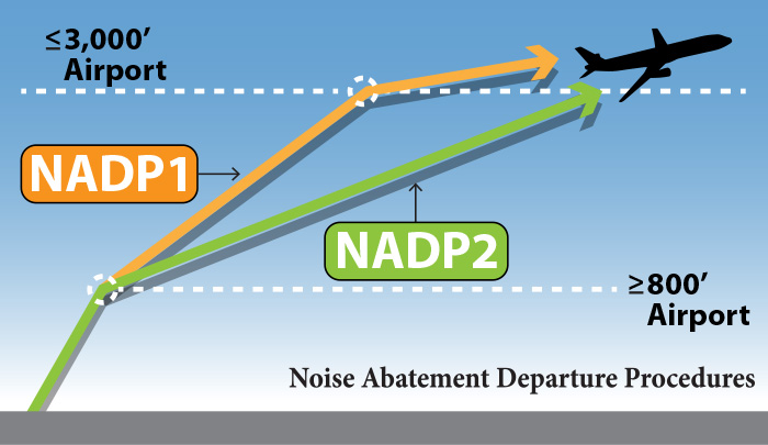
At John Wayne Airport (SNA) in Orange County, California, noise abatement on departures is managed through a combination of specialized Noise Abatement Departure Procedures (NADPs), strict regulatory limits, and operational constraints. Because SNA is located in a densely populated, noise-sensitive residential area, the airport enforces some of the most stringent noise rules in the United States. These rules are governed locally by the General Aviation Noise Ordinance (GANO) and commercial access regulations, which establish clear single-event decibel ceilings and strict curfew hours.
Noise Abatement Takeoff / Departure Procedures
Standard Aviation Profiles (NADP1 vs. NADP2)
To minimize ground-level noise impact, aircraft use two general types of FAA-recognized departure profiles, classified under Advisory Circular guidelines as Close-In (NADP1) and Distant (NADP2):
- Close-In (NADP1): This profile prioritizes noise reduction for communities closest to the runway end. It calls for a steep initial climb. Upon reaching a safe minimum altitude (typically around 800 feet Above Ground Level, or AGL), the pilot initiates a thrust reduction while maintaining a conservative speed, continuing along the departure route under lower power until clear of immediate residential zones.
- Distant (NADP2): This profile shifts the noise-abatement focus to communities further down the flight path. The aircraft accelerates and retracts flaps earlier, retaining higher climb thrust longer and delaying thrust reduction until reaching a higher altitude.
Because these procedures are recommended by the FAA rather than dictated by the airport authority, airlines select the profile that best matches their specific aircraft performance and weight configuration to guarantee they do not exceed SNA’s fixed ground-monitoring limits.
The SNA “Steep Climb & Power Cut-Back”
Because Runway 20R at SNA is relatively short (5,700 feet) and bordered immediately by noise-sensitive neighborhoods, departing commercial jets typically execute a highly specialized variation of a close-in profile. Informally referred to by pilots as the “SNA Noise Abatement Takeoff,” the maneuver proceeds as follows:
- Maximum Power & Steep Climb: Pilots advance engines to full or near-full rated takeoff thrust to break ground quickly and establish a steep, aggressive pitch angle.
- The Cut-Back: Upon reaching a safe altitude—typically between 500 and 800 feet AGL—the flight crew dramatically reduces engine thrust to a minimal, safe climb setting. To passengers in the cabin, this sudden thrust reduction often feels like a momentary drop or deceleration, but it is a deliberate maneuver designed to quiet the engines just as the aircraft overflies the closest homes.
- Strategic Vectoring: Once safely climbing under reduced power, aircraft execute a left turn to a designated heading (e.g., 175°) to route the flight track directly over less sensitive geographic corridors, such as the Newport Bay channels, eventually tracking out over the Pacific Ocean.
Operational Context & Sound Metrics
Key Noise Metrics Explained
To understand how compliance is measured at SNA, the airport relies on specific acoustic metrics that utilize A-weighted decibels (dBA), which adjust raw sound pressure levels to match the pitch sensitivity of the human ear.
- SENEL (Single Event Noise Exposure Level): Expressed in dB SENEL, this metric measures the total acoustic energy of a single isolated noise event (like a lone jet flyover) compressed into a theoretical reference duration of one second. Because it integrates the entire duration of the sound, a SENEL value is typically 5 to 10 dBA higher than the instantaneous Maximum Noise Level recorded during the pass.
- CNEL (Community Noise Equivalent Level): A 24-hour, time-weighted average noise metric used by the State of California to determine land-use compatibility. Under California Title 21, the acceptable exterior residential noise threshold near airports is 65 dBA CNEL. The metric adds a strict 5 dBA penalty to sounds occurring in the evening (7:00 PM to 10:00 PM) and a 10 dBA penalty to nighttime sounds (10:00 PM to 7:00 AM) to account for lower ambient background noise and heightened human sensitivity to disruptions.
Noise Monitoring Stations (NMS) and Limits
SNA tracks compliance utilizing 10 permanent, automated Noise Monitoring Stations (NMS) positioned strategically to the north and south of the airfield (e.g., in Newport Beach, Santa Ana, Tustin, and Irvine).
The airport categorizes aircraft and enforces strict, non-negotiable dB SENEL limits at these stations. For example, at the closest stations south of Runway 20R:
| Noise Monitoring Station | Distance from Localizer | Commercial Class A Limit | Commercial Class E Limit | Daytime GA Limit | Nighttime GA Limit |
| NMS 1S | 0.4 nm | 102.5 dB SENEL | 94.1 dB SENEL | 102.5 dB SENEL | 87.5 dB SENEL |
| NMS 2S | 0.4 nm | 101.8 dB SENEL | 93.5 dB SENEL | 101.8 dB SENEL | 87.6 dB SENEL |
| NMS 3S | 0.7 nm | 101.1 dB SENEL | 90.3 dB SENEL | 101.1 dB SENEL | 86.7 dB SENEL |
Note on Enforcement: Commercial carriers are monitored on a quarterly-averaged basis; violating these ceilings can result in an airline losing its allocation slots or being banned from operating that specific aircraft type at SNA. General Aviation (GA) aircraft are monitored on a strict single-event basis. Under GANO rules, if a GA aircraft triggers three violations within a rolling three-year window, the aircraft, its owner, and the operator are denied use of the airport for three years.
Airport Curfews
To protect surrounding communities during hours of rest, SNA enforces a mandatory curfew.
- Commercial Departures: Strictly prohibited between 10:00 PM and 7:00 AM local time (extended to 8:00 AM on Sundays).
- Commercial Arrivals: Prohibited between 11:00 PM and 7:00 AM (8:00 AM on Sundays).
- Nighttime Penalties: Any emergency or authorized general aviation operation permitted during these hours must adhere to significantly reduced nighttime ceilings (down to 86.7 – 87.6 dB SENEL depending on the monitor), effectively restricting late-night operations to only the quietest light aircraft.
Summary
The “noise abatement takeoff” at John Wayne Airport is a finely tuned balancing act between aviation safety and aggressive environmental engineering. By combining steep, high-power initial climbs with rapid thrust cut-backs, pilots successfully navigate aircraft below stringent, legally mandated dB SENEL ceilings monitored across Orange County neighborhoods. Ultimately, whether an airline selects an NADP1 or NADP2 profile, the benchmark for success is absolute: keep the sound footprint below the airport’s strict decibel limits, or forfeit the right to fly there.
See also: Airport, Traffic & Community Noise Revision C link
– Tom Irvine
📌 Turbofan Engine Knowledge Hub
Explore additional articles on turbofan engine acoustics, vibration, structural dynamics, fatigue, flight incidents, and aircraft noise measurements: Turbofan Engine Sound, Vibration & Structural Dynamics .