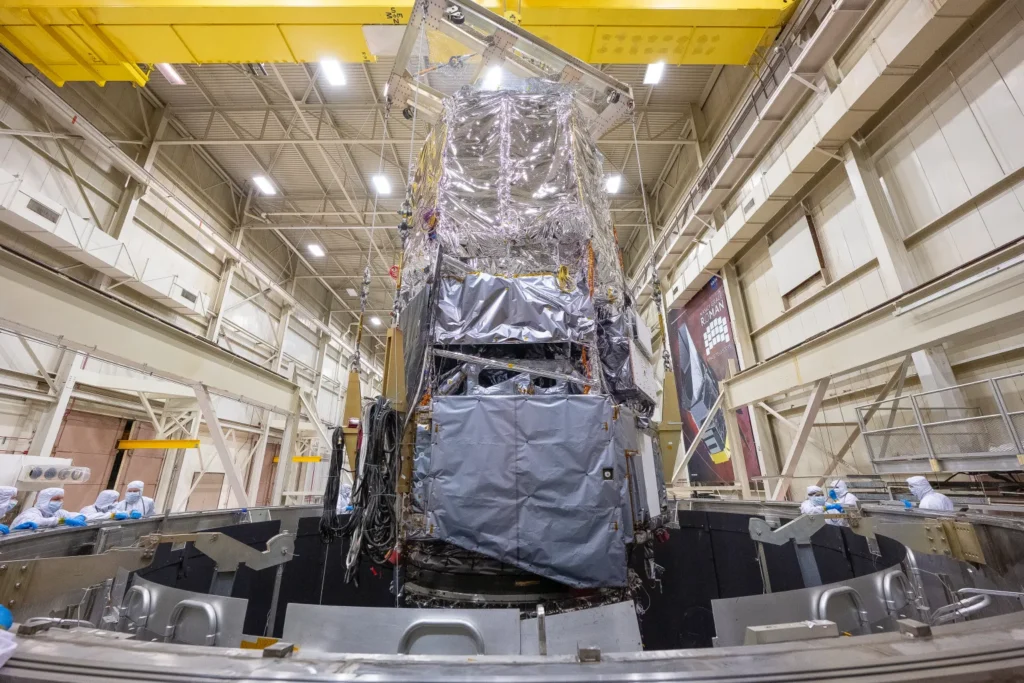
NASA’s Nancy Grace Roman Space Telescope has passed its final major prelaunch environmental tests at Goddard Space Flight Center. The test sequence included electromagnetic compatibility, vibration, and acoustic testing. These are the kinds of tests that determine whether a large precision observatory can survive launch and still perform its optical science mission once it reaches space.
Roman is NASA’s next flagship astrophysics observatory. It will use a 2.4-meter primary mirror, similar in size to Hubble’s, but with a much wider field of view. NASA lists the launch vehicle as a SpaceX Falcon Heavy from Kennedy Space Center, with the observatory bound for the Sun-Earth L2 region.
The test campaign is interesting from a structural dynamics standpoint because Roman is both massive and delicate. It must survive high launch loads, yet afterward it must maintain optical alignment, low jitter, low contamination, and clean electromagnetic behavior for faint infrared observations.
Electromagnetic Compatibility
The first of the final major tests was an electromagnetic interference test. NASA reports that the observatory was placed in a special configuration with absorbent panels to block outside radio signals and reduce reflections within the facility. Engineers then powered Roman’s electronics and measured the signals they generated.
This matters because Roman’s detectors must observe faint infrared signals. Electrical noise that seems harmless in an ordinary spacecraft subsystem can become a science-performance problem when the payload is trying to measure weak astronomical sources. Passing the EMC test means the observatory’s electrical systems can operate together without creating unacceptable interference.
Vibration Testing
Roman then moved to vibration testing on a large shaker table. The goal was to simulate the lower-frequency mechanical vibration expected during launch. NASA noted that the observatory was moved between facilities inside a custom portable clean room to protect the optics and sensitive surfaces from contamination.
The vibration test is not simply a brute-force shake. Engineers gradually build up the test levels while monitoring structural response. Accelerometers and other sensors are used to confirm that the test article behaves as expected. These data also help validate or update the finite element model.
For a large observatory, this is especially important. Launch-vehicle vibration can excite structural modes, and those modes can affect not only strength margins but also alignment, deployment mechanisms, and post-launch optical performance.
Acoustic Testing
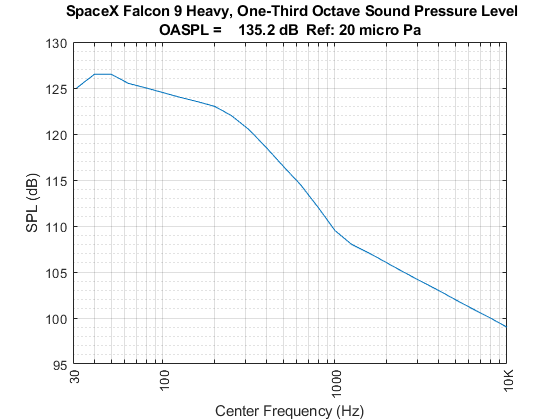
The acoustic test is the most dramatic part of the story. NASA reports that Roman was placed in a sound booth and exposed to sound levels up to 138 dB, approximately comparable to a jet engine at close range. The purpose was to simulate the intense acoustic environment generated during launch.
Because Roman is a one-of-a-kind flight observatory, the acoustic and vibration campaign was likely a protoflight-style environmental verification rather than a qualification test on a separate qualification article. NASA reported that the flight observatory was exposed to acoustic levels up to 138 dB. By comparison, SpaceX’s public Falcon Heavy user guide lists a 135.2 dB OASPL maximum predicted acoustic environment for typical payloads at 60% fairing fill factor, without qualification margin. The roughly 2.8 dB difference is consistent with applying test margin to the predicted launch environment, although the exact Roman mission-specific Falcon Heavy acoustic spectrum has not been publicly released.
Acoustic loading is different from shaker-table vibration. A shaker applies mechanical input through a support interface. Acoustic testing surrounds the structure with high sound pressure levels, creating distributed loading over external surfaces. Large lightweight structures can be particularly sensitive to this environment because panels, covers, sunshields, and other broad surfaces can convert acoustic pressure into structural vibration.
The Roman test therefore gives a good teaching example for the difference between:
• low-frequency base-driven vibration
• high-frequency acoustic excitation
• localized shock from separation events
• electromagnetic compatibility testing
Each test addresses a different part of the launch and mission environment.
See also: The Great Spacecraft Base Input Vibration Test Debate
– Tom Irvine