Introduction
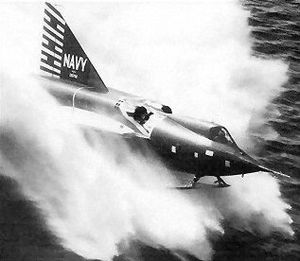
The Convair F2Y Sea Dart was one of the boldest experiments of the early jet age: a delta-wing, supersonic seaplane fighter that took off and landed on retractable hydro-skis in San Diego Bay. It remains the only seaplane ever to exceed the speed of sound.
The program is also a rich case study in structural dynamics. The Sea Dart was plagued by severe hydro-ski vibration that engineers never fully cured, and the program effectively ended when one aircraft disintegrated in midair after divergent pitch oscillations drove the airframe past its structural limits.
Background
The Sea Dart began as Convair’s entry in a 1948 U.S. Navy competition for a supersonic interceptor. The Navy at the time doubted that supersonic fighters, with their long takeoff rolls and high approach speeds, could operate safely from carrier decks. Ernest Stout’s team at Convair’s hydrodynamic research laboratory proposed an elegant alternative: put a delta-wing fighter on water skis and dispense with the runway entirely.
Convair received a contract for two XF2Y-1 prototypes in January 1951. The aircraft featured a watertight hull, engine intakes mounted high above the wing to avoid spray ingestion, and retractable hydro-skis. At rest, the Sea Dart floated with its hull half-submerged. During the takeoff run, the skis extended at about 50 mph, lifting the fuselage clear of the water. The aircraft then planed across the surface, accelerating to a takeoff speed of roughly 145 mph.
The first flight was actually inadvertent — Convair chief test pilot Sam Shannon briefly became airborne during a high-speed taxi test on January 14, 1953. The first official flight followed on April 9, 1953.
The prototype’s interim Westinghouse J34 engines were underpowered, and even the intended J46 afterburning turbojets (4,500 lbf dry, 6,100 lbf in afterburner, each) fell short of specification. The airframe also predated area-rule fuselage shaping, so transonic wave drag was high. Nevertheless, on August 3, 1954, test pilot Charles E. Richbourg pushed a J46-powered Sea Dart past Mach 1 in a shallow dive — the first and only supersonic flight by a seaplane.
The Hydro-Ski Vibration Problem
The defining structural dynamics issue of the program was violent vibration and pounding transmitted through the hydro-skis during taxi and takeoff. The severity increased with water roughness, and the shaking was intense enough to blur the pilot’s vision and hammer the airframe and installed equipment.
The physics is a repetitive water-impact problem. A planing ski running across a wavy surface experiences a sequence of slamming impacts, one per wave encounter. The forcing frequency is the wave encounter frequency:
f = (V + c) / λ
where V is the boat speed, c is the wave celerity component along the track, and λ is the wavelength. For a takeoff run accelerating from 50 to 145 mph across typical bay chop, the encounter frequency sweeps through a broad band — virtually guaranteeing that it would traverse the ski/strut/oleo natural frequencies and the low-order fuselage bending modes somewhere along the run.
Each individual wave impact is itself a transient shock. Classical water-entry theory (von Kármán, Wagner) shows that the peak slamming pressure scales with the square of the impact velocity, so the pounding loads grew rapidly as the aircraft accelerated. The result was a swept-sine-like base excitation punctuated by repetitive shock — a brutal environment for the airframe, the pilot, and the avionics.
Convair attacked the problem with oleo shock absorbers and progressively improved damping arrangements, which helped but never eliminated the vibration. In 1954 the first prototype was rebuilt with a single ski in place of the original twin-ski arrangement, which reduced the pounding to a workable level. The last twin-ski flight was made on April 28, 1955.
The November 1954 Breakup
On November 4, 1954, Sea Dart BuNo 135762 disintegrated in midair over San Diego Bay during a low-altitude, high-speed demonstration for Navy officials and the press, killing Richbourg. The aircraft developed pitch oscillations during the flypast and broke apart when the airframe limits were inadvertently exceeded.
This was not a classical high-cycle fatigue failure. It was a dynamic overload: divergent longitudinal oscillations at low altitude and high dynamic pressure, where each cycle drove the structural loads higher until ultimate strength was exceeded. Early delta-wing aircraft with primitive flight control augmentation were particularly susceptible to pilot-induced oscillation in pitch, where the pilot’s corrective inputs lag the aircraft response by roughly 180 degrees and pump energy into the oscillation rather than damping it.
The crash, combined with the persistent ski vibration, the disappointing J46 performance, and the Navy’s success in solving the carrier-operations problems that had motivated the program, sealed the Sea Dart’s fate. Production aircraft were cancelled. Five airframes were built, three flew, and the type made its final flight in 1957. The four survivors are preserved in museums, including one at the San Diego Air & Space Museum.
Lessons for the Structural Dynamics Engineer
- Repetitive water impact is a shock-and-vibration environment, not a static load case. The Sea Dart’s ski loads combined a swept forcing frequency (wave encounter) with high-magnitude transients (slamming). Modern hydro-structure problems — planing hulls, seaplane floats, wave-energy devices — call for shock response spectrum and fatigue damage spectrum characterization of measured data, not just peak-load envelopes.
- Isolation and damping have limits when the forcing sweeps through your modes. The oleo dampers softened the impacts but could not prevent resonant response as the encounter frequency swept the structural modes during acceleration. The effective fix was configuration change (single ski) — modifying the source, not just the transmission path.
- Dynamic overload and fatigue are different failure modes with different fixes. The 1954 breakup was an ultimate-strength failure driven by divergent oscillation, a flight-dynamics and controls problem. The ski pounding was a durability and equipment-environment problem. Both manifested as “vibration,” but they demanded entirely different engineering responses.
The Sea Dart’s flights lasted only four years, but the aircraft remains a compact lesson in hydrodynamic forcing functions, resonance during swept excitation, and the consequences of divergent oscillation.
See also my free ebooks on shock and vibration response spectra and related topics:
https://blog.vibrationdata.com/2025/11/27/toms-ebooks/
References
- Convair F2Y Sea Dart, National Air and Space Museum
- R. F. Dorr, “XF2Y-1 Sea Dart: A Jet Fighter on Water Skis,” Defense Media Network
- San Diego Air & Space Museum, Sea Dart collection notes
- T. von Kármán, “The Impact on Seaplane Floats During Landing,” NACA TN-321, 1929
- H. Wagner, “Über Stoß- und Gleitvorgänge an der Oberfläche von Flüssigkeiten,” ZAMM, 1932