A fault tree for the July 10 uncontained engine failure over North Macedonia — and why one seatbelt turned a repeat of Southwest 1380 into an injury instead of a fatality.
The Incident
On the morning of Friday, July 10, 2026, Ryanair flight FR1879 — a Boeing 737-800 (registration 9H-QEU) operated by Ryanair Group subsidiary Malta Air — departed Thessaloniki, Greece, bound for Memmingen, Germany. Approximately six minutes after takeoff, climbing through roughly 15,000–16,000 ft over North Macedonia, the aircraft suffered an apparent uncontained failure of its right (No. 2) engine, a CFM International CFM56-7B.
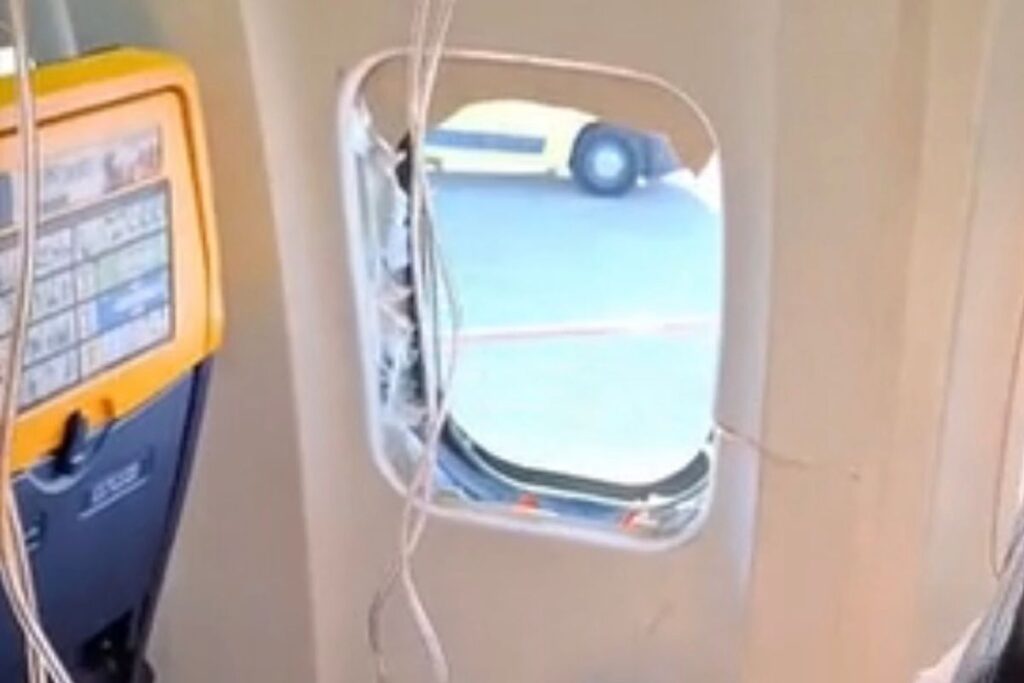
Liberated debris struck the fuselage and shattered a passenger cabin window, causing rapid decompression. A 61-year-old Serbian passenger seated at the window was partially ejected — head and shoulders outside the aircraft — and was held in by his fastened seatbelt while fellow passengers and crew pulled him back inside. He was treated for friction burns and shock. Oxygen masks deployed, the crew executed an emergency descent to 6,000 ft, burned fuel for about 30 minutes, and landed safely back at Thessaloniki about one hour after departure.
Post-flight photos show extensive damage to the right engine: missing and damaged fan blades, a heavily damaged fan/booster section, and punctures in the cowling. Reporting from The Air Current indicates the window rupture was preceded by an apparent fan blade failure. The investigation is led by the Aircraft Accident and Incident Investigation Committee of North Macedonia, supported by Greece’s HARSIA, the NTSB, the FAA, Boeing, and CFM.
Historical Precedents
Southwest 3472 (Aug 2016): CFM56-7B fan blade separated at the dovetail due to fatigue cracking; debris damaged the fuselage; no serious injuries.
Southwest 1380 (Apr 2018): fan blade No. 13 separated at the dovetail from a low-cycle fatigue crack; liberated inlet-cowl debris shattered a window, and a passenger was partially ejected and fatally injured.
Those events led to FAA airworthiness directives mandating ultrasonic and eddy-current inspections of CFM56-7B fan blade dovetails, plus a redesigned inlet to improve fragment containment. A key early question for FR1879: does the blade failure mode resemble the 2016/2018 dovetail cracking, and why did debris defeat the containment provisions?
Fault Tree
Subtlety from Southwest 1380: the object that broke the window was not the fan blade itself but a piece of inlet cowl liberated by the blade impact. Branch E2c may again prove to be the operative path — photos of 9H-QEU show a missing section of the right engine’s forward cowling.
The Ejection Load — Quick Estimate
At 16,000 ft, ambient pressure is about 7.97 psia. Early in the climb the 737’s outflow valve still holds the cabin near a low cabin altitude, so the differential was plausibly 3–4 psid (well below the ≈8 psid cruise differential of Southwest 1380 at FL320). A 737 cabin window opening is roughly 9 in × 12.5 in ≈ 112 in².
F ≈ (3.5 lbf/in²)(112 in²) ≈ 390 lbf initial expulsion load
The transient at pane loss is harsher still: local flow accelerates toward the orifice, and the ~250 kt slipstream drag then acts on any body part outside the mold line — hence the friction burns. The seatbelt converted this from a fatality into an injury. The differential decays within seconds as the cabin blows down toward ambient, which is why fellow passengers could then pull the man back inside.
Vibration & Fatigue Perspective
Fan blades live in a brutal dynamic environment: per-rev aerodynamic excitation from inlet distortion and wake interactions, potential flutter boundaries, and centrifugal mean stress that makes even modest vibratory alternating stress damaging at the dovetail contact, where fretting degrades fatigue capability. The 2016/2018 CFM56-7B events traced to fatigue cracking initiating at the dovetail — precisely the region targeted by the subsequent inspection ADs. Whether FR1879 repeats that mechanism, involves a different blade location, or traces to FOD will be a central investigation finding.
For the underlying methods — S-N fatigue, rainflow cycle counting, resonance, and shock response — see my free ebooks: blog.vibrationdata.com/toms-ebooks · vibrationdata.com
Sources
- CNN — cnn.com/2026/07/10/travel/ryanair-passenger-sucked-out-plane-scli-intl
- CBS News — cbsnews.com/news/man-sucked-out-ryanair-plane-window-greece-flight-witness-says/
- The Air Current (fan blade failure reporting) — theaircurrent.com/feed/dispatches/engine-fan-blade-failure-preceded-rupture-ryanair-737-window-greece/
- Flightradar24 blog (flight profile, engine damage) — flightradar24.com/blog/…/passenger-partially-sucked-out-of-ryanair-malta-air-737/
- Le Monde — lemonde.fr/en/international/article/2026/07/11/man-nearly-sucked-out-of-detached-window-on-ryanair-flight_6755368_4.html