By Tom Irvine
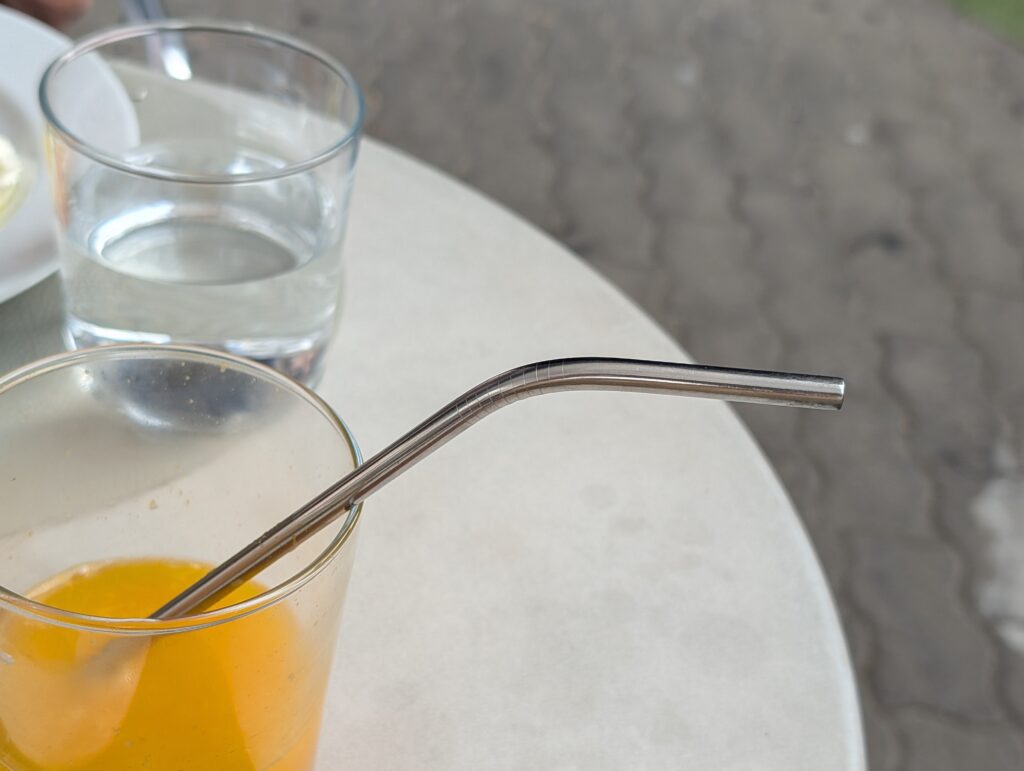
While enjoying a glass of orange juice at an outdoor café in Madeira, Portugal on a sunny Independence Day morning, I noticed the reusable stainless steel straw resting across the glass — its elegant curved bend a perfect reminder that one of the most important phenomena in structural mechanics is hiding in plain sight at breakfast tables worldwide.
That gentle, permanent curve in the straw is the result of plastic deformation and residual stress — the same fundamental mechanics that govern fatigue life in aerospace structures, pressure vessels, and military hardware.
The Geometry of a Bent Straw
The metal straw shown here is fabricated from Type 304 stainless steel tubing, typically with an outer diameter of about 6 mm and wall thickness of approximately 0.5 mm. The bend radius at the elbow is roughly 10–15 mm. This compact geometry is deceptively rich in mechanics.
During manufacture, the tube is bent using a mandrel or rotary draw bender. As the tube is bent around the die, the material on the outer radius experiences tension while the inner radius experiences compression. When the bending load is released — springback occurs — but because the outer and inner fibers have yielded plastically, the material cannot return fully to its original straight shape. A permanent curvature remains, along with a locked-in distribution of residual stress.
Elastic–Plastic Bending Theory
For a tube in pure bending, the longitudinal (axial) stress at a fiber located at distance \( y \) from the neutral axis is given by the elastic flexure formula:
\[ \sigma = \frac{M \, y}{I} \]
where \( M \) is the applied bending moment and \( I \) is the second moment of area of the cross-section. For a thin-walled tube of outer radius \( R_o \) and inner radius \( R_i \):
\[ I = \frac{\pi}{4}\left(R_o^4 – R_i^4\right) \]
The maximum elastic stress occurs at the outermost fiber \( y = R_o \). Yielding initiates when this stress reaches the yield strength \( \sigma_y \), defining the elastic moment limit:
\[ M_y = \frac{\sigma_y \, I}{R_o} \]
Beyond \( M_y \), the yielded zones spread inward from both outer and inner surfaces. The stress distribution transitions from linear (elastic core) to a stepped profile, with the outer fibers capped at \( \pm \sigma_y \) and sometimes extending into strain hardening if the material is not perfectly plastic.
For a fully plastic cross-section (plastic hinge), the plastic moment is:
\[ M_p = \sigma_y \, Z_p \]
where \( Z_p \) is the plastic section modulus. The ratio \( f = M_p / M_y \) is the shape factor, which for a hollow circular cross-section is typically in the range 1.27–1.40.
Springback and the Origin of Residual Stress
When the bending tool is released, the applied moment drops to zero. However, the elastic portion of the strain recovers — this is springback. The elastic springback moment is equivalent in magnitude but opposite in sign to the applied moment, superimposed elastically onto the plastic stress distribution. The residual stress field \( \sigma_r(y) \) is therefore:
\[ \sigma_r(y) = \sigma_\text{plastic}(y) – \frac{M \, y}{I} \]
where the second term represents the elastic springback stress distribution. The result is a self-equilibrating residual stress pattern — tensile on one face, compressive on the other — with no net bending moment:
\[ \int_A \sigma_r(y) \, dA = 0, \qquad \int_A \sigma_r(y) \, y \, dA = 0 \]
For our stainless steel straw, the outer radius of the bend retains compressive residual stress (the outer fiber overstretched during bending, springback pulls it back into compression), while the inner radius retains tensile residual stress. This is the opposite of the loading-induced distribution during the bend — a counterintuitive but important result.
Why Residual Stress Matters for Fatigue
Residual stresses are invisible to the naked eye, but they profoundly affect fatigue life. A compressive residual stress reduces the effective mean stress at a crack initiation site, decreasing the stress ratio:
\[ R = \frac{\sigma_{min}}{\sigma_{max}} \]
A more negative \( R \) suppresses crack opening and slows crack growth. This is the operating principle behind shot peening, laser shock peening, and autofrettage — all industrial processes deliberately engineered to introduce beneficial compressive residual stresses at fatigue-critical surfaces.
The modified Goodman relation for mean stress correction is:
\[ \frac{\sigma_a}{S_e} + \frac{\sigma_m}{S_u} = 1 \]
where \( \sigma_a \) is the alternating stress amplitude, \( \sigma_m \) is the mean stress (which includes any residual component), \( S_e \) is the endurance limit, and \( S_u \) is the ultimate tensile strength. A compressive residual stress reduces \( \sigma_m \), moving the operating point away from the failure line and extending fatigue life. A tensile residual stress does the opposite — it is detrimental.
For our straw, the inner-radius tensile residual stress is a concern if the straw experiences repeated bending in service. Cracks, if they initiate on the inner radius at the bend (already the highest stress concentration location in bending), do so with a tensile residual bias — reducing fatigue life relative to an unstressed tube.
Residual Stress in Aerospace Structures
The same principles that govern the straw’s bent elbow apply at a vastly larger scale in aerospace engineering. Consider the following examples:
Fuselage Skin Panels
Aluminum alloy 2024-T3 fuselage skins are cold-worked at fastener holes to introduce compressive residual stress, extending the fatigue life at these stress concentration sites. The Aloha Airlines Flight 243 accident (1988) demonstrated the catastrophic consequence of multi-site damage when fuselage lap joints reached the end of their fatigue life — residual stress management is central to damage tolerance design.
Turbine Blade Root Dovetails
Titanium fan blade dovetail roots are shot-peened to impose compressive residual stresses. This is especially critical given titanium’s susceptibility to cold dwell fatigue — a phenomenon where sustained tensile stress at dwell loads activates the Stroh mechanism, driving slip band cracking along grain boundaries. Compressive residual stresses partially counteract the dwell tensile loading, reducing the effective stress intensity at incipient cracks.
Pressure Vessel Autofrettage
Gun barrels and hydraulic pressure vessels are deliberately over-pressurized during manufacture to plastically deform the bore material, leaving the inner wall in compression. When in-service pressure is subsequently applied, the compressive residual stress must first be overcome before net tensile stress develops — dramatically increasing burst pressure and fatigue life.
Measuring Residual Stress
Unlike applied stresses, residual stresses cannot be measured by load cells or strain gauges in a simple way. Common experimental methods include:
- X-Ray Diffraction (XRD): Measures lattice plane spacing changes; Bragg’s law \( \lambda = 2d\sin\theta \) yields strain, converted to stress via Hooke’s law. Surface method, penetration depth ~10–50 μm.
- Neutron Diffraction: Deeper penetration (mm to cm), suitable for bulk residual stress mapping in thick components.
- Hole Drilling: A small blind hole is drilled; the resulting strain relief is measured by a rosette gauge. ASTM E837 standard governs the procedure.
- Slitting/Crack Compliance: A slot is progressively cut; the released strains are integrated to back-calculate the residual stress profile through thickness.
- Contour Method: A part is cut by wire EDM; the out-of-plane surface contour is mapped and used with FEA to determine the residual stress normal to the cut plane.
For our humble stainless steel straw, XRD would be the appropriate technique — and indeed, manufacturing quality control for medical-grade stainless tubing often involves XRD spot-checks at bent sections.
Vibration and Residual Stress: A Dynamic Angle
Residual stress interacts with vibration in subtle but important ways. In structural dynamics, the natural frequency of a beam under axial stress is modified by the geometric stiffness effect. For a simply supported beam with axial compressive load \( P \), the modified natural frequency is:
\[ f_n = f_{n,0} \sqrt{1 – \frac{P}{P_{cr}}} \]
where \( f_{n,0} \) is the natural frequency at zero axial load and \( P_{cr} \) is the Euler buckling load. Residual stress acts as a distributed internal “axial load,” shifting natural frequencies. Techniques such as vibration-based residual stress estimation exploit this effect — measuring frequency shifts before and after stress relief annealing to infer residual stress magnitude.
Conversely, vibratory stress relief (VSR) is an industrial process in which a structure is vibrated at resonance frequencies to redistribute and partially relax residual stresses — an alternative to thermal stress relief in large weldments where furnace treatment is impractical.
Even our stainless straw participates in this dance: tapping the straw on the table glass excites its flexural modes, and an accelerometer measurement (were one small enough to attach) would reveal the natural frequencies at the bent elbow — subtly shifted by the residual stress locked in from manufacture.
Material Considerations: Type 304 Stainless Steel
Type 304 austenitic stainless steel (nominally 18% Cr, 8% Ni) is the standard material for reusable drinking straws. Its relevant mechanical properties are:
| Property | Value |
|---|---|
| Young’s Modulus \( E \) | 193 GPa |
| Yield Strength \( \sigma_y \) (annealed) | 215 MPa |
| Ultimate Tensile Strength \( S_u \) | 505 MPa |
| Elongation at fracture | ~40% |
| Strain hardening exponent \( n \) | ~0.34 |
| Density \( \rho \) | 7,900 kg/m³ |
The high elongation and strain hardening capacity of 304 SS mean that significant plastic strains can accumulate during bending without fracture — and the Ramberg–Osgood constitutive relation captures the elastic–plastic stress–strain response:
\[ \varepsilon = \frac{\sigma}{E} + \alpha \left(\frac{\sigma}{\sigma_y}\right)^n \frac{\sigma_y}{E} \]
where \( \alpha \) is a fitting constant (typically 0.002 for the 0.2% offset convention). This nonlinear response is what enables the permanent bend — and the locked-in residual stress — to exist.
Environmental Considerations: Stress Corrosion Cracking
In coastal environments like Madeira — classified as ISO 9223 Category C5 (very high corrosivity) — the combination of residual tensile stress and chloride-laden sea air raises the specter of stress corrosion cracking (SCC). Type 304 stainless steel is susceptible to chloride SCC when residual tensile stresses exceed a threshold stress intensity \( K_{ISCC} \).
The SCC crack growth rate is governed by:
\[ \frac{da}{dt} = C_{env} \, K^m \quad \text{for } K > K_{ISCC} \]
where \( a \) is crack length, \( K \) is the stress intensity factor, and \( C_{env} \), \( m \) are environment-dependent material constants. The inner-radius tensile residual stress at the straw’s bend — combined with crevice conditions at the straw-lip contact zone — creates a locally aggressive environment. Type 316L (with added molybdenum) is preferred over 304 in marine applications for precisely this reason.
For a drinking straw this concern is academic, but for a structural tube in a coastal offshore platform or a marine heat exchanger, the analogous geometry demands careful material selection and residual stress management.
Summary
A reusable stainless steel straw, bent elegantly at its drinking elbow, encapsulates an entire graduate-level curriculum in solid mechanics and structural durability:
- Elastic–plastic bending and the progression from elastic to fully plastic moment capacity
- Springback mechanics and the formation of self-equilibrating residual stress fields
- The influence of residual stress on fatigue life via mean stress modification (Goodman criterion)
- Industrial applications of intentional compressive residual stress: shot peening, laser shock peening, autofrettage
- Experimental methods for residual stress measurement: XRD, neutron diffraction, hole drilling, contour method
- Dynamic coupling: frequency shifts due to geometric stiffness and vibratory stress relief
- Environmental interaction: stress corrosion cracking in chloride-rich coastal environments
Next time you sip through a metal straw, you are holding a precision-engineered artifact of materials science — one whose invisible internal stress state tells the complete story of its manufacture, its remaining fatigue life, and its environmental vulnerability.
References and further reading available at vibrationdata.com. Related posts: Aluminum Fuselage Corrosion Fatigue; Stress Corrosion Cracking and Fracture Mechanics; Titanium Cold Dwell Fatigue.
Looking for a deep dive on this topic? Explore our comprehensive guide and resource collection on the Residual Stress & Structural Integrity Hub.
Thanks.