A small avionics box is held down by six bolts. The shock spec calls for 100 G on each axis, the drawing calls for a torque, and somebody has to show that the bolts survive. That one question is really several. How much preload does the torque actually give? How is the shock load shared among the bolts? Does the joint stay clamped? Do the threads strip first? Will the bolt survive the cycling? And what happens when the torque wrench delivers the high end of its scatter rather than the nominal value?
The bolt_calculations_a app in the Vibrationdata Matlab GUI package now covers each of those steps in its own tab. I have prepared two slide decks that walk through the methods and a complete worked example, one in English units and one in metric. This post gives an overview.
Download the slides:
Bolt Joint Calculations, English Units, Revision A (PowerPoint, 37 slides)
Bolt Joint Calculations, Metric Units, Revision A (PowerPoint, 37 slides)
Bolt Calculations GUI, Worked Examples, Revision B (PowerPoint, 21 slides): four examples checked against hand calculations, including bolt fatigue by the Goodman method
NINE TABS
The app (version 1.13 as of November 22, 2026) has nine tabs:
- Bolt Preload: recommended preload from the proof strength, F = c At Sp, with c = 0.75 for reused connections and 0.90 for permanent ones. Unified sizes #2 through 1-1/2 inch, or ISO metric M3 through M39.
- Bolt Torque Preload: the short-form relation T = K D Fp, solved for torque, preload or diameter.
- Torque Scatter: the preload range produced by a torque specification, including the torque tolerance, the uncertainty of the tightening method and relaxation.
- Joint Stiffness: bolt stiffness from the shank and threaded lengths, member stiffness from 30° pressure cones (frusta) for members of different materials or a tapped hole, and the joint constant C = kb/(kb + km).
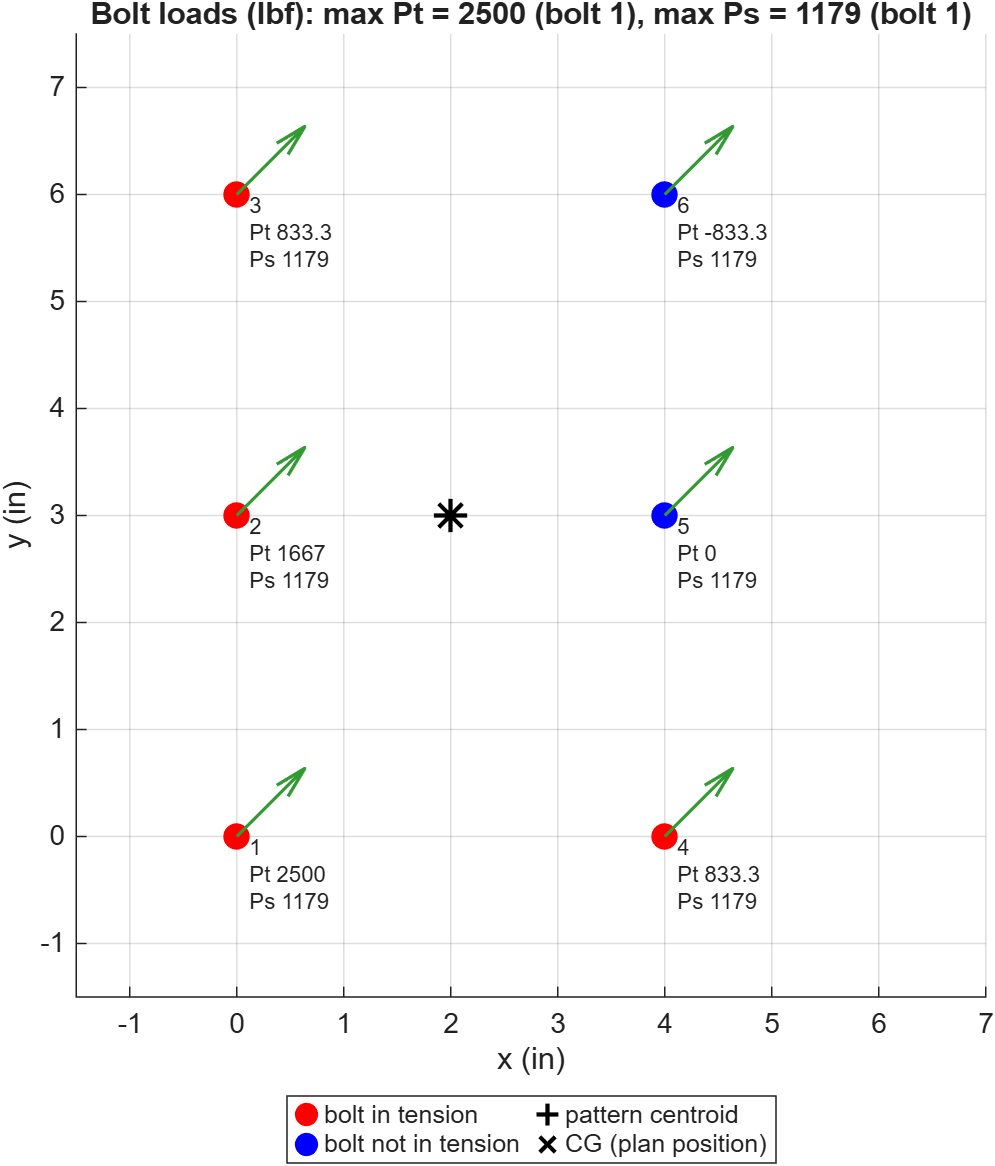
- Bolt Pattern: tension and shear in each bolt of an arbitrary pattern for a load m g G applied at the CG.
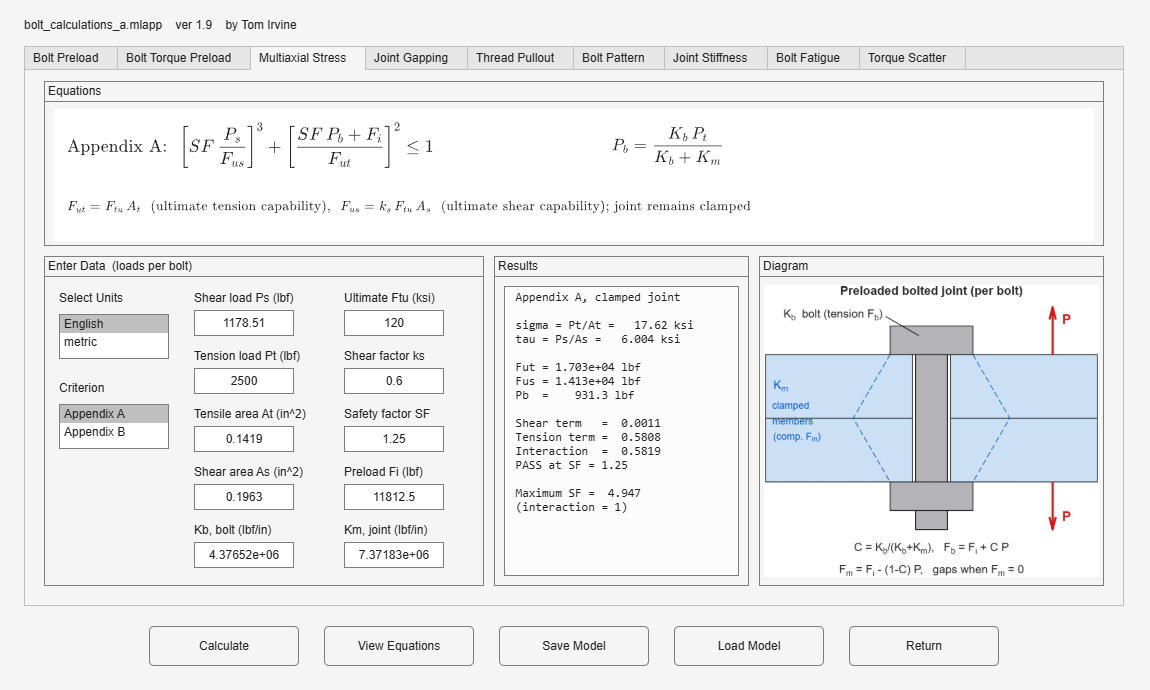
- Multiaxial Stress: combined tension and shear interaction at a safety factor, per Appendices A and B of my earlier paper Shock Analysis of Avionics Mounting Bolts.
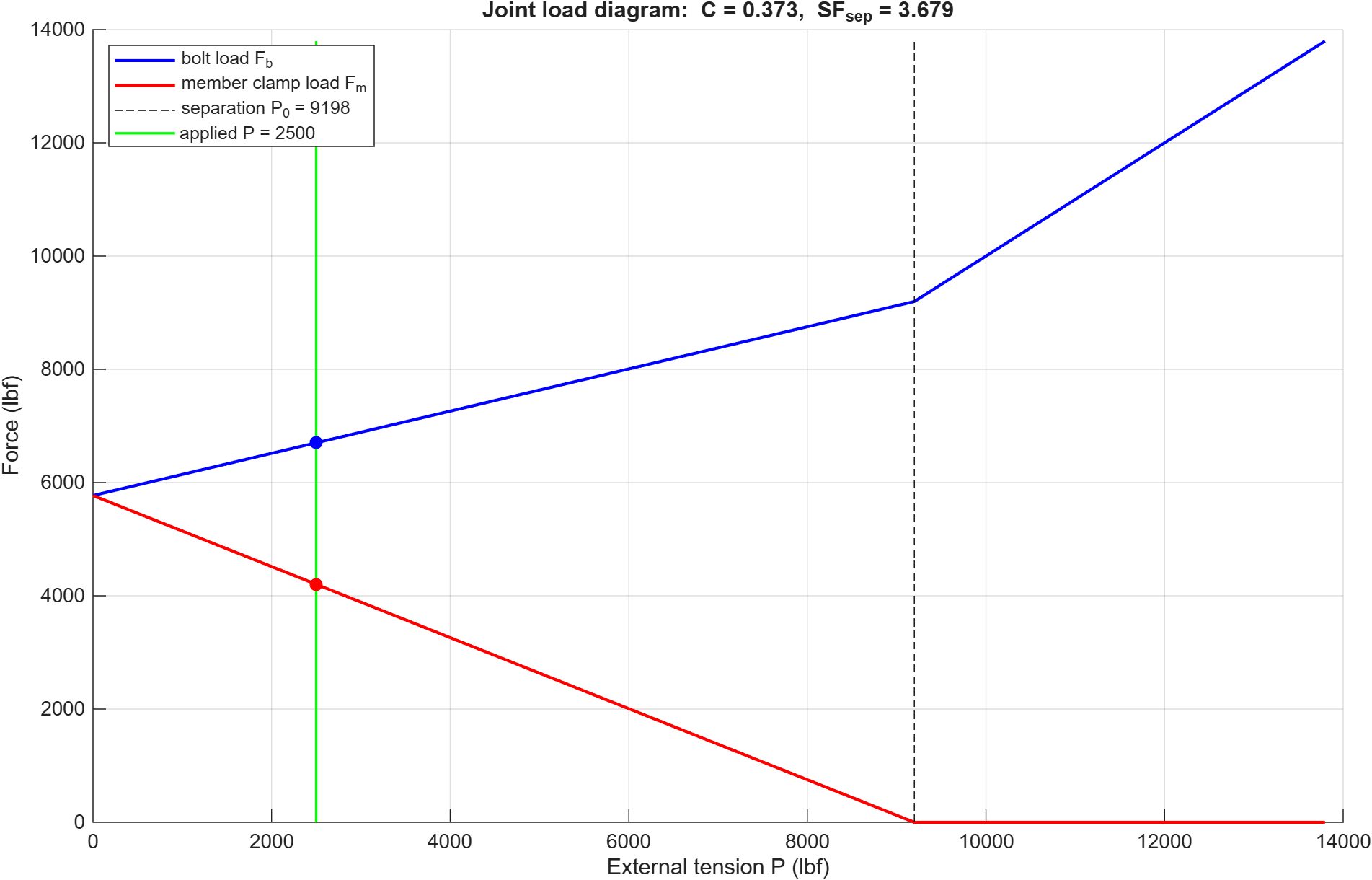
- Joint Gapping: separation load P0 = Fi/(1 − C) and the separation safety factor.
- Thread Pullout: stripping strength from the thread shear area, entered or calculated from the thread diameter limits.
- Bolt Fatigue: Goodman safety factor for a preloaded bolt and the yield (proof) check.
Every tab has its own English or metric selection, an equation strip, and a diagram or table. View Equations opens a PDF with the derivations and references. Save Model and Load Model store all nine tabs in one file. Plots open in separate windows.
THE TABS TALK TO EACH OTHER
Three tabs have Send buttons that pass their results, converted to the receiving tab’s units, to the checking tabs:
- Torque Scatter sends the minimum preload to Joint Gapping, because the lowest clamp force governs separation, and the maximum preload to Multiaxial Stress, Thread Pullout and Bolt Fatigue, because the highest preload governs bolt stress.
- Joint Stiffness sends kb and km to the four checking tabs.
- Bolt Pattern sends the maximum bolt tension and shear.
Using the minimum preload for one check and the maximum for another is easy to forget when the calculations are done by hand. Here it is built into the workflow.
THE WORKED EXAMPLE
Both decks follow one joint through every tab in order. The English version is:
| Item | Value |
|---|---|
| Component | 50 lbm, CG at (2, 3) in, 2 in above the mounting surface |
| Load | 100 G on x, y and z at the same time (illustrative) |
| Bolts | Six 1/2″-13 UNC, SAE J429 Grade 5, on a 4 × 6 in pattern |
| Members | 0.50 in steel under the head, 0.75 in aluminum under the nut |
| Tightening | Torque wrench, 900 in-lbf ± 5 percent, K = 0.2, preload uncertainty ± 25 percent |
The metric deck uses a parallel case: a 25 kg component on six M12×1.75 class 8.8 bolts with an 88 N·m torque. Every result in both decks is checked against an independent hand calculation, which is shown on its own slide before the GUI screenshot.
The results for the English example:
- Target preload 9,046 lbf, which needs about 905 in-lbf. The torque spec is rounded to 900 in-lbf.
- Preload range from that torque: 5,771 to 11,812 lbf, a ratio of 2.05.
- Joint constant C = 0.37 for the steel and aluminum stack.
- Most heavily loaded bolt: 2,500 lbf tension and 1,179 lbf shear.
- Multiaxial interaction 0.58 at SF = 1.25, a pass, with a maximum SF of 4.9.
- Separation safety factor 3.68 with the minimum preload.
- Thread pullout safety factor 11. The joint gaps before the threads strip.
THE CATCH: TORQUE SCATTER
Everything passes except one check, and that one is the most instructive. At the maximum preload of 11,812 lbf, the bolt is already at 98 percent of its proof load before any external load is applied. Add the bolt’s share of the shock load and the yield safety factor drops to 0.946. The fatigue check gives nf = 1.50, with an assumed endurance strength.
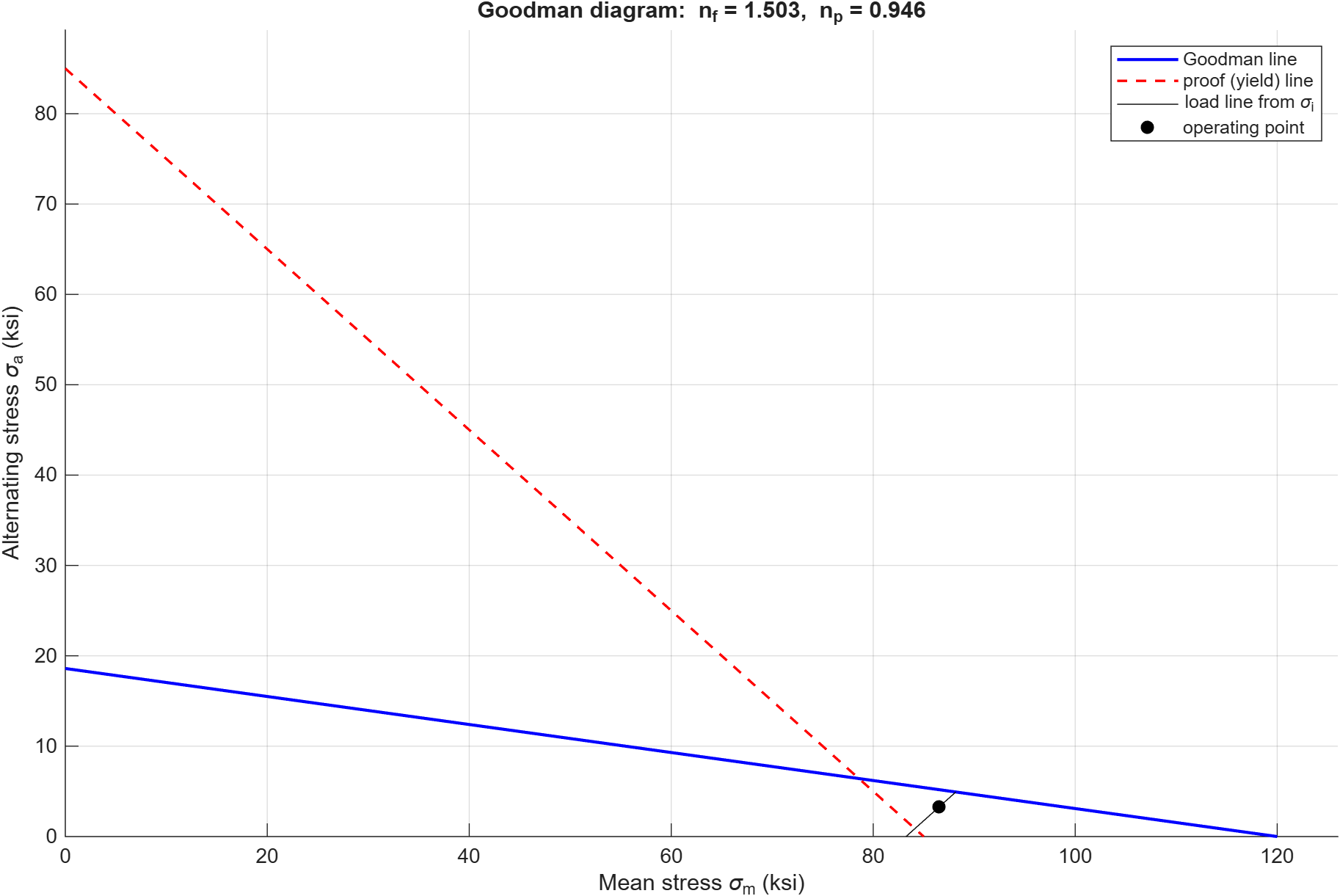
Nothing is wrong with the nominal design. A torque specification aimed at 75 percent of proof is standard practice. The problem is the ± 25 percent scatter of an ordinary torque wrench. The fixes are to lower the torque, which the separation check can afford, or to tighten more accurately. Turn-of-nut is about ± 15 percent, and a load-indicating washer about ± 10 percent. The metric example shows the same result, with np = 0.927.
SOURCES
The app uses public-domain methods only:
- Shigley’s Mechanical Engineering Design, for preload, joint stiffness, separation and Goodman fatigue.
- Machinery’s Handbook, for thread shear areas.
- ASME B1.1 and ISO 898-1, for thread data.
- NASA RP-1228, for fastener groups.
- Sandia SAND2008-0371.
- MechaniCalc, for preload accuracy by tightening method.
- NASA-STD-5020B.
Full references are on the last slide of each deck and in the View Equations PDF. Values in the example that are not from a cited table, such as the endurance strength and the thread shear ultimate, are labeled as assumed inputs. Replace them with your own project values.
The app is part of the Vibrationdata Matlab Signal Analysis & Structural Dynamics Package. Please send me an email if you have questions or suggestions for additional tabs.
Tom Irvine
More stand-alone Matlab GUIs: Matlab Engineering GUI Packages Hub
Learn This in a Live Course
Bolted joint fatigue, preload under vibration, and the stress analysis behind this GUI are covered in the Fatigue and Structural Dynamics & FEA courses. The February 2027 series includes live one-hour classes, IACET CEUs, recorded sessions and slides. See the schedule and fees or register here.