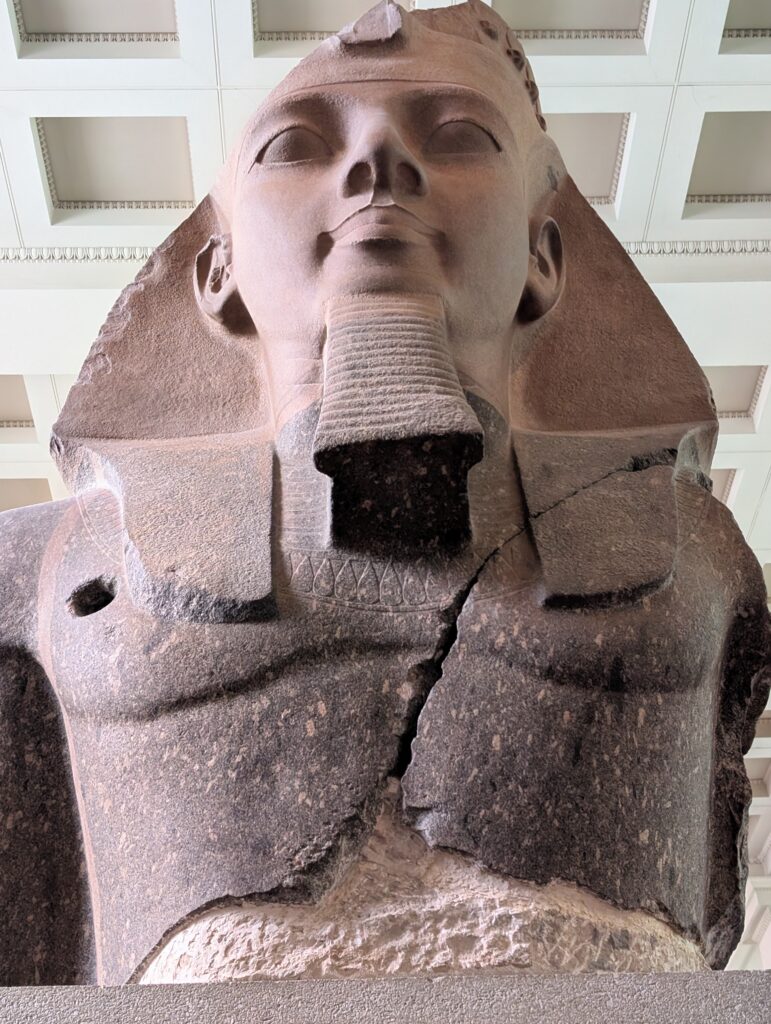
The Ramesses II bust (Younger Memnon), British Museum, Room 4. The large diagonal fracture across the chest is clearly visible. A circular hole, likely an ancient lifting attachment point, is visible on the left side of the chest. Photograph by Tom Irvine, July 2026.
Standing in Room 4 of the British Museum, it is impossible to miss the crack. The Ramesses II bust — known formally as the Younger Memnon (EA19), carved around 1250 BCE from a single block of two-toned granodiorite — displays a large diagonal fracture running across its chest. The statue has survived roughly 3,270 years, multiple seismic events, two thousand miles of sea transport, and the London climate. It has not been repaired in any structural sense. And yet it stands.
This post examines why — through the lens of fracture mechanics.
The Object
The Younger Memnon was quarried at Aswan from granodiorite, a coarse-grained igneous rock mineralogically similar to granite. It was removed from the Ramesseum temple complex at Luxor in 1821 by Giovanni Belzoni on behalf of the British Consul Henry Salt, transported down the Nile and across the Mediterranean, and has been on display at the British Museum since 1827. The bust stands approximately 2.67 m tall and weighs roughly 7.25 tonnes.
The diagonal fracture across the chest is not a conservation artifact — it predates the British Museum’s acquisition. Its precise origin is unknown, but transport shock is the most probable cause.
Material Properties of Granodiorite
Before analyzing the crack, it helps to understand the material. Granodiorite is a coarse-grained plutonic rock composed primarily of quartz, feldspar, and hornblende. Its mechanical properties differ sharply from structural metals:
| Property | Granodiorite | Mild Steel (for reference) |
|---|---|---|
| Compressive strength | 130–200 MPa | ~250 MPa (yield) |
| Tensile strength | 7–15 MPa | ~400 MPa (UTS) |
| Young’s modulus | 40–70 GPa | 200 GPa |
| Fracture toughness \( K_{Ic} \) | 0.8–2.0 MPa√m | 50–100 MPa√m |
| Density | 2,700–2,800 kg/m³ | 7,850 kg/m³ |
| Poisson’s ratio | 0.20–0.25 | 0.29 |
The fracture toughness contrast is stark. Granodiorite has \( K_{Ic} \approx 1 \) MPa√m, roughly 50 to 100 times lower than structural steel. Once a crack initiates, very little additional stress intensity is needed to propagate it. The material is inherently brittle.
Why Did the Crack Arrest?
Given the low fracture toughness, the interesting question is not why the crack formed — it is why the crack stopped. Four mechanisms are likely responsible.
1. Gravity-Induced Crack Face Compression
The fracture plane runs diagonally across the chest, oriented roughly 30–45° from horizontal. Under self-weight loading, the stress field normal to this plane is compressive. Compressive normal stress reduces the Mode I stress intensity factor:
\[ K_I = \sigma_{\text{net}} \sqrt{\pi a} \cdot F(a/W) \]
When \( \sigma_{\text{net}} \leq 0 \), the crack faces are pressed together and \( K_I \leq 0 \). A crack cannot propagate in pure compression. Gravity effectively clamps the fracture shut.
2. Grain-Scale Interlocking and Friction
Granodiorite’s coarse grain structure (millimeter-scale feldspar and quartz crystals) creates a rough fracture surface with significant geometric interlocking. The friction coefficient at granite-family rock interfaces is typically \( \mu = 0.6 \)–\( 0.8 \). This interlocking provides shear resistance across the crack plane and dissipates any residual Mode II or Mode III stress intensity.
3. Load Path Redistribution
As the crack propagated, the local compliance increased, causing stress redistribution to the intact material on either side of the crack tip. This is analogous to the crack-tip plastic zone in metals — except that in stone, the redistribution is elastic and geometric rather than plastic. The crack tip stress intensity dropped as the crack grew, rather than accelerating as it might in an unconstrained tensile specimen.
4. High Paris Exponent Suppresses Sub-Critical Growth
Paris Law describes sub-critical fatigue crack growth:
\[ \frac{da}{dN} = C \left( \Delta K \right)^n \]
For metals, \( n \approx 2 \)–\( 4 \). For granite-family rocks, \( n \approx 20 \)–\( 40 \). The extremely high exponent means that crack growth rate falls off very sharply as \( \Delta K \) decreases. Once the crack tip stress intensity dropped below a threshold — which it did, due to gravity clamping and load redistribution — sub-critical growth became negligible over any engineering timescale.
The Circular Hole: An Accidental Stop-Drilling Analogue
A circular hole is visible on the left side of the chest. This is almost certainly an ancient Egyptian lifting or attachment point — used with ropes and wooden beams during transport or ritual placement, a standard practice documented at multiple New Kingdom sites.
But from a fracture mechanics perspective, this geometry is instructive. A circular hole at a crack tip redistributes the stress field, replacing the sharp singular stress concentration of a crack tip (where \( K_I \to \infty \) as the tip radius \( \rho \to 0 \)) with the finite stress concentration of a circular hole:
\[ K_t = 3 \quad \text{(for a circular hole in an infinite plate under uniaxial tension)} \]
This is precisely the geometric principle behind stop drilling — intentionally drilling a hole at a fatigue crack tip to arrest propagation by eliminating the stress singularity. The Egyptian lifting hole achieves the same geometry, entirely by coincidence.
A companion post on this site discusses stop drilling in detail, including the Liberty Bell as a historical case study.
Transport Shock as the Probable Fracture Origin
The crack almost certainly did not form during normal service at the Ramesseum. A standing statue subject only to dead load and low-amplitude seismic excitation would have remained intact — the self-weight stress field is compressive and the ambient \( \Delta K \) is negligible.
The most probable fracture event is transport shock. Belzoni’s 1821 removal involved dragging the bust on wooden sledges over rough terrain, lowering it down riverbanks, and loading it onto a barge. Any of these operations could have generated a short-duration impulsive load with a tensile component transverse to the eventual crack plane.
Under dynamic loading, the effective stress intensity is amplified by the dynamic stress intensity factor \( K_I^{\text{dyn}} \), which can exceed the quasi-static value significantly for high loading rates. If \( K_I^{\text{dyn}} \) briefly exceeded \( K_{Ic} \approx 1 \) MPa√m, the crack would have initiated and propagated at crack velocities on the order of 30–50% of the Rayleigh wave speed. Arrest occurred when the transient stress field dissipated and gravity reasserted compressive clamping.
Conservation Engineering at the British Museum
The British Museum’s conservation practice for large Egyptian stone objects includes several engineering measures relevant to structural integrity:
- Photogrammetry crack mapping: Three-dimensional surface models are used to monitor crack geometry and detect any sub-millimeter changes in crack opening displacement over time.
- Environmental monitoring: Temperature and relative humidity cycling drive differential thermal expansion across the crack faces. Monitoring ensures that seasonal cycles remain within safe limits.
- Vibration monitoring: Floor vibration from foot traffic and HVAC equipment is measured and managed to keep dynamic stress amplitudes well below any threshold for sub-critical crack growth.
- Internal consolidation: For severely fractured pieces, hidden stainless steel rods drilled through the core and epoxy-grouted provide supplemental tensile capacity. Whether this has been applied to the Younger Memnon is not publicly documented.
Structural Engineering Lessons
The Ramesses II bust offers four durable lessons for structural engineers:
- Compressive stress fields arrest brittle cracks. Designing structures so that the dominant service load keeps crack planes in compression is a fundamental crack arrest strategy — exploited in prestressed concrete, autofrettaged gun barrels, and shot-peened aerospace components.
- Microstructure governs toughness. The coarse interlocking grain structure of granodiorite provides crack surface friction and bridging that a finer-grained or more homogeneous material would not. Material selection at the microstructural level matters.
- Geometric singularities concentrate damage. Whether it is a sharp crack tip, a notch, or a re-entrant corner, singular stress concentrations are where failures initiate. The circular lifting hole — whatever its original purpose — reduces the local stress concentration relative to a sharp crack tip.
- Brittle cracks do not heal. Unlike fatigue damage in some polymer composites, a through-crack in granodiorite is permanent. The statue will carry this fracture for as long as it stands. Structural interventions must work with the cracked geometry, not assume recovery.
Closing Thought
The Younger Memnon has been cracked for at least 200 years and possibly for over 3,000. It remains structurally coherent because the physics favor it: gravity clamps the crack shut, the rough fracture surfaces interlock, and the high Paris exponent makes sub-critical fatigue growth negligible. It is not in spite of its age that it stands — it is in part because of what 3,270 years of gravitational preload have done to the crack face stress field.
Fracture mechanics did not exist as a discipline until the twentieth century. Granodiorite followed its rules regardless.
Tom Irvine is the author of VibrationData and teaches professional courses in structural dynamics, shock, vibration, and acoustics. See vibrationdata.com for course listings and free technical resources.