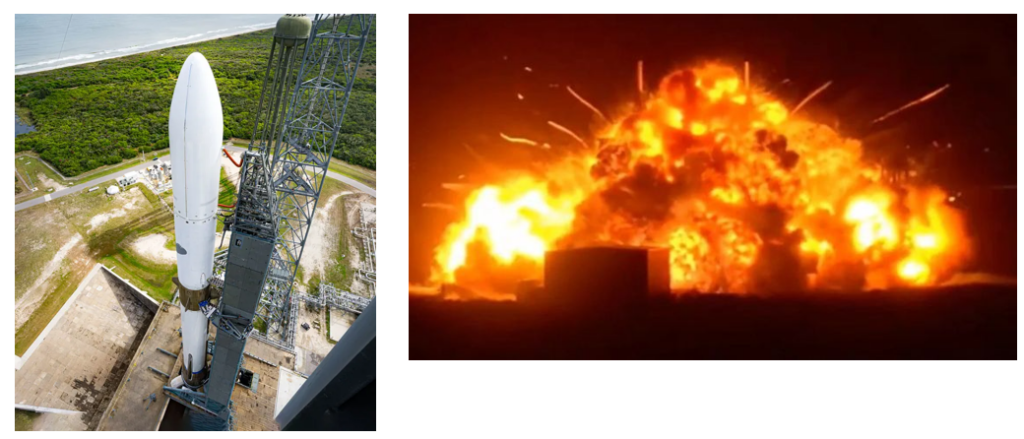
Tough day for Blue Origin’s New Glenn. Blue Origin was performing a static fire (hotfire) test ahead of an anticipated fourth launch — the rocket was likely fully fueled, contributing to what is described as one of the largest rocket explosions in U.S. history. Blue Origin, local officials, and news organizations continue to report that all personnel were accounted for and no injuries occurred. No payload was aboard.
For a pad static fire test, the data picture is actually pretty good compared to a flight anomaly for data recovery.
Telemetry: Static fire tests are heavily instrumented events. All engine health data (chamber pressure, turbopump speeds, propellant flow, valve positions, temperatures) would be telemetered in real time to the Launch Control Center and likely to offsite data servers. That data was almost certainly captured up to the moment of the anomaly — and the last few hundred milliseconds before initiation are the most valuable for root cause.
Ground-based DAQ: The pad itself would have extensive hardwired instrumentation — load cells, accelerometers, strain gauges on the hold-down structure, facility sensors, high-speed cameras. Much of this runs on ground DAQ systems in hardened or separated facilities. Survival depends on proximity to the fireball and whether the data was being streamed/logged offsite in real time.
Flight computers/onboard recorders: These are gone. No survivable black box equivalent exists on an expendable or recoverable rocket at this stage of development.
High-speed cameras: Multiple ground and remote cameras were running. Frame-by-frame analysis of the initiation sequence will be a major diagnostic tool — similar to Challenger’s SRB joint photography. Given that civilian cameras from miles away caught it clearly, Blue Origin’s dedicated camera array almost certainly has high-resolution footage of the ignition sequence.
Homes shook in nearby Cape Canaveral and Cocoa Beach, with residents turning to social media to report the event. That’s a clear indicator of significant acoustic/blast overpressure propagating several miles from Launch Complex 36.
Officials warned that debris from the explosion could wash ashore on nearby beaches for days or weeks. This indicates that fragments were dispersed over a wide area.
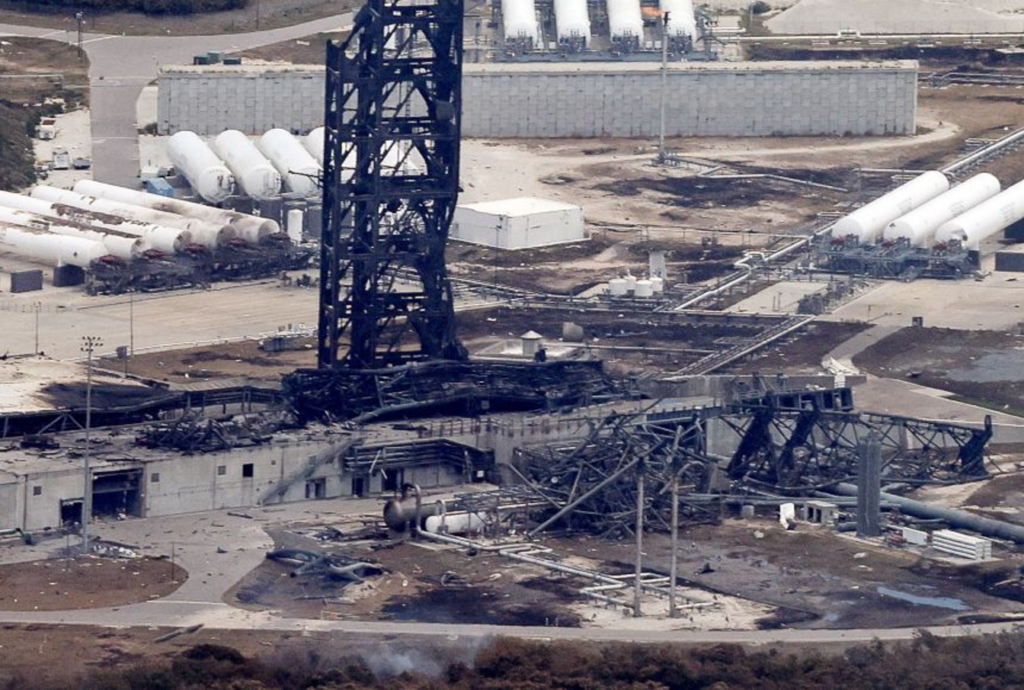
As the smoke cleared, there was no sign of the erector-gantry used to move New Glenn from its hangar to the pad, and one of two tall lightning towers was no longer visible. Helicopter footage showed multiple fires and apparently severe damage.
__________
The FAA oversaw and accepted findings from a Blue Origin-led investigation into the prior NG-3 failure (April 19, 2026). The final mishap report identified the direct cause as a cryogenic leak that froze a hydraulic line, leading to a thrust anomaly during the second stage engine burn. Blue Origin identified nine corrective actions, and the FAA was set to verify their implementation before the next mission. The May 28 static fire was NG-4 — Blue Origin had just received FAA clearance to proceed based on those corrective actions, making the explosion particularly striking.
See also:
Launch Vehicle Static Fire Test Explosion Fault Tree
– Tom Irvine
📌 Related Earthquake Engineering Knowledge Hub
This article is featured in our main Earthquake Engineering & Structural Dynamics Hub . Visit the hub to explore related articles on shock response spectra, time history analysis, seismic equipment qualification, and structural case studies.