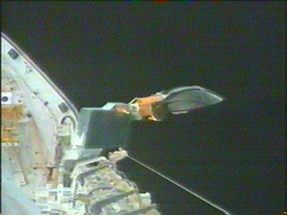
Figure 1. Space Shuttle Orbiter Ku-band Antenna
Introduction
Mechanical vibration is usually undesirable in a structure because it can lead to fatigue and other types of failures. Vibration does have its beneficial uses, however. For example, dither vibration was used to ensure that the Space Shuttle’s Ku-Band antenna operated properly. This vibration was a concern for microgravity experiments, on the other hand.
Dither is a British colloquialism for “undecidedness.” It comes from the Middle English verb didderen meaning “to tremble.”
The term dither in engineering has several meanings, which are somewhat related. Here are three examples;
- Dither is a low level random noise added to an audio signal to mask digital distortion.
- Dither is a vibration employed in some mechanical systems to avoid stiction and to ensure smooth motion. Stiction is short for static friction.
- Dither is a small vibration of a solenoid current superimposed over the average value. It has the purpose of reducing the hysteresis or sticking of a valve by keeping its moving parts vibrating.
Historical Background
The following account is based on an article by Nika Aldrich.
The British naval air fleet had problems with their navigation systems during World War II. These systems were analog computers that used cranks, gears, and cogs, somewhat similar to the mechanisms in an antique grandfather’s clock. Unfortunately, the gears and cogs would operate in a sluggish manner due to internal static friction. The system was thus difficult to calibrate prior to flight.
The navigation systems, however, gave better performance once the aircraft was airborne.
Engineers determined that the vibrations from the planes engines were in effect “lubricating” the cogs and gears, so that the system worked more properly and predictably.
This “noise” added to the system helped the accuracy of the system by removing the opportunity for the gears to stick. As a result, the British installed small motors on their navigation systems to vibrate the mechanisms on the ground during preflight calibration.
The vibration of the motors added to the navigation systems provided “dither” to help the rigid cogs and gears operate more fluidly.
Space Shuttle Orbiter Ku-band Antenna
The Orbiter Ku-band antenna system was used to transmit voice, data, and video images to the ground via the Tracking and Data Relay Satellite System (TDRSS).
The Ku-band antenna supplemented the S-band antenna system. The Ku-band antenna could transmit data at a higher rate that the S-band system, but the S-band antenna had a larger beam width.
The Ku-band antenna could also be used as a radar system for tracking objects in space.
This antenna was located in the payload bay. It was used only after the Orbiter had reached its orbit and opened its payload doors.
The deployed assembly consisted of a two-axis, gimbal-mounted, high-gain antenna; an integral gyro assembly; and a radio frequency electronics box.
The gimbal motors positioned the Ku-band antenna. The rate sensors determined how fast the antenna was moving.
The antenna was a parabolic dish, 3 feet in diameter, made from graphite epoxy.
Antenna Dither
The Ku-band antenna was dithered via a command signal at a frequency of 17 Hz to maintain its ability to smoothly search for and track the TDRSS satellites.
The dithering was intermittent, depending on a number of factors.
The 17 Hz dither frequency is clearly seen in acceleration data collected on-orbit, when the dither is on, as shown in Figure 2.
The dither may also have integer harmonics at 34 and 51 Hz as shown in Figure 3.
Additional frequencies are given in Table 1. Each of these frequencies may affect the performance of microgravity experiments.
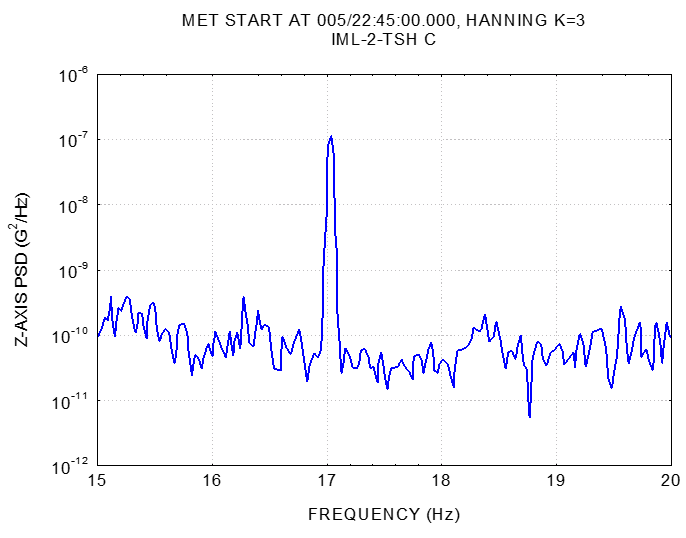
Figure 2. Power Spectral Density Plot
The overall level is 80 micro G, over the domain shown in the figure.
The data is from the STS-65 mission on the Columbia Orbiter. The Orbiter carried the International Microgravity Laboratory (IML-2).
The vibration level is a concern because it could interfere with crystal growth, dendritic solidification of molten materials, and other microgravity experiments.
Reference: TM-1999-209048.pdf
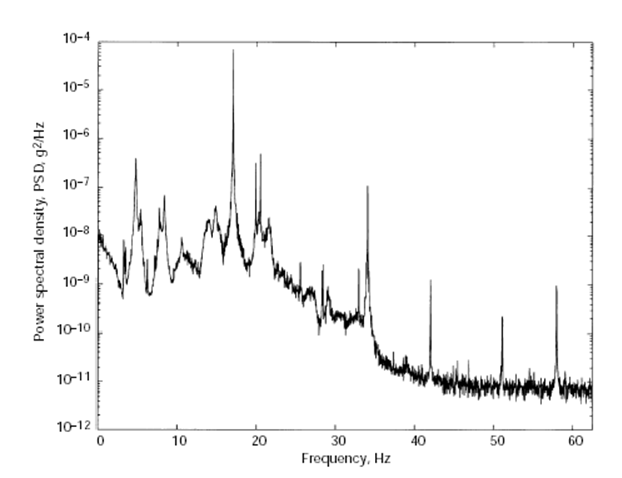
Figure 3. Power Spectral Density, STS-62 Mission
Reference: TM-107032.pdf
Table 1. Vibration Frequencies Commonly Seen in Orbiter Accelerometer Data
| Freq (Hz) | Disturbance Source |
| 0.43 | Cargo bay doors |
| 3.5 | Orbiter fuselage torsion |
| 3.66 | Structural frequency of Orbiter |
| 4.64 | Structural frequency of Orbiter |
| 5.2 | Orbiter fuselage normal bending |
| 7.4 | Orbiter fuselage lateral bending |
| 17 | Ku-band antenna dither |
| 20 | Experiment air circulation fan |
| 22 | Refrigerator freezer compressor |
| 38 | Experiment air circulation fan |
| 39.8 | Experiment centrifuge rotation speed |
| 43 | Experiment air circulation fan |
| 48 | Experiment air circulation fan |
| 53 | Experiment air circulation fan |
| 60 | Refrigerator piston compressor |
| 80 | Experiment water pump |
| 166.7 | Orbiter hydraulic circulation pump |
– Tom Irvine