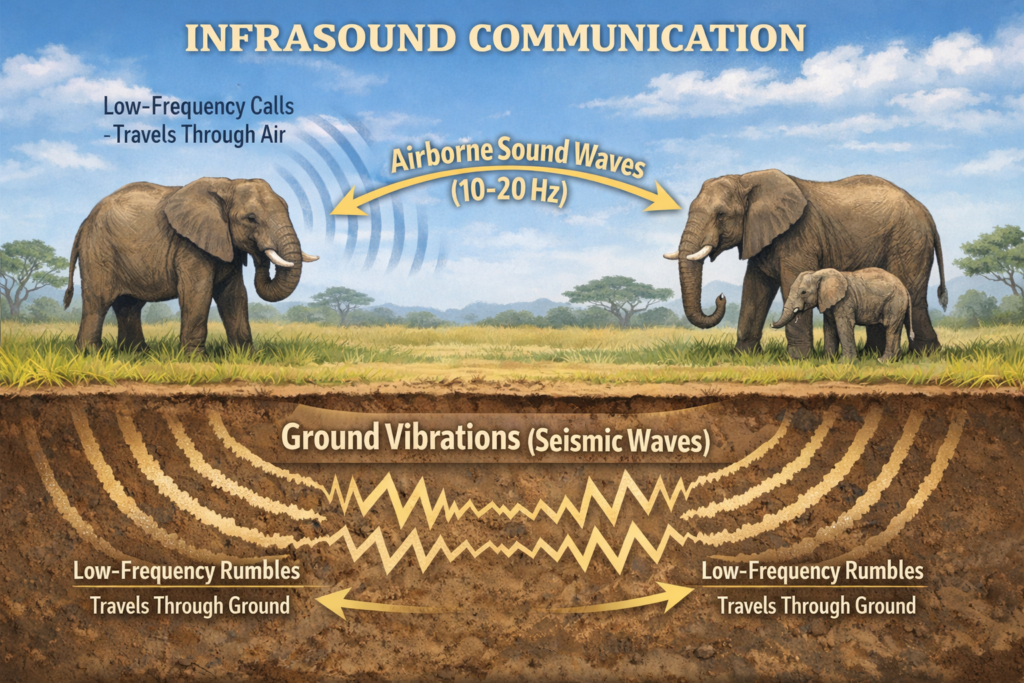
Elephants are among the most socially complex land mammals. Family members may separate while searching for food or water, yet they still need to coordinate their movements, recognize distant callers, warn one another of danger, and maintain social bonds.
One way they accomplish this is through powerful low-frequency vocalizations called rumbles. Many elephant rumbles contain energy below the normal lower limit of human hearing. These infrasonic components can travel for several kilometers under favorable conditions, allowing elephants to exchange information even when they are too far apart to see one another.
The communication system is even more remarkable because some of the vibrational energy also enters the ground. An elephant may therefore receive information through two related channels: airborne sound detected by the ears and seismic vibration detected through contact with the ground.
What Is Infrasound?
Infrasound is conventionally defined as sound with a frequency below 20 Hz. A frequency of 20 Hz corresponds to 20 pressure cycles per second.
The 20 Hz boundary is approximate rather than absolute. Human sensitivity falls rapidly at very low frequencies, and a sufficiently intense low-frequency signal may sometimes be heard or felt. Nevertheless, 20 Hz is a useful dividing line between the conventional infrasonic and audible frequency ranges.
Low-frequency sound has a very long wavelength. Using a nominal speed of sound of 343 m/sec, the wavelength at 15 Hz is approximately:
λ = c/f = 343/15 ≈ 23 meters
This long wavelength helps explain why elephant rumbles behave differently from short-wavelength, high-frequency sounds. Low-frequency sound generally experiences less atmospheric absorption and can bend around some obstacles more effectively, although its actual propagation range still depends on terrain, vegetation, wind, temperature gradients, and background noise.
Elephant Rumbles Include Infrasonic Energy
Elephants produce a variety of vocalizations, including rumbles, trumpets, roars, cries, and snorts. The rumble is especially important for low-frequency communication.
Many adult elephant rumbles have a fundamental frequency below 20 Hz. The vocalization may also contain harmonics and other components above 20 Hz. As a result, a nearby human may hear the audible portion of a rumble without hearing its lowest-frequency component.
Calves generally produce higher-frequency rumbles than adults because their vocal anatomy is smaller. The frequency also varies with the individual elephant, its physical size, emotional state, behavioral context, and the type of call being produced.
Researchers have found that elephant calls can carry information related to:
- Individual identity and recognition of familiar elephants.
- Contact and location when members of a family group are separated.
- Group coordination, including readiness to move or reunite.
- Reproductive condition and mating behavior.
- Alarm, excitement, reassurance, or distress.
- Age, sex, and emotional state of the caller.
How Far Can an Elephant Rumble Travel?
There is no single maximum range for elephant communication. The useful distance varies with the strength and frequency content of the call, the hearing sensitivity of the receiving elephant, and environmental conditions along the propagation path.
Under favorable conditions, low-frequency elephant calls can be detected across distances of several kilometers. Propagation may improve during calm nighttime conditions when the atmosphere develops a temperature structure that refracts sound back toward the ground rather than allowing it to disperse upward.
Conversely, strong winds, irregular terrain, dense vegetation, vehicle traffic, machinery, and other background noise may reduce the effective communication range. Thus, the same call may be detectable at a much greater distance on one evening than during a noisy or windy afternoon.
Airborne Sound and Ground-Borne Vibration
When an elephant rumbles, pressure fluctuations radiate through the atmosphere as airborne sound. Some of the energy may also couple into the ground at the elephant’s feet and through interaction between the sound field and the ground surface.
Footfalls, stamping, mock charges, and other body movements can also generate ground vibration. These disturbances propagate through soil and rock as seismic waves. Researchers have measured low-frequency ground motion associated with elephant vocalizations and movement, supporting the idea that the ground provides an additional information channel.
Airborne and seismic measurements should not be treated as interchangeable. They represent different physical quantities and are measured with different instruments.
| Communication channel | Measured quantity | Typical sensor | Propagation medium |
|---|---|---|---|
| Airborne sound | Acoustic pressure | Low-frequency microphone or infrasound sensor | Atmosphere |
| Ground-borne vibration | Particle velocity, displacement, or acceleration | Geophone, seismometer, or accelerometer | Soil and rock |
The relationship between the two channels depends on source coupling, ground stiffness, soil layering, moisture, distance, and sensor location. Seismic waves are also affected by attenuation and dispersion as they travel through nonuniform ground.
How Elephants May Detect Seismic Signals
Elephants appear to be particularly well adapted to sensing low-frequency ground motion. Their feet contain vibration-sensitive mechanoreceptors, including Pacinian corpuscles, that respond to mechanical disturbances.
Researchers have proposed two principal transmission paths:
- Somatosensory detection through the feet. Ground motion stimulates mechanoreceptors in the foot pads, producing nerve signals that the brain can interpret.
- Bone conduction. Vibrations may travel through the limbs and skeleton toward the middle or inner ear.
The precise contribution of each pathway remains an active subject of research. It is therefore more accurate to say that elephants are thought to detect seismic signals through a combination of sensitive foot structures and bone-conducted vibration rather than describing their feet simply as ears.
Observers have reported postures consistent with vibration detection. An elephant may become motionless, lean forward, redistribute its weight, or place more of its foot surface in contact with the ground. Reducing its own movement would also reduce self-generated vibration and improve its ability to detect a weak external signal.
Do Elephants Understand the Meaning of Ground Vibrations?
Experimental and field observations indicate that elephants can respond differently to different low-frequency or seismic stimuli. Responses may include increased alertness, changes in direction, movement toward a caller, bunching together, or movement away from a potential threat.
This does not necessarily mean that every footstep is an intentional message. Some ground vibrations may be deliberate signals, while others may provide incidental information about the presence, direction, distance, or activity of another elephant.
The distinction is similar to human hearing. A person can receive information from both intentional speech and unintentional sounds such as approaching footsteps. Elephants may likewise interpret a combination of deliberate calls and environmental vibration cues.
A Multimodal Communication System
Infrasound is only one part of a much broader elephant communication system. Elephants combine several sensory channels:
- Audible and infrasonic vocalizations, including rumbles, trumpets, roars, and cries.
- Ground vibration produced by vocalizations, footsteps, and forceful body movements.
- Touch, including trunk touches, caresses, nudges, and body contact.
- Visual signals, including posture, head position, ear position, and coordinated movement.
- Chemical signals carried by urine, secretions, breath, and other scents.
The channels complement one another. Visual and tactile signals are effective at close range. Scent may remain after an elephant has left an area. Low-frequency acoustic and seismic signals can provide information when vegetation, terrain, darkness, or distance prevents visual contact.
How Scientists Measure Elephant Rumbles
Researchers can investigate elephant communication using synchronized acoustic and vibration measurements. A typical monitoring system may include:
- Low-frequency microphones or infrasound sensors.
- Geophones or broadband seismometers placed in the ground.
- Video recordings to identify the calling elephant and document behavior.
- GPS timing so measurements from several sensors can be compared.
- Weather and soil measurements to characterize propagation conditions.
A time-history plot may reveal the duration and amplitude of a call, while a Fourier transform or spectrogram shows how its energy is distributed with frequency. Synchronized sensor arrays can also be used to estimate the direction or location of the source from differences in signal arrival time.
From a vibration-analysis standpoint, several complications arise. The measured signal may include overlapping elephant calls, footsteps, wind-induced sensor noise, vehicles, machinery, nearby people, and natural seismic activity. Ground properties can filter the waveform, changing both its amplitude and frequency content with distance.
Human Noise Can Interfere With the Signal
Human activity can alter both the acoustic and seismic environments used by elephants. Engines, road traffic, construction equipment, mining, generators, and aircraft can produce low-frequency energy that overlaps parts of the elephant communication band.
Human-generated vibration does not merely mask communication. Research has shown that elephants can detect and distinguish some seismic noise associated with human activity and may respond with risk-avoidance behavior, including moving away from the source.
The effect of human noise therefore depends on context. It may obscure a biologically important signal, reduce its useful range, attract attention, or be interpreted as evidence of danger. These effects are especially important near roads, settlements, tourist facilities, industrial operations, and wildlife migration routes.
Why Elephant Infrasound Matters
Understanding elephant infrasound and seismic sensing has practical value beyond scientific curiosity.
- Conservation: Passive acoustic and seismic sensors can help detect elephants in large or visually obstructed habitats.
- Human-elephant conflict: Early detection systems may provide warnings when elephants approach farms, roads, or settlements.
- Habitat planning: Noise and vibration studies can help identify human activities that may disrupt important communication corridors.
- Animal behavior: Calls provide insight into elephant identity, social relationships, reproductive behavior, and emotional state.
- Engineering: The subject provides an unusual application of acoustics, signal processing, structural dynamics, soil vibration, and sensor-array analysis.
Summary
Elephants do not communicate through infrasound alone. They use a sophisticated combination of sound, ground vibration, sight, scent, and touch.
Many adult rumbles have fundamental frequencies below 20 Hz, although the same call may also contain audible harmonics. The low-frequency components can propagate over long distances through the atmosphere, while associated vibrations may travel through the ground. Elephants appear capable of detecting and interpreting information from both channels.
To human observers, a distant landscape may seem silent. To an elephant, however, it may contain a network of low-frequency calls and subtle ground vibrations carrying information about family members, movement, reproduction, and danger.
References and Further Reading
- Garstang, M., “Long-Distance, Low-Frequency Elephant Communication”
- Soltis, J., “Vocal Communication in African Elephants”
- Herbst et al., “How Low Can You Go? Physical Production Mechanism of Elephant Infrasonic Vocalizations”
- Reinwald et al., “Seismic Localization of Elephant Rumbles as a Monitoring Approach”
- Mortimer et al., “Noise Matters: Elephants Show Risk-Avoidance Behaviour in Response to Human-Generated Seismic Cues”
- ElephantVoices: Acoustic Communication
- ElephantVoices: Seismic Communication
Book: Silent Thunder: In the Presence of Elephants
— Tom Irvine
1 thought on “Elephant Infrasound: How Elephants Communicate Over Long Distances”