🐘 The Secret Language of Giants: How Elephants Communicate Through Infrasound
When we think of animal communication, we might picture birdsong or whale calls. But elephants, some of the most intelligent and socially complex mammals on Earth, have evolved a secret communication channel that humans can’t hear: infrasound. These low-frequency signals travel vast distances, allowing elephants to stay connected across the savanna in ways that would astonish most of us.
🎶 What Is Infrasound?
Infrasound refers to sound waves with frequencies below the human hearing threshold, typically below 20 Hz. Humans simply can’t hear these sounds, but many animals, including elephants, use them intentionally for communication.
🗣️ Elephant Rumbles: More Than Meets the Ear
Elephants produce powerful vocalizations known as rumbles. These deep sounds often have fundamental frequencies between 15–35 Hz, placing them squarely in the infrasonic range.
These rumbles serve many social functions:
- Keeping in touch with family and herd members over long distances.
- Coordinating group movements and signaling readiness to move.
- Announcements related to mating, danger, or food — behaviors that benefit from long-range communication.
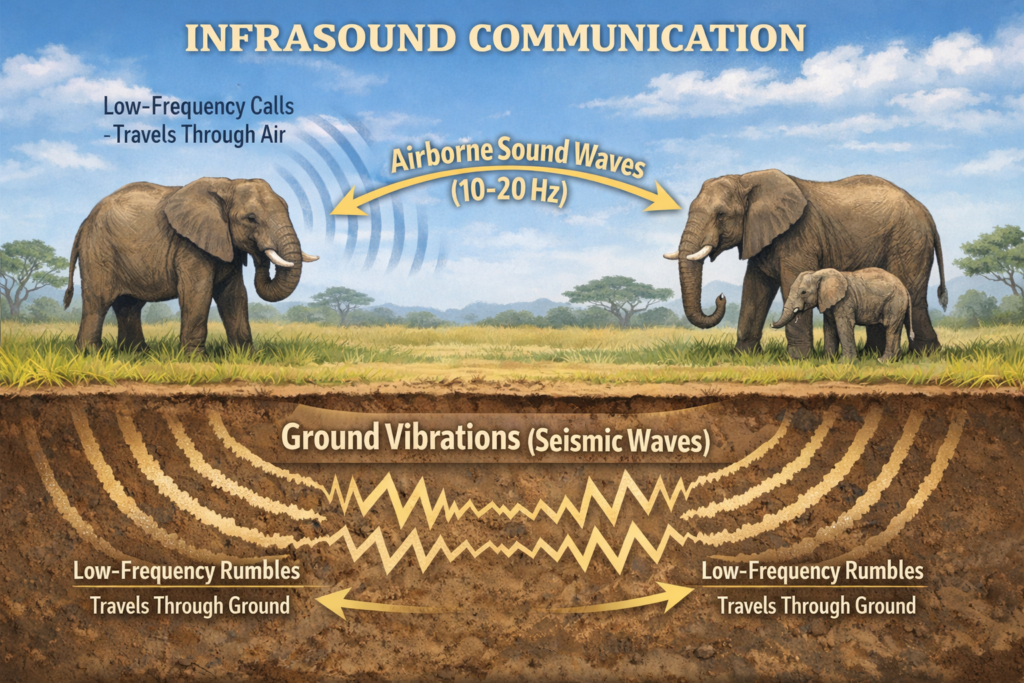
Because infrasonic sound waves attenuate slowly, they can travel farther than higher-pitched calls, in some cases up to 10 km, making them ideal for long-distance messaging across wide open terrain. Some of these infrasonic rumbles propagate through the air much like normal sound.
Even though humans can’t hear them, elephants can detect them with their keen auditory systems
🌍 Ground-Borne Communication: Talking Through the Earth
Here’s where elephant communication gets really fascinating: the same low-frequency rumble can also create vibrations that travel through the ground.
🦶 Seismic Signals from Rumbles and Footsteps
When an elephant rumbles or moves, the energy doesn’t just travel through the air — it also couples into the ground as seismic waves. Researchers have recorded these ground vibrations, which occur in the range of 10–40 Hz — exactly where seismic energy travels efficiently.
In practical terms, that means elephants may be “talking” not only through the air but also through mini-earthquakes beneath their feet.
🐾 Listening With the Feet
Elephants have specialized adaptations that help them detect these subtle ground vibrations:
- Their huge, padded feet are extremely sensitive to vibrations, much like built-in geophones.
- These ground cues are transmitted through the skeleton and into sensory pathways that the elephant brain can interpret.
Scientists observing elephants in the wild have documented herds responding to these seismic cues by:
- changing direction,
- moving toward distant callers,
- or indicating alertness to potential threats.
🔊 A Multimodal Communication System
Elephants don’t rely on just one channel. Their communication toolkit includes:
- Touch (like trunk touches and caresses),
- Visual cues (body posture and ear flapping),
- Chemical signals (scent),
- Airborne sound,
- and ground vibration.
This rich array of communication methods helps them maintain complex social bonds over large distances, even when they’re out of sight from each other.
🌍 Human Noise: An Interruption in the Signal
Recent research suggests that elephants can also detect human-generated seismic noise — from vehicles, machinery, or other sources — and may interpret it as risk cues, adjusting their behavior accordingly. This highlights how sensitive and integral ground-based communication is to their survival.
🐘 Why This Matters
Understanding elephant communication isn’t just an academic curiosity, it helps us appreciate:
- the complexity of their social lives,
- the importance of acoustic and seismic environments to wildlife,
- and the subtle ways human activity can impact animal behavior.
Elephants are not just loud — they are quietly connected, through air and earth, in a secret language that has evolved over millions of years.
Book: Silent Thunder, In the Presence of Elephants
– Tom Irvine