Photograph taken at a seaside retaining wall in Madeira, Portugal, July 2026. The bolt and nut shown are carbon steel — heavily corroded after prolonged exposure to the Atlantic marine environment.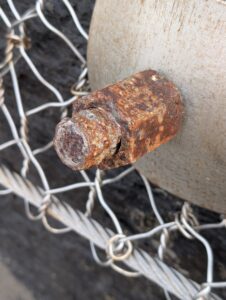
Figure 1. Severely corroded carbon steel bolt and nut at a seaside retaining wall, Madeira, Portugal. Note the layered, scaly rust (iron oxides and oxyhydroxides), loss of hex geometry on the nut, and pitting visible on the bolt shank. The chain-link fence wire — likely galvanized steel — shows far less degradation, illustrating the benefit of a sacrificial zinc coating.
Introduction
The photograph above shows a carbon steel bolt and nut in an advanced state of corrosion at a coastal retaining wall in Madeira, Portugal. The Atlantic marine environment is among the most aggressive corrosion environments that structural hardware can face: high relative humidity, chloride-laden salt spray, cyclic wetting and drying, and elevated temperatures all combine to drive electrochemical attack at an accelerated rate.
What makes this image instructive is the contrast between the heavily corroded steel fastener and the relatively intact galvanized chain-link fence wire visible in the same frame. Both are iron-based alloys. The difference in degradation state illustrates in a single photograph the value of proper material selection and protective coatings.
This post covers the corrosion mechanisms at work, how to assess degradation severity, and practical prevention and mitigation strategies for structural fasteners in marine or coastal environments.
The Corrosion Mechanism: Electrochemical Attack
Metallic corrosion is fundamentally an electrochemical process. In the presence of an electrolyte — in this case, salt water (NaCl dissolved in water from ocean spray and condensation) — iron undergoes oxidation at anodic sites and oxygen reduction at cathodic sites. The half-reactions are:
Anodic (oxidation):
Fe → Fe²⁺ + 2e⁻
Cathodic (reduction):
O₂ + 2H₂O + 4e⁻ → 4OH⁻
The ferrous ions (Fe²⁺) combine with hydroxide to form iron hydroxide, which further oxidizes to form the familiar reddish-brown iron oxides — collectively known as rust. In a marine environment, chloride ions (Cl⁻) are particularly destructive because they:
- Break down passive oxide films that would otherwise protect the metal surface
- Form soluble iron chloride complexes that prevent re-passivation
- Increase the electrolyte conductivity, accelerating the galvanic cell reaction rate
- Concentrate in crevices and pits, creating locally acidic conditions that sustain active dissolution
What the Photo Tells Us: Failure Mode Analysis
Several distinct degradation features are visible in Figure 1:
Uniform (general) corrosion is evident across the entire exposed bolt and nut surface — the orange-brown iron oxide layer indicates widespread metal loss. The original hex geometry of the nut has been almost entirely consumed; removal with a wrench would be impossible without cutting tools.
Pitting corrosion is visible on the bolt end face. Pitting is particularly dangerous in structural fasteners because it acts as a stress concentrator. Under cyclic loading — even low-amplitude vibration from wind, traffic, or wave action — pits initiate fatigue cracks. The stress intensity factor at a pit of radius r and depth a is:
KI = F·σ·√(πa)
where F is a geometry factor and σ is the applied stress. Pitting thus couples corrosion damage with fatigue crack initiation — the synergistic process known as corrosion fatigue.
Crevice corrosion is likely active at the nut-to-substrate interface (the bearing face against the concrete or masonry). Crevices trap electrolyte, become oxygen-depleted, and develop locally low pH — conditions that sustain aggressive dissolution even when the open surface has re-passivated.
Preferential attack at the thread roots is a common failure locus. Thread roots are geometric stress concentrators (stress concentration factor Kt ≈ 3–4 for standard thread profiles), and they also trap moisture. The combination of corrosion and mechanical stress at thread roots is a leading cause of fastener fracture in coastal structures.
The Role of Salt Spray: ISO 9223 Corrosivity Categories
ISO 9223 classifies atmospheric corrosivity into five categories (C1–C5) based on annual mass loss of standard metal coupons. Madeira’s Atlantic coastal environment falls clearly into C5 (very high), the most aggressive category, characterized by:
- High time-of-wetness (coastal fog, spray, humidity above 80% RH for extended periods)
- High chloride deposition rate (>60 mg/m²/day Cl⁻ at the waterline zone)
- Elevated temperature accelerating reaction kinetics
Under C5 conditions, unprotected carbon steel can lose 200–700 µm/year in thickness. A typical M12 bolt with a 12 mm nominal diameter and a thread root diameter of roughly 10 mm would be fully compromised structurally within a few years — consistent with what the photograph shows.
Prevention Strategies: Material Selection
The most robust solution for marine fasteners is to select an inherently corrosion-resistant alloy rather than relying solely on coatings. The hierarchy of options, in rough order of increasing corrosion resistance and cost:
316L Stainless Steel
Type 316L (UNS S31603) is the standard marine-grade stainless, containing 16–18% Cr, 10–14% Ni, and 2–3% Mo. The molybdenum addition significantly improves resistance to chloride pitting versus the lower-cost 304/18-8 grade. The pitting resistance equivalent number (PREN) for 316L is approximately 24–26, versus 18–20 for 304. For most coastal structural applications above the splash zone, 316L provides adequate service life.
Duplex Stainless Steel (2205)
Duplex grades (e.g., UNS S32205, PREN ≈ 35) offer superior chloride resistance compared to 316L, with roughly twice the yield strength. This means a smaller-diameter fastener can carry the same load, which can be economical despite the higher material cost. Recommended for splash-zone and frequently immersed applications.
Super Duplex and 6Mo Alloys
For severely aggressive environments (submerged marine, chemical splash), super duplex grades (e.g., 2507, PREN ≈ 42) or 6-molybdenum austenitic alloys (e.g., AL-6XN, PREN ≈ 47) provide near-immunity to chloride pitting at ambient temperatures. Cost is substantially higher.
Titanium
Grade 5 titanium (Ti-6Al-4V) is essentially immune to seawater corrosion and has a specific strength exceeding most stainless alloys. It is used in critical aerospace and subsea fastening applications where weight and corrosion performance are both at a premium.
Silicon Bronze
A traditional choice for marine hardware, silicon bronze (C65500: ~97% Cu, 3% Si) is highly resistant to seawater corrosion and does not cause galvanic attack on aluminum hulls. Its strength is lower than stainless steel, limiting it to lighter structural applications.
Prevention Strategies: Protective Coatings
When carbon steel or lower-alloy fasteners must be used (for cost or strength reasons), coatings are the primary defense.
Hot-Dip Galvanizing (HDG)
Hot-dip galvanizing applies a metallurgically bonded zinc coating (typically 45–85 µm, per ASTM A153) that protects by two mechanisms: (1) a physical barrier, and (2) cathodic (sacrificial) protection — zinc is anodic to iron and corrodes preferentially at holidays or damage sites. In C4 (high) environments, HDG may provide 10–20 years of protection before the zinc is consumed. In C5 marine conditions, service life drops to 5–10 years. The chain-link fence in Figure 1 is almost certainly galvanized, explaining its relative survival.
Mechanical Zinc Plating and Electroplating
Standard electroplated zinc (ASTM B633, 5–25 µm) provides some galvanic protection but is far thinner than HDG and not recommended for direct marine exposure. Mechanical zinc plating offers slightly better performance due to the compressive, non-hydrogen-embrittled coating structure — an important consideration for high-strength fasteners where hydrogen embrittlement is a risk.
Geomet / Dacromet (Zinc Flake Coatings)
Zinc-aluminum flake coatings (e.g., Geomet, Dacromet) are applied by dip-spin or spray and cured at elevated temperature. They provide excellent salt spray performance (often 1,000+ hours per ISO 9227) and do not cause hydrogen embrittlement. They are widely used in automotive and construction applications.
PTFE-Based and Organic Coatings
Fluoropolymer coatings (e.g., Xylan, Teflon-impregnated systems) provide corrosion protection plus lubricity, reducing installation torque. They are common on stainless fasteners to prevent galling during installation. As a standalone anti-corrosion solution on carbon steel in marine environments, they are insufficient.
Thermal Spray Coatings (HVOF, Arc Spray)
High-velocity oxygen fuel (HVOF) or arc-sprayed zinc or aluminum coatings can be applied to fabricated steel structures at thicknesses of 100–300 µm, providing long-term cathodic protection with much lower porosity than flame spray. Used on bridges, offshore platforms, and coastal retaining walls.
Cathodic Protection
For structures that are permanently or periodically submerged, cathodic protection (CP) can supplement or replace coating systems. CP works by making the steel structure the cathode in the electrochemical cell, eliminating anodic dissolution.
Sacrificial anode CP uses zinc, aluminum, or magnesium anodes bolted to the structure. These corrode in lieu of the steel. Zinc anodes are most common in seawater; aluminum-indium alloys offer higher efficiency. Anode consumption rate follows Faraday’s Law — the current output and service life can be calculated from the steel surface area, electrolyte resistivity, and anode mass.
Impressed current CP (ICCP) uses an external DC power supply connected to inert anodes (platinized titanium, mixed metal oxide). ICCP can protect large structures with precise potential control but requires monitoring and maintenance of the power supply.
For the type of fastener in Figure 1, local zinc or aluminum sacrificial anodes attached to the bolt region of the wall structure could significantly extend the fastener service life — a common practice in harbor and seawall construction.
Corrosion Inhibitors and Sealants
Thread sealants and anti-seize compounds applied at installation serve multiple functions: they exclude electrolyte from thread roots, prevent crevice corrosion at faying surfaces, and facilitate eventual disassembly. Recommended products for marine environments include:
- Lanolin-based compounds (e.g., Lanocote) — natural, environmentally benign, highly water-resistant, widely used in marine fastening
- Copper-based anti-seize — excellent at preventing thread galling and seizing; note that copper is cathodic to both steel and aluminum, so galvanic compatibility must be verified
- Zinc-rich pastes — provide sacrificial cathodic protection at the contact interface
- PTFE tape — effective electrolyte barrier for threaded connections, particularly stainless-to-stainless joints where galling is the primary concern
Design Considerations for Coastal Structures
Beyond material and coating selection, the structural design itself influences corrosion performance:
Avoid dissimilar metal contact. Galvanic corrosion occurs when two metals of different electrochemical potential are in electrical contact in the presence of an electrolyte. The more active (anodic) metal corrodes preferentially. The severity depends on the potential difference (from the galvanic series) and the cathode-to-anode area ratio. A large stainless steel plate with a single carbon steel bolt will rapidly destroy the bolt.
Minimize crevices. Design connections to drain and dry rather than trap moisture. Avoid back-to-back angles, lapped joints, and through-bolt configurations where water can accumulate against the bearing face.
Provide access for inspection and replacement. In the most aggressive environments, periodic replacement of sacrificial fasteners is more economical than attempting to achieve infinite life. Design for disassembly — which the bolt in Figure 1 no longer permits.
Apply torque at installation accounting for coating friction factors. The torque-tension relationship for a fastener is:
T = K · D · Fp
where K is the nut factor (typically 0.15–0.20 for lubricated steel, 0.10–0.15 with PTFE or anti-seize), D is the nominal diameter, and Fp is the desired preload. Coatings and lubricants significantly affect K. Under-torquing leaves the joint susceptible to fretting and loosening; over-torquing can strip the galvanizing or yield the fastener.
Inspection and Assessment
For existing coastal structures, a corrosion assessment should address:
- Visual inspection: Classify rust grade per ISO 4628-3 (Ri0 through Ri5, where Ri5 indicates 40–50% rust coverage). The fastener in Figure 1 is solidly at Ri5.
- Remaining cross-section: Ultrasonic thickness measurement or caliper measurement of accessible fastener shanks can quantify metal loss. Tensile strength loss scales approximately linearly with cross-sectional area loss.
- Torque audit: A torque wrench check can reveal whether a corroded fastener has lost preload — though severely corroded fasteners (like Figure 1) cannot be meaningfully re-torqued.
- Half-cell potential survey: For reinforced concrete structures with embedded steel, a copper-copper sulfate (CSE) half-cell potential survey maps active corrosion zones in the rebar per ASTM C876.
Summary: Prevention and Mitigation Hierarchy
The priority order for coastal fastener corrosion management, from most to least preferred:
- Select the right alloy from the start — 316L stainless for most coastal applications; duplex or super duplex for splash zone and immersed zones.
- Apply a durable coating — hot-dip galvanizing for carbon steel hardware; zinc-aluminum flake coatings for machined fasteners.
- Apply thread sealant at installation — lanolin, zinc-rich paste, or PTFE as appropriate to the material pair.
- Use cathodic protection — sacrificial zinc or aluminum anodes for submerged or tidal-zone structures.
- Design to minimize crevices and galvanic couples — use isolation sleeves and washers where dissimilar metals must be used together.
- Inspect regularly and replace on schedule — define a replacement interval based on the corrosivity category and coating expected life; do not wait for visible structural distress.
The bolt and nut in the photograph represent the end state of what happens when none of these measures are applied — or when a carbon steel fastener installed decades ago has simply outlived its serviceable life in one of the world’s most aggressive atmospheric environments. The structural integrity of the connection it was meant to secure is now entirely in question.
References
- ISO 9223:2012, Corrosion of metals and alloys — Corrosivity of atmospheres — Classification, determination and estimation
- ISO 4628-3:2016, Paints and varnishes — Evaluation of degradation of coatings — Part 3: Assessment of degree of rusting
- ASTM A153, Standard Specification for Zinc Coating (Hot-Dip) on Iron and Steel Hardware
- ASTM C876, Standard Test Method for Corrosion Potentials of Uncoated Reinforcing Steel in Concrete
- Fontana, M.G., Corrosion Engineering, 3rd ed., McGraw-Hill, 1986
- Revie, R.W. and Uhlig, H.H., Corrosion and Corrosion Control, 4th ed., Wiley-Interscience, 2008
- Melchers, R.E., “Long-term immersion corrosion of steels in seawater with elevated nutrient concentration,” Corrosion Science, 81, 2014
- NACE SP0169, Control of External Corrosion on Underground or Submerged Metallic Piping Systems
Tom Irvine | VibrationData | blog.vibrationdata.com
1 thought on “Carbon Steel Marine Corrosion”