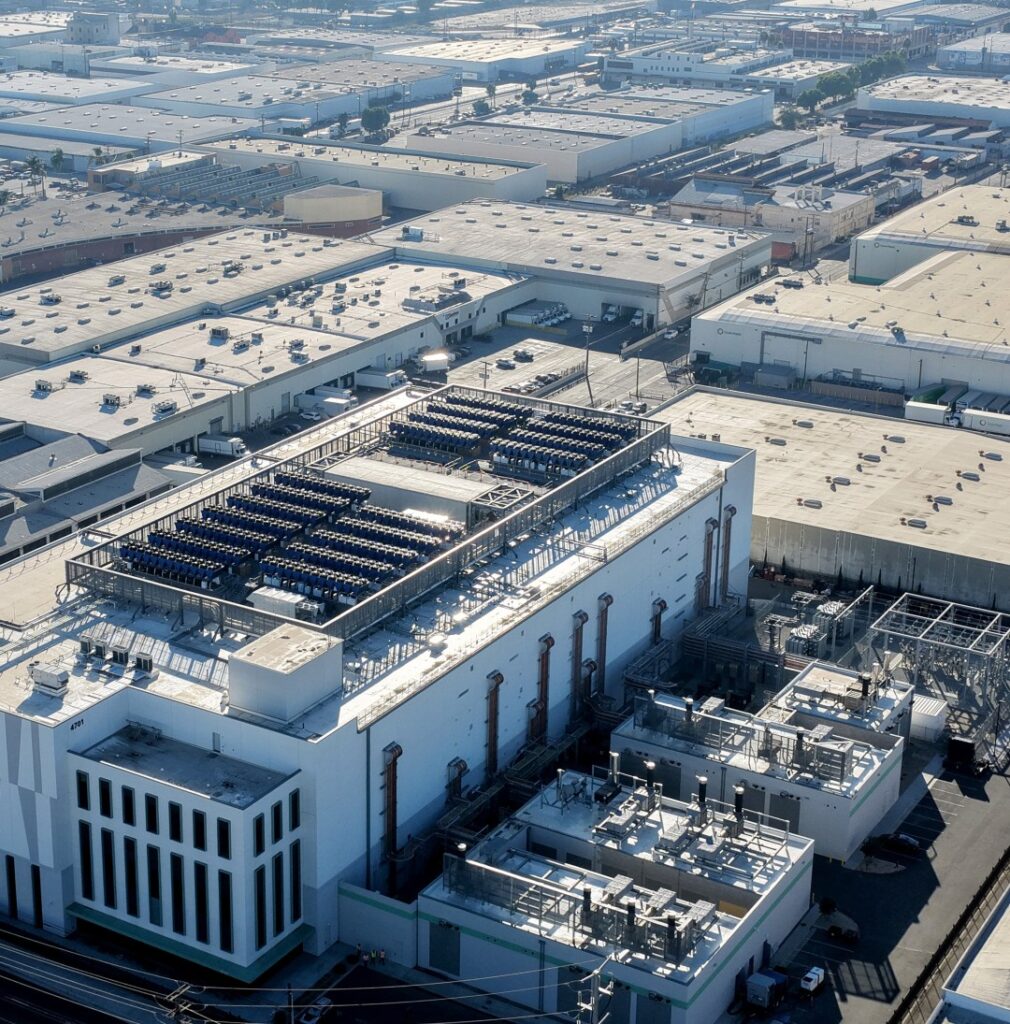
The data center construction boom has made a 24/7 mechanical plant into everyone’s new neighbor — and the acoustics run in both directions: noise radiating out to the community, and noise and vibration attacking the equipment inside.
Driven by cloud computing and AI, data centers are being built at a furious pace, and increasingly on parcels near homes and businesses. A recent piece by Feinblatt and Proko of TRC (now part of WSP) makes the development-side case well: a data center is a continuously operating mechanical facility, and projects that treat noise and vibration as an afterthought risk permit denials, community opposition, and expensive retrofits. This post summarizes their argument in plain engineering terms, then adds the half of the story that fascinates a vibration engineer — the ways noise and vibration threaten the data center’s own equipment.
The Outward Problem: A Mechanical Plant That Never Sleeps
A data center’s acoustic sources form a substantial inventory: cooling towers and air-cooled chillers with large axial fans, rooftop air handling units, pumps, backup diesel generators (tested regularly, and deafening when they run), and the substation transformers that feed the whole site. Each source has its own signature, and the total noise problem is more subtle than a single decibel number.
Two features make data center noise particularly troublesome for neighbors. The first is low-frequency content. Large slow fans and generators put their energy in the bottom octave bands, where atmospheric and barrier attenuation are weakest, building facades provide the least insulation, and the sound is felt as much as heard. The second is tonality. Fan blade-passing tones, compressor tones, and transformer hum are discrete-frequency sounds, and the ear judges a pure tone to be considerably more annoying than broadband noise of the same energy. Transformer hum is a classic example with a clean physical origin: magnetostriction in the core drives the tank walls at twice the line frequency — 120 Hz in North America — plus harmonics, producing the steady hum that is nearly impossible to ignore once noticed.
Regulators have caught up with these subtleties. As the TRC authors note, many jurisdictions now impose pure-tone prohibitions, octave-band thresholds, stricter nighttime limits, and analysis at the nearest sensitive receptor rather than merely at the property line — all layered on top of the traditional A-weighted limits. For a first estimate of whether a source will be a problem, the hemispherical spreading relation is still the back-of-envelope workhorse:
$$ L_p = L_w – 20 \log_{10} r – 11 \; \text{dB} $$
where \( L_p \) is the sound pressure level at distance \( r \) (meters) from a source of sound power level \( L_w \) over a reflecting plane, before accounting for barriers, air absorption, and ground effects. A cooling plant with a combined sound power in the 100+ dBA range does not need much arithmetic to show that a receptor a few hundred meters away will notice — especially at 2 a.m. against a quiet rural background.
The mitigation toolbox is well established: equipment selection favoring low-tonality, low-speed fans; generator enclosures and exhaust silencers; sound barrier walls and acoustic enclosures placed with the help of predictive modeling; and vibration isolation under large rotating machinery so structure-borne paths do not bypass the airborne treatments. The TRC piece’s central practical point deserves emphasis: predictive noise modeling belongs at the site selection stage, where it costs little, rather than after commitments are made, where an acoustic surprise can force a redesign.
The Inward Problem: When Noise Attacks the Servers
Less widely appreciated is that the equipment inside a data center is itself vibration-sensitive — and the most famous demonstrations involve sound, not shaking.
Hard disk drives position their read/write heads over tracks spaced well under a micrometer apart. Any vibration of the drive — whether transmitted through the rack or induced acoustically on the drive’s covers and arms — degrades the servo’s ability to hold the head on track, and the drive responds by waiting or retrying. In a now-classic 2008 demonstration, Sun Microsystems engineer Brendan Gregg simply shouted at a disk array in a running data center and watched disk latency spike in real time on the monitoring instrumentation. The acoustic excitation of the drives was enough to measurably disturb their I/O performance.
Lest anyone assume this is yesterday’s problem, spinning disks still carry the bulk of the world’s stored bytes. Industry analyses in 2026 put HDDs at roughly 80 percent of total storage capacity in AI data centers: the typical architecture is tiered, with NVMe flash serving the hot data (AI training, databases, inference) and a cold tier — the large majority of capacity — built on enterprise HDD arrays. The economics still drive the split. One first-quarter 2026 comparison put 30 TB QLC enterprise SSD cost per unit capacity at roughly 22.6 times that of HDD, and a representative total-cost-of-ownership model showed a hybrid system at about 7.3M USD over three years versus 31M USD for pure flash.
Far from fading away, HDDs are currently in a supply crunch: enterprise drives have faced lead times of up to two years as manufacturers struggle to keep up with AI demand, with some product lines effectively sold out through 2027. New HAMR drives are pushing 36–44 TB, and one analyst projects nearline HDD will comprise over 90 percent of capacity shipments by 2029, up from 54 percent today. The trend line does point toward flash for a growing share of new deployments — performance per watt matters enormously in power-constrained AI buildouts — but spinning disks will anchor the bulk-capacity and archive tiers well into the 2030s. The acoustic vulnerability described here is not going anywhere soon.
The extreme version of this effect has taken entire facilities offline. Gaseous fire suppression systems discharge inert gas through nozzles at high pressure, and an unsilenced discharge can generate sound levels above 130 dB in the white space — with substantial energy in the frequency range where drive components respond. In September 2016, a fire suppression test at an ING Bank data center in Bucharest produced a discharge so loud it damaged dozens of hard drives, knocking the bank’s operations offline for roughly ten hours. Siemens and others subsequently published guidance showing measurable HDD throughput degradation beginning around 110 dB, with damage risk growing rapidly above that. The industry response includes silenced discharge nozzles, staged discharge, and — in the long run — the migration to solid-state storage, which is indifferent to acoustics.
Structure-borne vibration matters too. Chillers, pumps, and generators inside or adjacent to the building must be isolated not only for the neighbors’ sake but to keep floor vibration in the white space benign. The generic vibration criterion (VC) curve methodology developed by Colin Gordon for vibration-sensitive facilities provides the standard framework: one-third octave band velocity limits on the floor, selected according to the sensitivity of the installed equipment. Ordinary server floors are far less demanding than a lithography bay, but the framework, the survey methods, and the isolation engineering are the same discipline.
KEY POINT: A data center’s noise and vibration problem is bidirectional. Outward: low-frequency and tonal noise from a 24/7 cooling and power plant, now regulated by octave-band and pure-tone criteria, not just an A-weighted number. Inward: rotating machinery vibration and even airborne sound degrade hard drive performance — a fire suppression discharge has taken a bank’s data center down for hours, and spinning disks still hold roughly 80 percent of stored capacity. Both problems are cheapest to solve at the design stage.
A Familiar Moral
Readers of this blog will recognize the recurring theme: whether the topic is machinery protection setpoints, pylon fuse pins, or a cooling plant beside a subdivision, the cost of addressing dynamics grows steeply with project maturity. A predictive noise model at site selection, an isolator specified in the equipment schedule, or a silenced suppression nozzle in the original fire protection design each costs a small fraction of the retrofit, the enforcement action, or the outage that follows the alternative.
References
M. Feinblatt and M. Proko, “Understanding Noise and Vibration in Data Center Development and Operations,” TRC Companies (WSP), June 26, 2026: https://www.trccompanies.com/insights/understanding-noise-and-vibration-in-data-center-development-and-operations/
B. Gregg, “Shouting in the Datacenter,” Sun Microsystems demonstration video, 2008; see also B. Gregg, “Unusual Disk Latency,” blog post, 2008.
“Do AI Data Centers Use SSD or HDD?”, OSCOO, June 2026 (HDD/SSD capacity share, cost comparison, and TCO model): https://www.oscoo.com/news/do-ai-data-centers-use-ssd-or-hdd/
“Storage Wars: Is This the End for Hard Drives in the Data Center?”, Data Centre Dynamics, June 2026 (HDD lead times and supply constraints): https://www.datacenterdynamics.com/en/analysis/storage-wars-is-this-the-end-for-hard-drives-in-the-data-center/
“Enterprise HDD Remains Dominant Storage Technology,” Horizon Technology, December 2025 (HAMR capacities and nearline HDD shipment projections): https://horizontechnology.com/news/hdd-remains-dominant-storage-technology-1219/
Siemens Building Technologies, white paper on the impact of inert gas extinguishing system discharge noise on hard disk drive performance (silenced nozzle guidance).
Press reporting on the ING Bank Bucharest data center outage, September 2016 (fire suppression discharge noise damaging hard drives; e.g., Motherboard/VICE, “A Loud Sound Just Shut Down a Bank’s Data Center for 10 Hours”).
C. G. Gordon, “Generic Criteria for Vibration-Sensitive Equipment,” Proceedings of SPIE 1619 (1991); see also IEST-RP-CC012, Considerations in Cleanroom Design.
ANSI/ASA S12.9, Quantities and Procedures for Description and Measurement of Environmental Sound (Parts 1–7).
ISO 1996-1/-2, Description, Measurement and Assessment of Environmental Noise.
IEC 60076-10, Power Transformers — Determination of Sound Levels (transformer hum at twice line frequency and harmonics).
T. Irvine, Vibrationdata publications & free ebooks: https://blog.vibrationdata.com/2025/11/27/toms-ebooks/