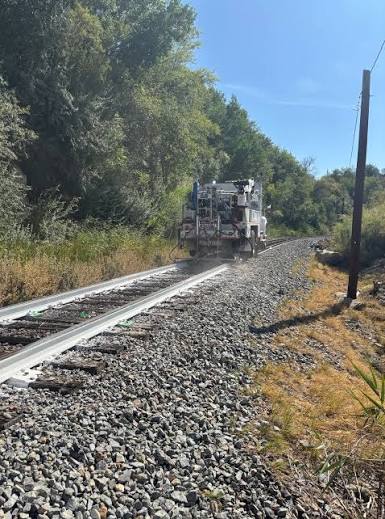
Union Pacific has begun spraying white paint on the sides of its rails in the hottest sections of its 32,000-mile network. The program, which entered targeted deployment in 2025, uses a hi-rail truck with a spray rig to coat both faces of the rail web and head sides. UP reports that the reflective coating lowers rail surface temperature by roughly 20°F. The method adapts a long-standing European and Australian practice to North American freight territory.
Twenty degrees may not sound like much, but for continuous welded rail (CWR) under thermal constraint, it translates directly into thousands of psi of compressive stress relief. This post works through the mechanics of rail thermal stress, the buckling phenomenon known as “sun kink,” and the chemistry that makes a white coating effective.
1. Thermal Stress in Continuous Welded Rail
Modern main lines use CWR: rail welded into strings a quarter-mile or longer, rigidly fastened to the ties, with the ballast section resisting lateral and longitudinal movement. Unlike old jointed rail with expansion gaps, CWR cannot expand freely. A fully constrained rail develops compressive stress as temperature rises above its stress-free installation temperature, called the rail neutral temperature (RNT). Railroads deliberately install or de-stress CWR at an elevated RNT, typically 90–110°F in hot climates, to bias the rail toward tension in cold weather and limit compression in hot weather.
For full longitudinal constraint, the thermal stress is
\[ \sigma = E \, \alpha \, \Delta T \]where for rail steel:
- \( E = 30 \times 10^{6} \) psi (elastic modulus)
- \( \alpha = 6.5 \times 10^{-6} \, /^{\circ}\mathrm{F} \) (coefficient of thermal expansion)
- \( \Delta T \) = rail temperature minus neutral temperature
This gives 195 psi of compression per °F above neutral. Note that the stress is independent of rail length — a common misconception is that longer rail strings are worse; the constrained thermal stress is the same per unit temperature rise regardless of length.
The compressive force in the rail is the stress times the cross-sectional area. For 136RE rail ( \( A \approx 13.4 \; \mathrm{in}^2 \) ):
\[ P = \sigma A = E \, \alpha \, \Delta T \cdot A \approx 2600 \; \mathrm{lbf \; per \; ^{\circ}F \; per \; rail} \]Worked Example
Consider a desert main line with RNT = 100°F. On a 105°F afternoon, direct sun can drive bare rail to 140°F or higher — rail routinely runs 30–40°F above ambient because polished steel with a dark oxidized web is an efficient solar absorber.
At rail temperature 140°F:
\[ \Delta T = 40 ^{\circ}\mathrm{F} \] \[ \sigma = (30 \times 10^{6})(6.5 \times 10^{-6})(40) = 7800 \; \mathrm{psi \; compression} \] \[ P = (7800)(13.4) = 104{,}000 \; \mathrm{lbf \; per \; rail} \]or about 209,000 lbf across the track panel. That is over 100 tons of axial compression trying to push the track out of line.
Now apply the white coating with its reported 20°F surface temperature reduction:
\[ \Delta T = 20 ^{\circ}\mathrm{F}, \quad \sigma = 3900 \; \mathrm{psi}, \quad P = 52{,}000 \; \mathrm{lbf \; per \; rail} \]The compressive force is cut in half. Since track buckling is a stability problem with a threshold character, halving the driving force can be the difference between a stable track and a violent buckle.
2. Sun Kink: Thermal Buckling of the Track Panel
“Sun kink” is lateral buckling of the track structure under thermal compression — the railroad analog of Euler column buckling, except the “column” is restrained elastically along its length by ballast friction against the ties. The track stays straight until the compressive force exceeds the lateral resistance capacity, then snaps sideways into a characteristic S-shaped misalignment, often several feet of lateral offset over a 30–60 ft wavelength. The buckle can form suddenly and without warning, frequently triggered by a passing train: vehicle-induced uplift ahead of and behind the axles momentarily reduces the tie-ballast friction, and lateral wheel forces provide the perturbation that pushes the panel over the stability limit.
The energy picture is instructive. The strain energy stored in our worked example above is substantial — the rail acts like a compressed spring hundreds of feet long. When the panel buckles, that stored energy converts to lateral deformation almost instantaneously. Witnesses describe tracks going from straight to grotesquely curved in a fraction of a second.
Key factors in buckling resistance:
- Lateral ballast resistance. A full, compacted ballast shoulder is the primary defense. Freshly tamped or disturbed ballast can lose 40% or more of its lateral resistance, which is why railroads impose slow orders and re-stressing after maintenance in hot weather.
- Rail neutral temperature migration. RNT is not fixed. Train traffic, rail creep, curve breathing, and maintenance all shift it downward over time, silently increasing \( \Delta T \) for the same rail temperature. This is why RNT measurement and re-stressing programs matter.
- Curves and misalignments. Existing lateral imperfections act as buckling imperfection seeds, exactly as in classical shell and column stability theory. Small alignment defects dramatically reduce the buckling temperature.
- Longitudinal restraint. Anchors and elastic fasteners keep the rail from running longitudinally and feeding compression into weak spots.
The consequences are serious. Federal Railroad Administration data attribute more than 2,100 derailments over four decades to track buckling — roughly 50 per year — with typical damage around $1 million per event before accounting for casualties and lading. The record heat of summer 2012 produced a cluster of major buckling derailments in a two-week span, including a Union Pacific coal train that derailed on a trestle in Northbrook, Illinois, destroying the bridge and killing two people below. The FRA issued a special safety advisory that summer, and buckling derailments dropped in subsequent years.
Operationally, railroads manage the risk with heat slow orders (reduced speed lowers the lateral wheel forces and dynamic energy available to trigger a buckle — Amtrak, for example, restricts speed when rail temperature reaches 140°F), inspection patrols during heat waves, and now, reflective coatings.
3. The Radiation Heat Balance: Why White Works
Rail temperature in the sun is set by a heat balance: absorbed solar flux in, versus convection to air and thermal (longwave infrared) radiation out, plus conduction into ties and ballast. In steady state:
\[ a_s \, G \, A_p \;=\; h \, A_c \left( T_{rail} – T_{air} \right) \;+\; \varepsilon \, \sigma_{SB} \, A_c \left( T_{rail}^{\,4} – T_{sky}^{\,4} \right) \]where \( a_s \) is solar absorptance, \( G \) is solar irradiance (up to ~1000 W/m² = 317 BTU/hr·ft² at solar noon), \( \varepsilon \) is longwave emissivity, and \( \sigma_{SB} \) is the Stefan-Boltzmann constant.
Weathered bare rail steel has solar absorptance around 0.7–0.9. A good white coating drops \( a_s \) to 0.15–0.25 while keeping longwave emissivity high, around 0.85–0.90. This combination — low solar absorptance, high thermal emittance — is the same “cool roof” physics used in building science. The coating simultaneously rejects most of the incoming solar load and radiates efficiently in the 8–13 μm atmospheric window. Bare polished steel, by contrast, has low emissivity (0.1–0.3 where not oxidized), so it absorbs well and radiates poorly — the worst combination.
The observed ~20°F rail temperature reduction is consistent with cutting solar absorptance roughly in half in this heat balance, given typical convective coefficients for a rail cross section in light wind.
4. Paint Chemistry
A rail coating is a demanding formulation problem: it must reflect solar radiation, adhere to marginally prepared steel applied from a moving vehicle, survive vibration, thermal cycling, ballast abrasion, and rain, and remain reflective as it weathers and collects dirt and brake dust.
Pigment: Rutile Titanium Dioxide
The workhorse white pigment is rutile TiO2, the most important white pigment in the coatings industry. Its effectiveness comes from an exceptionally high refractive index ( \( n \approx 2.7 \), versus ~1.5 for typical polymer binders). The large index mismatch at each pigment-binder interface scatters visible and near-infrared light strongly, so a thin film achieves high diffuse reflectance. Scattering efficiency peaks when particle size is roughly half the wavelength of the light being scattered — commercial TiO2 grades run about 0.2–0.3 μm for visible light. Research on heat-reflective paints has found optimum performance near 28% TiO2 loading by weight; beyond that, particle crowding reduces scattering efficiency per unit pigment.
One subtlety: about half the solar energy arrives in the near-infrared (0.7–2.5 μm), where standard visible-optimized TiO2 scatters less efficiently. “Cool” formulations add larger-particle-size TiO2 grades or supplementary NIR-scattering pigments to push total solar reflectance (TSR) higher. Reflecting white light is not the same as reflecting solar heat, and coatings are properly rated by TSR measured per ASTM E903/E1918, not by visual whiteness.
Functional Additives: Ceramic and Glass Microspheres
Many rail and roof coatings incorporate hollow ceramic or glass microspheres (typically 4–80 μm). These serve two roles: additional light scattering from the sphere-binder interfaces, and a modest insulating effect from the entrapped gas, which reduces conduction of whatever heat the surface does absorb. FRA-sponsored testing of low-solar-absorption rail coatings found that formulations with high loadings of inorganic fillers — titanium oxide or silica in a polymeric binder, and a fully inorganic reactive phosphate system — outperformed conventional organic paints thermally, with the best systems holding peak rail temperature rise well below that of uncoated steel. Proprietary ceramic systems such as those trialed on KCS/Watco trackage and on Brazil’s ViaMobilidade commuter lines (which coated 35 km of rail in São Paulo in 2025) use blends of ceramic particles selected for low thermal conductivity and broadband reflectance, applied at wet film thicknesses around 450 μm.
Binder Systems
- Waterborne acrylics dominate the reflective-coating category. Acrylic polymers are inherently UV-stable (no aromatic chromophores to photo-degrade, unlike epoxies which chalk badly in sunlight), flexible enough to tolerate rail thermal strain cycling, and sprayable at high production rates. Elastomeric acrylics add elongation for crack bridging.
- Inorganic/silicate and phosphate binders offer superior heat and UV durability and held up best in the FRA thermal testing, at the cost of more demanding surface preparation.
- Epoxies provide the best adhesion to steel and are used where mechanical durability governs (UP historically used white epoxy on locomotive cab roofs for the same solar-load reason), but require a UV-stable topcoat or acceptance of chalking.
For rail application from a hi-rail sprayer onto rusty, mill-scaled steel, adhesion promoters and surface-tolerant formulations matter as much as reflectance.
The Degradation Problem
The known weakness of white rail paint, documented since trials in the 1980s: performance decays as the coating gathers dirt, brake-shoe dust, and lubricant film, and as the film chalks and erodes. Solar reflectance can drop substantially within a season or two in a dirty environment, so the approach is maintenance-intensive — periodic recoating is part of the life-cycle cost. This is why UP frames the coating as a supplement to, not a replacement for, its primary controls: rail anchors, fasteners, RNT management, ballast maintenance, and inspection.
5. Closing Thoughts
The white rail program is a nice example of attacking a structural stability problem on the thermal-load side rather than the resistance side. Every degree of rail temperature avoided is 195 psi of compression that never enters the rail and 2,600 lbf per rail that the ballast never has to restrain. A 20°F reduction removes on the order of 100,000 lbf of compressive force from the track panel — cheap insurance against a failure mode that arrives suddenly, violently, and with an average price tag of a million dollars per derailment.
The physics is the same \( \sigma = E \alpha \Delta T \) relationship that governs thermally constrained structures everywhere, from piping systems to spacecraft. The chemistry is the same TiO2 scattering and cool-surface radiation balance found on reflective roofs. The railroad just had to be willing to look a little strange painting its rails white in the desert. As one rail engineer put it: it sounds crazy, but it works.
References
- Union Pacific Railroad, rail painting program announcement, 2025–2026.
- A. Kish and G. Samavedam, “Track Buckling Prevention: Theory, Safety Concepts, and Applications,” DOT/FRA/ORD-13/16, Volpe National Transportation Systems Center.
- Federal Railroad Administration, “Low Solar Absorption Coating for Reducing Rail Temperature and Preventing Rail Buckling,” FRA research report.
- FRA Safety Advisory 2012-02, track buckling inspections during extreme heat.
- “The Effect of Titanium Dioxide and Additives on Heat Reflection and Thermal Reduction of Paint,” Key Engineering Materials, Vol. 545 (2013).