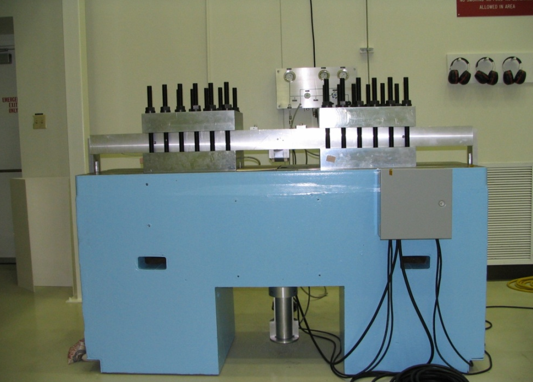
NASA/JPL Component Shock Testing Machine
Qualification Shock Test Philosophy for Reusable Launch Vehicle Components
by Tom Irvine
MPE = Maximum Predicted Environment
Proposed Rule:
- Initial Qualification (one flight): 3 shocks per axis at MPE + 6 dB
- For each additional flight: 1 shock per axis at MPE
Rationale:
Background:
Historically, qualification shock tests in NASA, Aerospace Corporation, SMC-S-016, and ESA programs are treated as life tests rather than cyclic fatigue tests. Requirements typically include 2–3 shocks per axis at 3–6 dB above the Maximum Predicted Environment (MPE). These are intended to envelope uncertainties in modeling, workmanship, and limited lifetime usage.
However, reusable launch vehicles introduce new considerations:
- Shock environments change subtly between flights due to interface wear, joint retorquing, or material aging.
- Avionics, connectors, and AM components show sensitivity to repeated high-frequency transients.
- Modern reliability assessments emphasize cumulative exposure rather than single-event qualification.
- High-confidence qualification must consider evolving shock paths, not just initial environments.
Technical Rationale:
- First three +6 dB shocks create robust over-test margin.
A +6 dB shock produces approximately twice the acceleration amplitude and four times the energy of an MPE shock. Three such shocks cover uncertainties in the flight environment, pyro-device variation, structural path differences, and internal component aging. This aligns with SMC-S-016 and NASA-STD-7003B qualification requirements. - Shock damage is dominated by peak amplitude, not repetition.
Shock is a transient, peak-driven phenomenon with very limited fatigue accumulation. Survivability against +6 dB shocks implies extremely high tolerance for multiple MPE-level shocks. Additional MPE shocks per flight add negligible damage but confirm hardware integrity. - One MPE shock per re-flight checks refurbishment and configuration changes.
Reusable hardware experiences:
- Small changes in joint torque
- Interface stiffening or loosening
- Connector and solder-joint degradation
- AM structural micro-evolution from thermal cycling
A single MPE shock before re-flight ensures the structural and electrical integrity of the hardware without the overtest risks associated with repeated +6 dB exposures.
- Cost and practical considerations.
Performing 3 × (+6 dB) shocks for each flight would:
- Accelerate aging of connectors and avionics
- Reduce reuse life of delicate electronics
- Increase test duration, hardware handling, and cost
By contrast, one MPE shock per flight serves as an efficient workmanship screen while maintaining reliability.
- Cumulative exposure logic supports the approach.
Since a +6 dB shock carries roughly 4× energy:
- Three +6 dB shocks ≈ 12 MPE-equivalent shocks
Thus the initial qualification covers many predicted missions. Additional MPE shocks simply add small increments of exposure.
Narrative Backstory for Documentation:
Reusable launch systems revealed that shock environments evolve subtly across flights. Slight structural changes, retorqued joints, and refurbishments shift the shock spectral content by several decibels. To maintain confidence, a qualification strategy must validate not only design robustness but also refurbishment integrity.
Three qualification shocks at +6 dB envelope modeling uncertainties, pyroshock variability, and potential degradation over multiple uses. For re-flown missions, a single MPE shock validates that interfaces, connectors, AM components, and structural boundaries continue to behave within expected parameters after refurbishment.
This approach balances reliability with practical concerns, maintaining flightworthiness without inflicting unnecessary overtest damage. It is consistent with the intent of SMC-S-016, NASA-STD-7003B, and modern reusable-vehicle reliability principles.