Stress corrosion cracking (SCC) is one of the most insidious failure mechanisms in engineering, precisely because it hides in plain sight. A component can look sound from the outside, show no measurable general corrosion, and still be riddled with fine intergranular or transgranular cracks running through its cross-section — cracks that require the simultaneous presence of three ingredients: a susceptible alloy, a sustained tensile stress (applied or residual), and a specific chemical environment that would otherwise seem mild. Remove any one leg of that triangle and the cracking stops. That specificity is what makes SCC such a rich source of case histories — each one is really a detective story about which environment quietly paired itself with which stressed alloy.
The five cases below span more than a century of industrial history and five very different industries: small arms, steam power, civil infrastructure, energy transmission, and nuclear power. Read together, they make the same point from five directions: SCC is rarely caused by an exotic material or an extreme environment. It’s caused by an ordinary material, under ordinary service stress, meeting an environment nobody thought to worry about.
1. Season Cracking — Brass Cartridge Cases (British India, Late 19th Century)
This is the case that gave stress corrosion cracking its name, if not its mechanism, more than a century before anyone understood the chemistry. British forces stationed in India stored brass cartridge cases in stables during the monsoon season, when reduced military activity meant ammunition sat in storage for extended periods. Cartridges emerged from these stables riddled with fine cracks, especially at the case’s crimped neck where it gripped the bullet — cracks that resembled the seasoning checks in dried timber, which is where the name came from.
It took until 1921 for Moore, Beckinsale, and Mallinson to correctly explain the mechanism: ammonia from decomposing horse urine, combined with residual tensile stress locked into the brass by cold-drawing during manufacture, produced classic SCC in the copper-zinc alloy. The cartridge cases had never been stress-relief annealed after drawing, so every case carried latent tensile stress at the surface, and the stable environment supplied exactly the trace ammonia vapor needed to complete the triangle. Any copper-bearing alloy — brass, bronze, or copper itself — remains susceptible to ammonia-driven SCC to this day; it’s one of the most textbook alloy-environment pairings in the field.
Lesson: residual manufacturing stress is just as dangerous as applied service stress, and stress-relief heat treatment after cold work is often the cheapest possible SCC mitigation.
2. Caustic Embrittlement of Riveted Steam Boilers (Late 19th – Early 20th Century)
As industrial and locomotive boiler pressures climbed through the late 1800s, a wave of boiler failures emerged that didn’t fit the usual overheating or general-corrosion pattern. Investigators traced the cause to sodium hydroxide (caustic), which formed in boiler water from the hydrolysis of sodium carbonate used to soften feedwater. Under normal circulation this posed no problem, but at riveted seams, tube-to-tube-plate joints, and other crevices, boiler water could seep in by capillary action, then evaporate, leaving the caustic behind at ever-increasing concentration — a self-reinforcing evaporative trap.
Riveted joints were the perfect storm location: the cold-worked, highly stressed steel around each rivet hole sat directly in the path of this concentrating caustic. The resulting attack produced intercrystalline (intergranular) cracking that could propagate through the plate thickness with essentially no visible external warning, since the caustic gouging occurred from the inside. Boiler operators eventually developed the “embrittlement detector,” a simple test method from the U.S. Bureau of Mines, and adopted the practice of dosing boiler water with sodium nitrate, tannin, or lignin — additives that either blocked the hairline cracks against further caustic ingress or altered the chemistry to inhibit the reaction. Modern practice avoids the problem largely by switching to phosphate-based water treatment and welded (rather than riveted) pressure vessel construction, removing both the crevice geometry and the stress concentration that made riveted boilers so vulnerable.
Lesson: crevice geometry that permits evaporative concentration can turn an entirely benign bulk water chemistry into a locally aggressive one — the danger is rarely in the tank, it’s in the crevice.
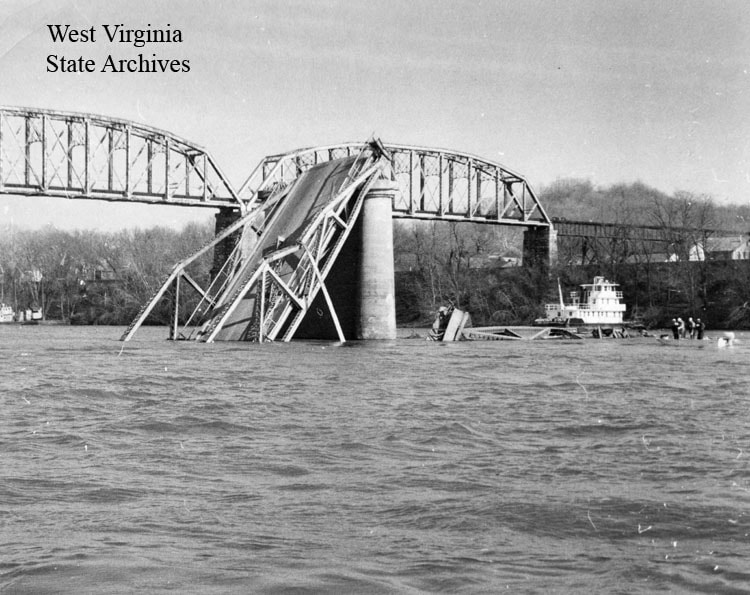
3. The Silver Bridge Collapse (Point Pleasant, West Virginia, 1967)
The Silver Bridge was a 1928 eyebar-chain suspension bridge carrying US Route 35 across the Ohio River between Point Pleasant, West Virginia, and Gallipolis, Ohio — a design using pin-connected, heat-treated high-strength steel eyebars rather than the wire cables more common on suspension bridges. On the evening of December 15, 1967, during heavy holiday traffic, the bridge collapsed in seconds, killing 46 people.
The National Transportation Safety Board traced the failure to a single eyebar — designated 330, in the north chain of the Ohio-side span — that fractured at a critical flaw only about 0.1 inch (2.5 mm) deep. That flaw began as a small corrosion pit at the load-bearing surface inside the eyebar’s pin hole, a location completely inaccessible to the visual-only inspection methods available at the time (in fact, to any inspection method short of full disassembly). From that pit, the flaw grew to critical size through the joint action of stress corrosion cracking and corrosion fatigue — the investigation could not conclusively separate which mechanism dominated, but atmospheric pollutants including hydrogen sulfide and sulfur dioxide were implicated in promoting hydrogen absorption into the high-strength steel, increasing its susceptibility to environmentally assisted cracking. Once the crack reached critical size, the eyebar failed in a sudden cleavage (brittle) fracture, and because the design had no structural redundancy at that joint — only two eyebars carried the entire chain load at that point — the loss of one eyebar guaranteed total collapse.
The stress intensity at fracture can be framed in fracture-mechanics terms familiar from any SCC threshold discussion: cracking proceeds whenever the applied stress intensity factor \( K_I \) exceeds a threshold value \( K_{ISCC} \) characteristic of the alloy-environment pair, i.e., whenever
\[ K_I = Y \sigma \sqrt{\pi a} \; > \; K_{ISCC} \]where \( \sigma \) is the applied stress, \( a \) is the crack depth, and \( Y \) is a geometry factor. Eyebar 330’s tiny 0.1-inch flaw sat below this threshold for decades, then crossed it after four decades of slow environmental crack growth — a sobering illustration of how long a sub-critical SCC flaw can persist unnoticed before reaching the point of sudden, catastrophic growth.
Lesson: non-redundant, pin-connected high-strength steel details combined with hidden internal surfaces are a worst-case combination for SCC risk; the Silver Bridge disaster directly led to the U.S. National Bridge Inspection Standards adopted in 1971.
4. Natural Gas Transmission Pipeline SCC (North America, 1965 Onward)
Buried high-pressure gas transmission pipelines turned out to host not one but two distinct SCC mechanisms, discovered two decades apart. The first, “classical” or high-pH SCC, was identified in 1965 and occurs in a narrow cathodic potential window under a concentrated carbonate-bicarbonate electrolyte at pH 9–11, typically within about 20 miles downstream of a compressor station, where pipe temperature is elevated. The second, near-neutral pH SCC, wasn’t recognized until a 1985 rupture of a Canadian gas transmission line revealed transgranular cracking under totally different conditions: a dilute, near-neutral electrolyte (pH 6–8) trapped beneath disbonded pipeline coating, with dissolved CO₂ from decaying organic matter in the surrounding soil, sometimes assisted by sulfate-reducing bacteria.
Near-neutral pH SCC turned out to be more subtle still: subsequent research found that this cracking essentially does not propagate under purely static load — it requires the low-frequency cyclic pressure fluctuations inherent in normal pipeline operation, making it better described as a corrosion-fatigue process enhanced by hydrogen embrittlement than as classical SCC in the strict sense. Coating disbondment is the common thread across both mechanisms: an intact coating keeps the pipe surface either dry or under effective cathodic protection, and it’s only once the coating separates from the steel that either electrolyte can accumulate against the bare metal. Following a 1996 Canadian National Energy Board inquiry, pipeline operators across North America adopted risk-based inspection programs specifically targeting SCC-susceptible pipe segments — older pipe, near compressor stations, with disbonded coating — using in-line inspection tools capable of detecting crack colonies before they reach critical size.
Lesson: coating integrity is itself a corrosion-control system, not just an installation nicety; once it fails locally, two entirely different SCC mechanisms are ready to exploit the resulting crevice, depending on what happens to be in the surrounding soil.
5. Davis-Besse Reactor Vessel Head Degradation (Ohio, 2002)
This is the most recent and, in terms of averted consequences, the most alarming case on this list. Pressurized water reactors use control rod drive mechanism (CRDM) nozzles penetrating the reactor vessel head, historically fabricated from Alloy 600 (a nickel-chromium-iron alloy chosen for its general corrosion resistance) welded in place with Alloy 82/182 weld metal. Alloy 600 is highly resistant to general corrosion but, as the industry learned beginning in the late 1980s, susceptible to primary water stress corrosion cracking (PWSCC) — intergranular cracking driven by the combination of residual/operating stress at the nozzle and prolonged exposure to hot, high-pressure primary coolant water.
At Davis-Besse, a PWSCC crack in CRDM nozzle 3 penetrated through-wall, allowing borated primary coolant to leak onto the carbon steel reactor vessel head above the stainless steel cladding. Boric acid is a comparatively mild reagent in isolation, but sustained leakage, undetected over an extended period, dissolved a cavity through roughly six inches of low-alloy steel — ultimately leaving only the thin stainless steel liner, on the order of a few millimeters thick, to contain full reactor coolant system pressure. The cavity was discovered only when repair equipment behaved unusually during a nozzle inspection in March 2002 and technicians investigated further. Subsequent analysis found the corroded stainless steel liner itself contained stress corrosion cracks, meaning the cladding — never designed to serve as a pressure boundary — had been silently doing exactly that.
What makes this case particularly notable from a systems perspective is that the PWSCC mechanism itself was already well documented industry-wide by 2002; the first CRDM nozzle leak from this cause had been identified at Bugey Unit 3 in France back in 1991, more than a decade earlier. The failure at Davis-Besse was as much a story about inspection program adequacy and boric acid corrosion monitoring falling short as it was about the underlying metallurgy. It prompted new NRC inspection requirements for reactor vessel heads across the U.S. fleet, and utilities subsequently replaced Alloy 600 components with the more PWSCC-resistant Alloy 690 during vessel head replacements industry-wide.
Lesson: a known failure mechanism, documented at one facility, doesn’t stay contained to that facility — industry-wide susceptible material populations demand industry-wide, not plant-by-plant, inspection response.
Common Threads
Laid side by side, these five cases — separated by a century and completely different industries — share a strikingly consistent structure:
- The stress was already there. Cold-worked brass, riveted boiler plate, heat-treated eyebars, pipeline steel under internal pressure, and welded nozzles all carried residual or service stress as an unavoidable consequence of manufacture or normal operation — not an overload condition.
- The environment looked benign. Horse-stable ammonia, boiler feedwater, river-adjacent atmospheric pollutants, damp soil under a disbonded coating, and hot borated water are all environments engineers of their era considered manageable, even mundane.
- The crack was invisible until it wasn’t. In every case, the crack initiated and grew somewhere inaccessible to the inspection methods available at the time — inside a stable, inside a rivet crevice, inside a pin hole, under a disbonded coating, or under a stainless cladding layer — and was discovered only through failure, forensic investigation, or, in the fortunate Davis-Besse case, a chance mechanical anomaly during unrelated maintenance.
That third pattern is the real engineering takeaway. SCC mitigation isn’t primarily a materials-selection problem or an environment-control problem, though both help — it’s fundamentally an inspection-access problem. Every one of these failures happened at a location that was, by the design of the component itself, difficult or impossible to inspect without destructive disassembly. Designing for inspectability may be the single highest-leverage SCC countermeasure available, precisely because it’s the one that doesn’t depend on correctly guessing which otherwise-ordinary environment will turn out to be the dangerous one.
References
- “Season Cracking,” Wikipedia; Moore, H., Beckinsale, S., & Mallinson, C. E. (1921), original explanation of ammonia-induced SCC in cold-drawn brass.
- “Caustic Embrittlement,” Wikipedia and Corrosionpedia; U.S. Bureau of Mines embrittlement detector methodology.
- National Transportation Safety Board, “Highway Accident Report: Collapse of U.S. 35 Highway Bridge, Point Pleasant, West Virginia, December 15, 1967,” NTSB-HAR-71-1 (1970).
- Biezma, M., & Schanack, F. (2007). “Collapse of Steel Bridges.” Journal of Performance of Constructed Facilities, ASCE, 21(5), 398–405.
- National Energy Board (Canada), “Stress Corrosion Cracking on Canadian Oil and Gas Pipelines,” Report of the Inquiry, MH-2-95 (1996).
- U.S. DOT/PHMSA, “Stress Corrosion Cracking (SCC) Threat to Gas and Hazardous Liquid Pipelines,” Federal Register (2003).
- U.S. NRC, “Davis-Besse Reactor Pressure Vessel Head Degradation Lessons-Learned Task Force Report” (2002).
- U.S. NRC, “2002 Davis-Besse Reactor Pressure Vessel Head Degradation” knowledge summary, ML1403/ML14038A119.
See also: Stress Corrosion Cracking
📌 Related Bridge Dynamics Knowledge Hub
This case study is featured in our main Bridge Dynamics, Vibration & Structural Integrity Hub . Visit the hub to explore related articles on aeroelastic flutter, stress corrosion cracking, field modal testing, and seismic analysis.
Looking for a deep dive on this topic? Explore our comprehensive guide and resource collection on the Residual Stress & Structural Integrity Hub.
1 thought on “Five Notable Stress Corrosion Cracking Case Histories”