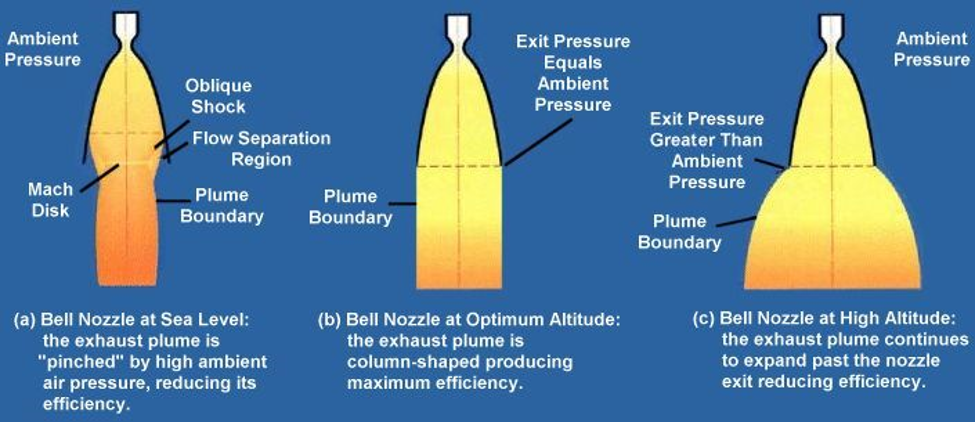
Liquid fuel rocket engines undergo hot fire testing before flight in order to verify their performance, design integrity, etc. The engines are mounted to heavy-duty, immovable stands for this purpose. These tests are also referred to as static fire tests.
Furthermore, the tests are almost always performed at ground ambient air conditions, which is appropriate for first stage engines. Similar tests are performed for solid rocket motors.
Upper stage engines are also subjected to ground ambient air static fire tests. But the test data is skewed by the atmospheric pressure effects. These engines can and should also be fired in altitude simulation chambers, although these more realistic tests are more expensive and time-consuming than open air tests. An example is the NASA Glenn In-Space Propulsion Facility.
Rocket engine designs often incorporate high expansion ratio nozzles for increased performance.
The flow in the nozzle will separate from the nozzle wall, with a resultant reduction in thrust when these nozzles are operated in an ambient pressure significantly higher than what they were designed for.
Separated flow can also cause nozzle burning due to the shock wave that exists at the separation point, nozzle damage due to unsymmetrical pressure distribution, and excessive vibration as the separation point moves erratically around the nozzle.
The following paper shows that the rocket engine overall vibration level may be as much as 18 dB higher at ground ambient air versus altitude simulation: Influence study of flow separation on the nozzle vibration response
– Tom Irvine