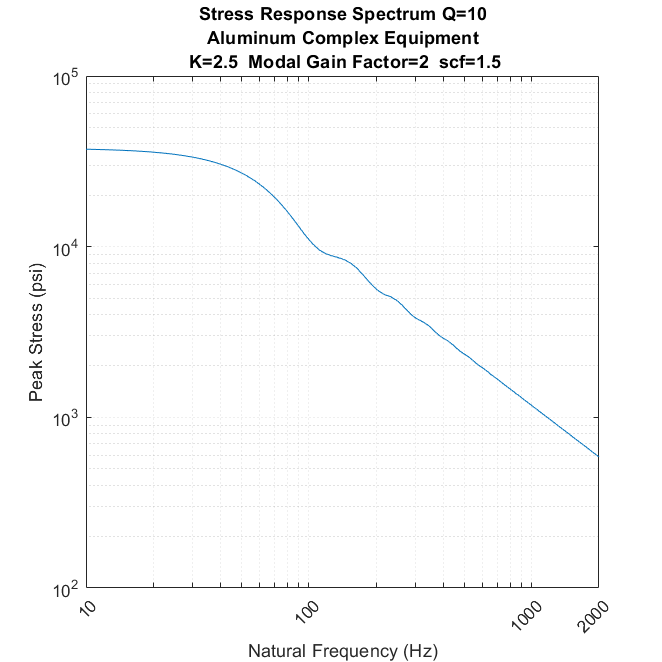
The image is the Stress Response Spectrum of 50 G, 11 msec Terminal Sawtooth Pulse Base Input
Presentation: stress_FDS_revC
Consider a component which must withstand a dynamic environment and where the stress response is the needed output metric for engineering evaluation. This presentation gives a method for converting shock and vibration response spectra into stress response spectra for this assessment.
The presentation also gives a method for extending relative fatigue damage spectra into stress-based cumulative damage index spectra The conversion is made using the stress-velocity method recommended by Hunt, Chalmers, Gaberson, Piersol, et al.
The proposed method accounts for the component’s modal participation factor and mass-normalized eigenvector coefficient. It gives an approximate estimate of the maximum global stress or fatigue damage as a function of the component’s natural frequency.
This method is useful for the component’s preliminary design and for determining whether a detailed dynamic finite element analysis is needed for stress response. It is also useful as “hand calculation” check for FEA stress response.
The stress velocity method can overcome the limitations of “equivalent quasi-static acceleration” analyses which are typically overly conservative.
See also: Shock & Vibration Stress & Strain as a Function of Velocity, Revision N, eBook link
And Severity Comparison for Sine Sweep, Random PSD and Shock Pulse: link
Conference Slides version
– Tom Irvine