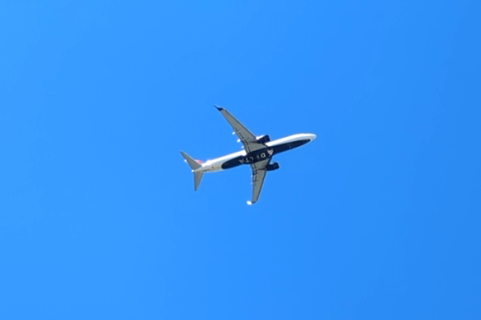
I made a video using my Android Smartphone of this aircraft taking off from SeaTac airport, headed northward. The image above was extracted from the video. The date was July 20, 11:50 AM. This was Delta flight 1172 headed to Fairbanks, Alaska, if my interpretation of the flightware.com data is correct. The nominal departure time was 11:27 AM, but the actual takeoff time was about 23 minutes later.
Most of the takeoff noise is due to the Boeing 737-800’s two CFM56-7B turbofan engines. Turbulent airflow over the airframe is another source. I extracted the audio signal from the video and performed a Waterfall FFT as shown below. The data appears to be swept narrowband random at first glance. But the frequency shifts are too large for a simple Doppler shift. Furthermore, the narrowbands are sweeping upward in frequency as the aircraft flew away from me past the 15 sec mark, contrary to the Doppler principle. Audio Link
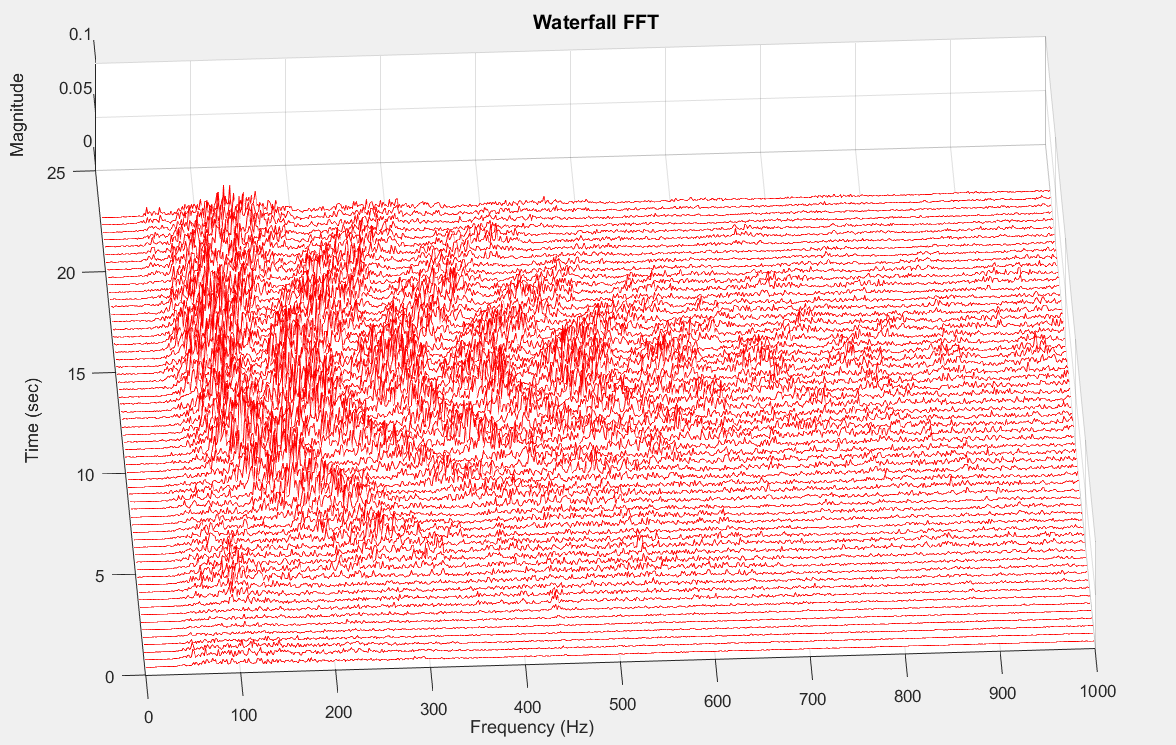
I have an unverified but plausible explanation for the apparent narrowband shifts as follows. The noise output is actually broadband. The aircraft noise sources have a certain directivity pattern in terms of radiated sound pressure which varies with frequency. The frequency-dependent directivity pattern has certain null angles along which no sound energy is radiated. The gaps between the narrowbands are due to these null angles. The null angles are effectively undergoing their own sine sweep depending on the relative position between the ascending aircraft and myself, the fixed-position ground observer. This explanation makes a good story whether or not it is true.
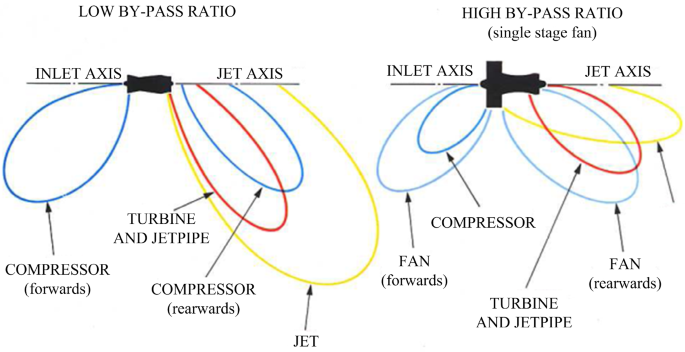
A jet engine directivity diagram is shown below. Assume that these are for a given frequency.
– Tom Irvine
What an erudite and informative post! You increase the level of education in this country! Thank you for your hard work.