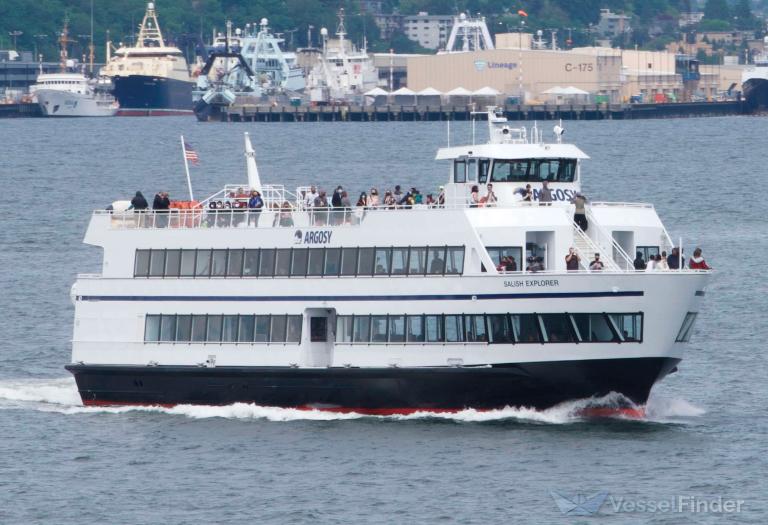
Argosy Cruises‘ Salish Explorer Passenger Ship (Image courtesy of Vessel Finder)
This ship is used for tours around the Puget Sound waterways in the Seattle area. My family and I had the opportunity to take a ride on this ship recently.
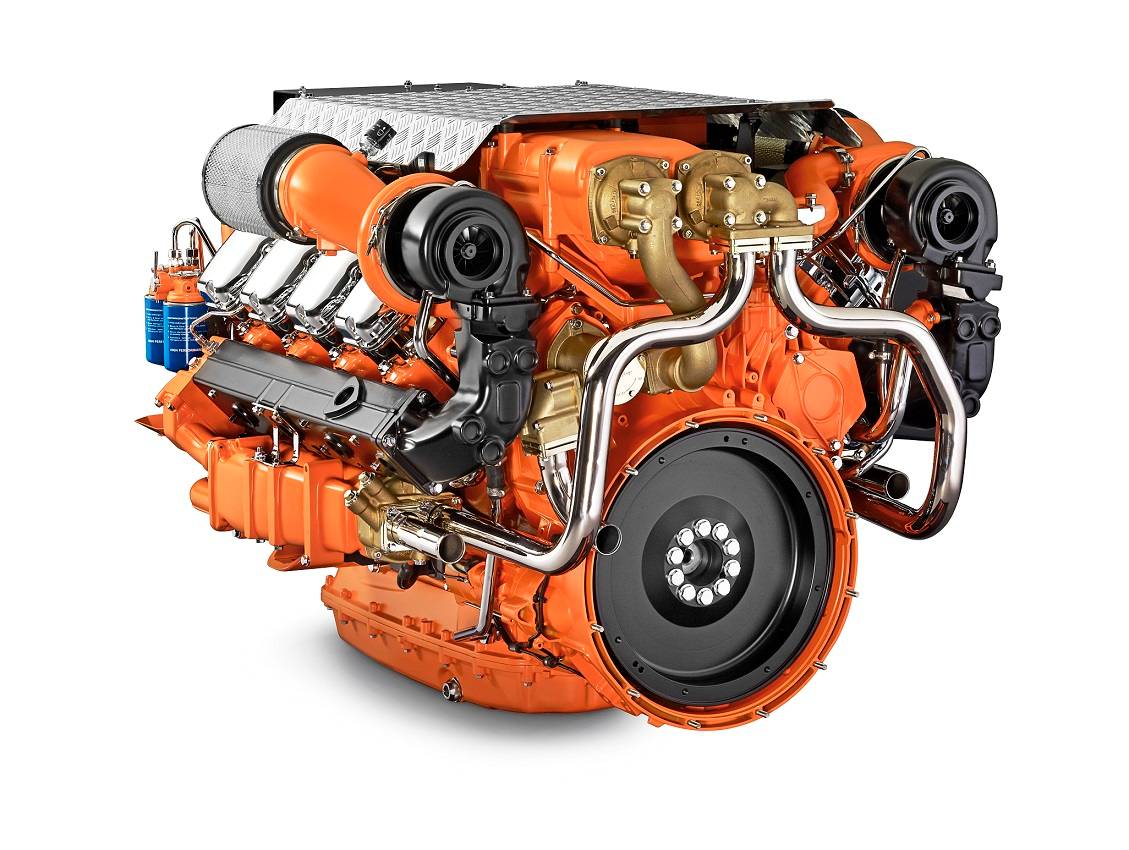
The Salish Explorer is powered with twin Scania DI 16-080M engines. The maximum engine shaft speed is 1800 RPM or 30 Hz. Auxiliary power is supplied via Northern Lights 65 kW and 40 kW generators, each running at 60 Hz.
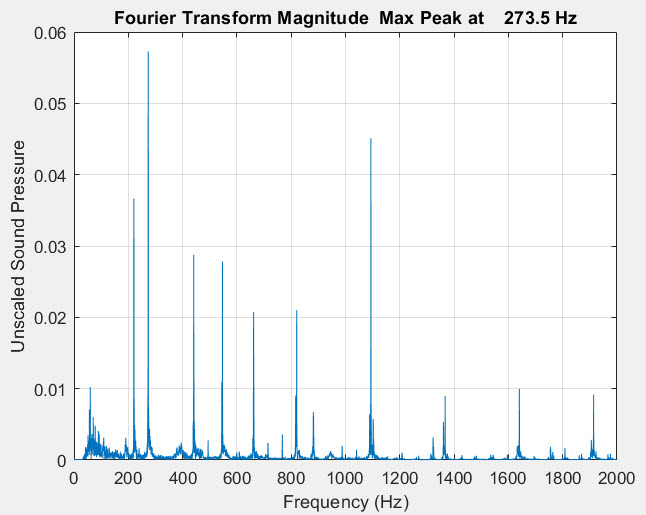
The Fourier transform of the ship’s horn sounding is shown above, as recorded on my Smartphone. The minor peak at 60 Hz is from either or both of the auxiliary power generators. A pattern of spectral peaks occurs at 220 Hz with integer multiples, which is an “A” note on the musical scale. Another pattern begins at 273.5 with integer multiples, just shy of a “C#” note. The presence of these two patterns indicates that the horn was actually a dual horn with two side-by-side horns. Horn Audio Recording
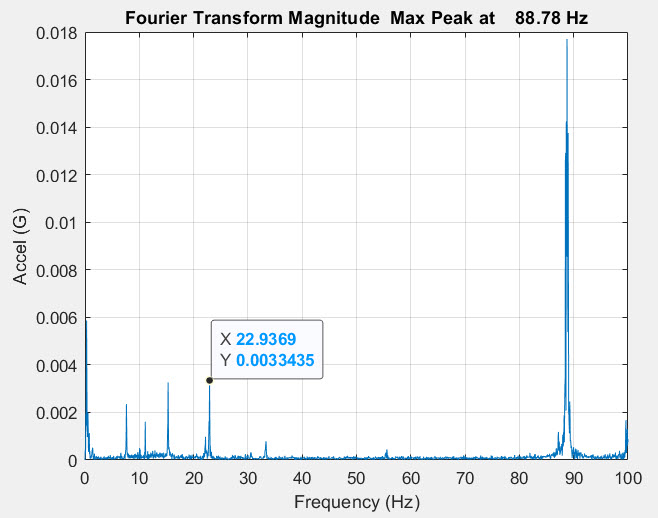
The Fourier transform of the acceleration time history in the vertical axis is shown above, as recorded on my Smartphone. The phone was placed flat on a horizontal surface on the upper deck.
The 22.9 Hz peak is plausibly the engine shaft speed operating at 76% of the full 1800 RPM speed. The 7.6 Hz peak would then be the propeller shaft speed assuming a typical 3:1 gearbox ratio. The 15.3 Hz peak would be the 2X harmonic of the propeller shaft speed.
Decreasing RPM from the engine through a gear ratio in the transmission reduces propeller RPM and increases available torque at the propeller.
The source of the 88.78 Hz peak is the subject of further investigation. Possible sources include onboard machinery or a fluid dynamic effect at the propeller called cavitation. Furthermore, the spectral peak may be a resonance amplification effect whereby a forcing frequency coincided with a structural natural frequency.
Update: I had an email exchange with the Marine Operations Manager at Argosy Cruises. His best guess was that the 89 Hz tone came from the PA audio system.
Audio systems can have a 60 Hz hum, typically a result of poor shielding, cable problems, or close proximity to strong magnetic fields. Another potential problem is a 120 Hz ground loop buzz. But the 89 Hz tone on the Salish Explorer is neither of these.
Another possibility is feedback noise due to the interaction of the microphone and a speaker. This ringing is caused by a signal which travels in a continuous loop through the system. In technical terms, feedback occurs when the gain in the signal loop reaches “unity” (0 dB gain).
Feedback can occur when an open microphone is too close to a speaker, or when the gain is set too high. The feedback tone can theoretically occur at any frequency. Very rarely does feedback occur below 80 Hz or above 8 kHz according to one source.
So the Salish Explorer’s 89 Hz hypothetical feedback would be at the very low end of observed feedback frequencies. If so, the problem could be easily fixed by reducing the gain or by moving the microphone further from the nearest speaker.
________________
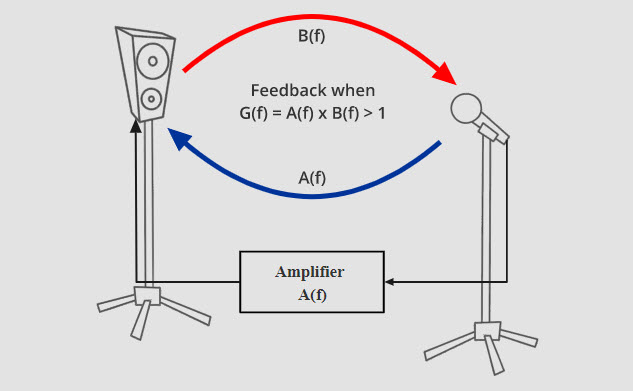
Acoustic Feedback (also known as Audio Feedback or Larsen effect) occurs in an electro-acoustic system when there are two simultaneous couplings:
- Electrical coupling between the system microphone and the loudspeaker with the amplification gain A(f);
- Acoustic coupling between the loudspeaker and the microphone with the feedback gain B(f).
When the total system gains G(f) = A(f) x B(f) exceeds one, the signal is amplified and amplified again leading to the so called “howling” or “whistling” effect depending on the frequency range where such positive feedback initially occurs.
– Tom Irvine
Hello, Tom,I hope all is well with you, what kind of matlab license do you use if I want to folllow your classes / examples, Best regards P. Vidori
No license is necessary. Please use the Matlab software & other materials. Best wishes, Tom
You’re correct, its my fault
do you still enjoy your job ?